
Moisture absorption is the primary cause of cloudiness in Potassium Bromide (KBr) pellets, a phenomenon that directly compromises the quality of infrared spectroscopy data. Because KBr is inherently hygroscopic, it pulls water vapor from the atmosphere or retains moisture from an improperly dried sample, turning the pellet opaque. To prevent this, you must rigorously dry both the KBr powder and the sample before preparation, ensure a vacuum seal during pressing to remove trapped air, and store finished pellets in a desiccated environment.
Core Takeaway A cloudy KBr pellet is not just a cosmetic issue; it indicates contamination that introduces background noise and obscures spectral peaks. The integrity of your data relies on maintaining a strictly anhydrous environment during both preparation and storage, as well as achieving the correct physical consistency of the powder.
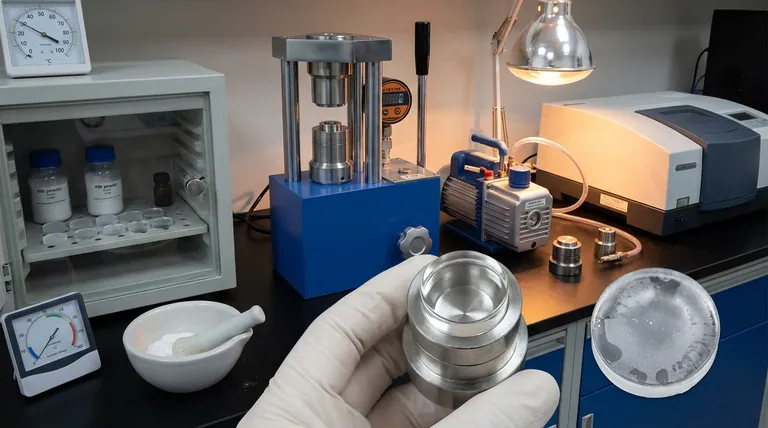
The Mechanisms Behind Cloudiness
The Hygroscopic Effect
KBr is naturally hygroscopic, meaning it aggressively attracts and holds water molecules from the surrounding environment. If the KBr powder or the analyte itself is damp during creation, moisture becomes trapped inside the matrix.
Over time, even a clear pellet can turn cloudy if stored in a humid atmosphere without protection. This moisture absorption creates a "fog" that blocks IR radiation and creates broad, interfering water bands in your spectrum.
Particle Size and Light Scattering
While moisture is the most common culprit, cloudiness can also result from improper particle size. If the sample or KBr crystals are too large, they cause scattering of the infrared light rather than transmission.
This often manifests as opaque "spots" rather than a uniform haze. The mixture must be ground to a fine, uniform consistency to ensure the infrared beam passes through the pellet without significant scattering losses.
Insufficient Pressing Force
The clarity of a pellet relies on fusing the powder into a solid, glass-like disk. Insufficient pressure prevents the particles from fusing completely, leaving microscopic air gaps within the pellet.
These air gaps act similarly to moisture, refracting light and causing the pellet to appear white or opaque. Conversely, the die set seals must be intact to allow a proper vacuum, removing air that would otherwise remain trapped.
Protocols for Prevention and Correction
Thorough Pre-Drying
Prevention begins before the material enters the die. You must ensure the KBr powder and the sample are thoroughly dried to remove any trace moisture.
Heating the KBr powder in an oven and storing it in a desiccator is standard practice. If a pellet is already cloudy due to surface moisture, heating it carefully might restore some transparency, but prevention is far superior to remediation.
Optimizing the Grind
To avoid scattering-induced opacity, the mixture should be homogeneous. Sieving the powder to remove coarse grains is a highly effective technique.
If a pellet shows opaque spots, the most reliable fix is to re-grind the pellet material to reduce particle size and then re-press it. This ensures a uniform distribution that promotes transparency.
Degassing and Vacuum Sealing
To minimize interference from air and moisture, the die set should be connected to a vacuum pump. Degassing the pellet during the pressing stage removes trapped air bubbles that lead to cloudiness.
This step is essential for eliminating background signals. A vacuum ensures the particles fuse into a dense, non-porous matrix that excludes atmospheric moisture.
Common Pitfalls and Trade-offs
The Pressure Balance
Achieving a clear pellet requires a delicate balance of force. While insufficient pressure causes opacity, excessive pressure can create stress fractures or cracks in the pellet.
You must calibrate your press to apply enough force to fuse the material without shattering the matrix. There is a "goldilocks" zone of pressure that yields a transparent, stable disk.
Environmental Control vs. Workflow Speed
Working quickly is often necessary to minimize exposure to humid air, but rushing the grinding or drying steps creates long-term failure.
You must accept the trade-off of a slower preparation time to ensure a dry environment. Using a glove box or a heat lamp during preparation is often necessary in humid laboratories, adding complexity but ensuring success.
Ensuring Spectral Integrity
Actionable Recommendations
To achieve the highest quality spectra, tailor your approach based on your specific failure points:
- If your primary focus is preventing gradual clouding: Store all materials and finished pellets in a dedicated desiccator to combat KBr's hygroscopic nature.
- If your primary focus is eliminating opaque spots: Sieve your powder and re-grind the mixture to ensure a uniform, fine particle size before pressing.
- If your primary focus is reducing background noise: Utilize a vacuum die to degas the sample during pressing, removing air and moisture interferences.
By controlling moisture and physical consistency, you transform the KBr pellet from a variable source of error into a reliable medium for precise analysis.
Summary Table:
| Cause of Cloudiness | Primary Prevention Method | Key Benefit |
|---|---|---|
| Moisture Absorption (Hygroscopicity) | Thoroughly dry KBr & sample; use vacuum press; store in desiccator | Eliminates water bands, reduces background noise |
| Improper Particle Size (Light Scattering) | Grind to fine, uniform powder; sieve mixture | Ensures uniform light transmission, prevents opaque spots |
| Insufficient Pressing Force / Trapped Air | Apply calibrated pressure; use vacuum die for degassing | Creates dense, transparent pellet without air gaps |
Achieve Flawless IR Spectroscopy with KINTEK's Lab Press Solutions
Struggling with cloudy KBr pellets that compromise your data? KINTEK specializes in precision lab press machines, including automatic and heated lab presses, designed to deliver the consistent pressure and vacuum sealing essential for creating perfectly clear pellets. Our equipment helps you:
- Eliminate moisture contamination with reliable vacuum degassing.
- Achieve uniform particle fusion through calibrated, consistent pressure.
- Streamline your workflow with user-friendly, durable presses built for laboratory demands.
Don't let pellet preparation undermine your analysis. Contact our experts today to find the ideal press for your laboratory's needs and ensure spectral integrity in every experiment.
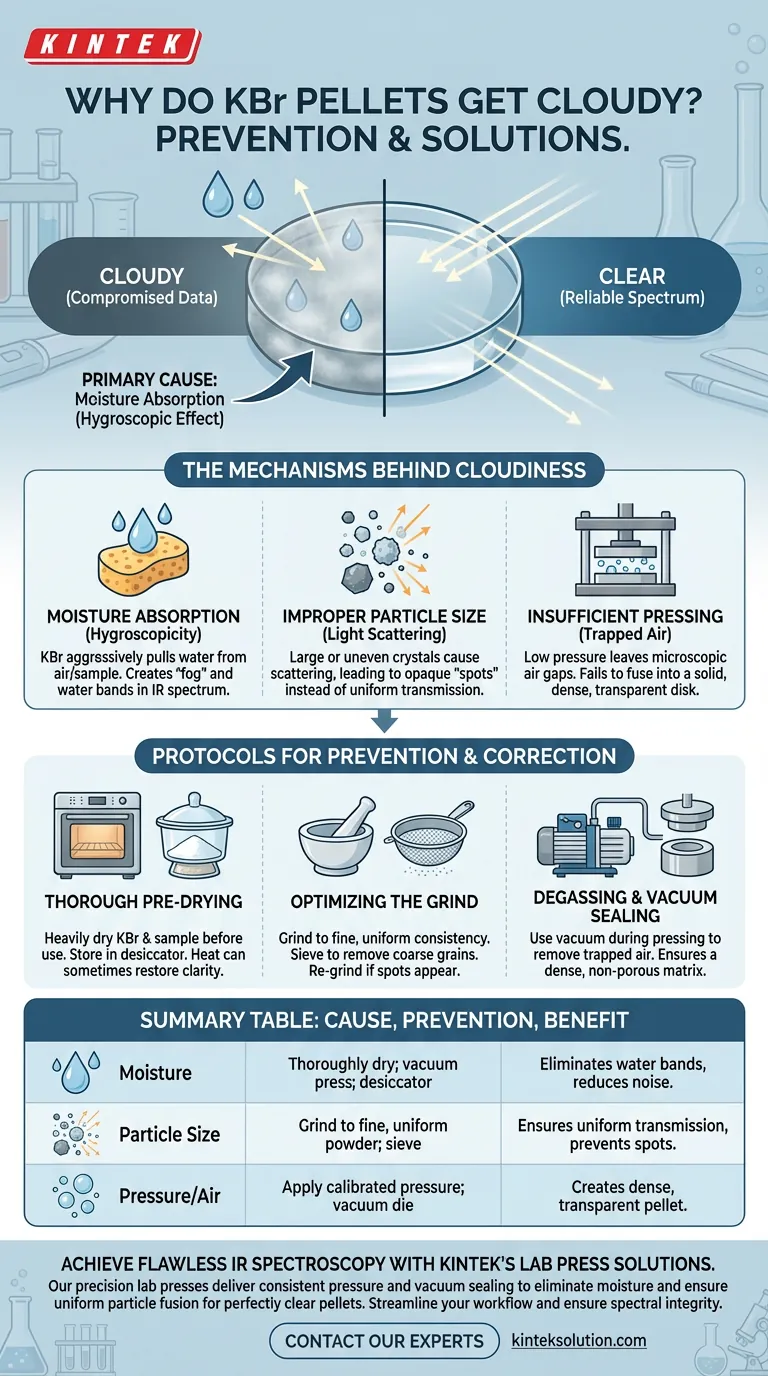
Visual Guide
Related Products
- XRF KBR Plastic Ring Lab Powder Pellet Pressing Mold for FTIR
- Laboratory Hydraulic Press 2T Lab Pellet Press for KBR FTIR
- XRF KBR Steel Ring Lab Powder Pellet Pressing Mold for FTIR
- Automatic Laboratory Hydraulic Press for XRF and KBR Pellet Pressing
- Laboratory Hydraulic Pellet Press for XRF KBR FTIR Lab Press
People Also Ask
- What is the purpose of making KBr pellets for FTIR? Achieve Precise Molecular Analysis with Solid Samples
- What factors should be considered when choosing a lab press for XRF pellet preparation? Ensure Accurate and Consistent Results
- Why are pellets used in XRF analysis, and what is their limitation? Boost Accuracy and Speed in Your Lab
- How are pellets prepared for XRF analysis and what is a potential drawback? Master XRF Sample Prep and Accuracy
- What are the different types of XRF pellet preparation methods available? Manual, Hydraulic, and Automated Presses Explained















