
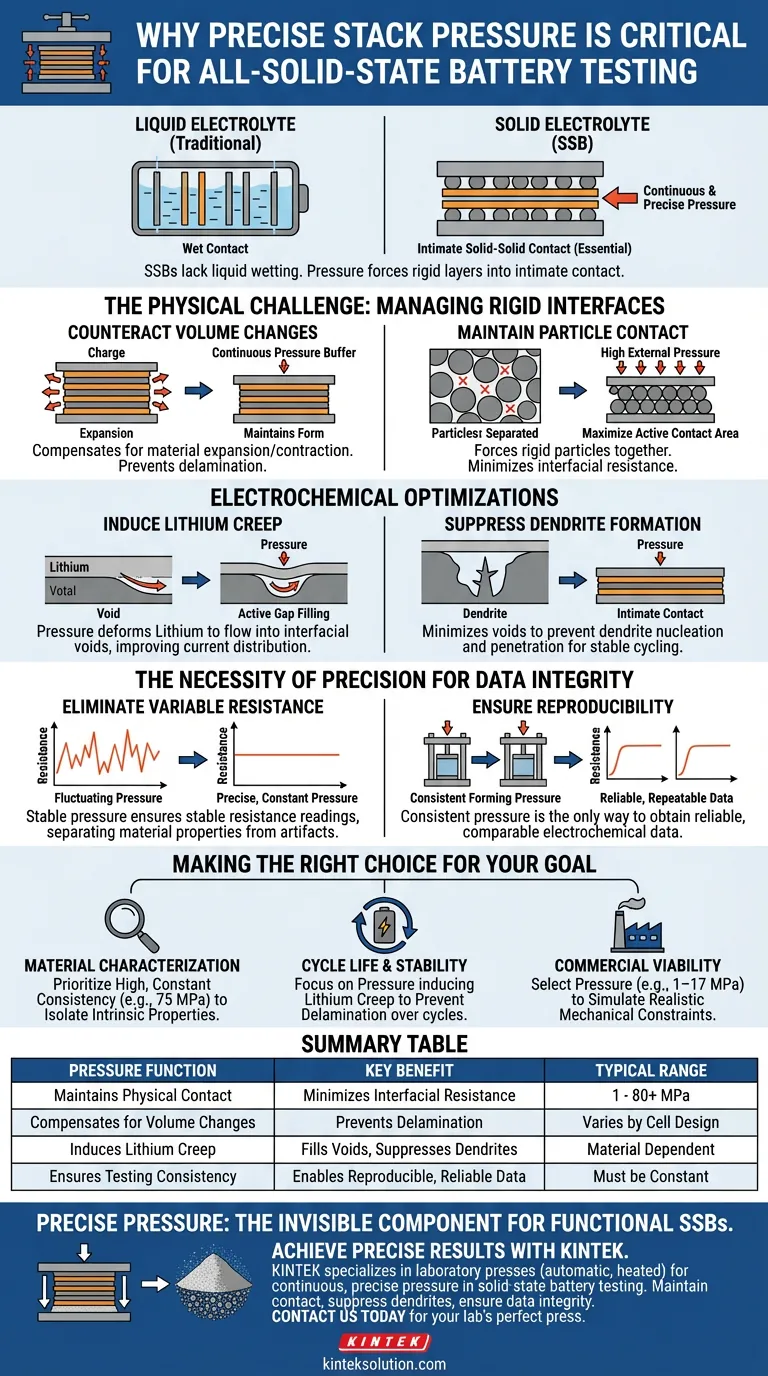
Solid-state batteries lack the inherent "wetting" ability of liquid electrolytes. Unlike traditional batteries where liquid fills every gap, solid-state batteries rely on rigid, solid-solid interfaces that must physically touch to function. Continuous and precise stack pressure is required to force these layers—cathode, solid electrolyte, and anode—into intimate physical contact and keep them there, preventing the device from failing due to internal disconnection.
The Core Mechanics Applying stack pressure is not merely about holding the cell together; it is an active electrochemical control parameter. It mechanically compensates for material volume changes during cycling and induces the physical deformation (creep) of lithium metal to fill voids, ensuring that the interfacial resistance remains low and consistent for reproducible data.
The Physical Challenge: Managing Rigid Interfaces
Counteracting Volume Changes
During charge and discharge cycles, battery materials undergo significant volumetric expansion and contraction. In a rigid system, these fluctuations effectively push the layers apart. Continuous pressure acts as a mechanical buffer, compressing the stack to counteract this expansion. Without it, the layers would separate, breaking the ionic pathway and causing immediate performance degradation.
Maintaining Particle-to-Particle Contact
Solid-state electrolytes and electrode materials are often composed of rigid particles. For lithium ions to move, these particles must establish a continuous path. High external pressure forces these particles together, maximizing the active contact area. This is essential for minimizing the interfacial resistance that otherwise throttles battery performance.
Electrochemical Optimizations
Inducing Lithium Creep
Lithium metal has unique mechanical properties; under appropriate pressure, it exhibits creep behavior, meaning it slowly deforms like a viscous fluid. Pressure forces the lithium to physically flow into and fill interfacial voids that form during operation. This active filling of gaps leads to a more uniform current distribution and improves the critical current density.
Suppressing Dendrite Formation
In anode-free configurations or cells using lithium metal, voids at the interface can act as nucleation sites for dendrites (sharp lithium growths that cause failure). By maintaining intimate contact and minimizing voids during the "stripping" (discharge) phase, stack pressure suppresses dendrite penetration. This is vital for achieving stable long-term cycling.
The Necessity of Precision for Data Integrity
Eliminating Variable Resistance
Interfacial resistance is a major performance-limiting factor in solid-state batteries. If the pressure fluctuates, the resistance fluctuates. A precise, constant pressure (e.g., maintained via hydraulic press or specialized fixture) ensures that resistance values are stable. This allows researchers to distinguish between the actual material properties and artifacts caused by poor contact.
Ensuring Reproducibility
To compare one battery cell to another, the assembly and testing conditions must be identical. Maintaining a consistent forming pressure minimizes variations in contact quality between different test cells. This consistency is the only way to obtain reliable, repeatable electrochemical data, such as impedance spectra and capacity utilization.
Understanding the Trade-offs
Pressure Magnitude Variability
There is no single "correct" pressure; references indicate requirements ranging from 1 MPa to over 80 MPa depending on the specific materials and cell design. Applying pressure that is too low will fail to maintain contact, while pressure that is drastically higher than practical applications renders the data theoretically interesting but commercially irrelevant.
Simulation of Real-world Conditions
Laboratory testing fixtures are designed to simulate the actual operating environment of a commercial cell. If the pressure applied in the lab cannot be engineered into a final battery pack, the performance data may be misleading. The pressure used must balance optimal electrochemical performance with engineering reality.
Making the Right Choice for Your Goal
When designing your testing protocol, align the pressure parameters with your specific objective:
- If your primary focus is material characterization: Prioritize high, constant consistency (e.g., 75 MPa) to minimize interfacial resistance and isolate the intrinsic properties of the active materials.
- If your primary focus is cycle life and stability: Focus on pressure ranges that effectively induce lithium creep to actively fill voids and prevent delamination over hundreds of cycles.
- If your primary focus is commercial viability: Select a pressure range (e.g., 1–17 MPa) that simulates the realistic mechanical constraints of a commercial battery pack to obtain actionable engineering data.
Ultimately, precise stack pressure is the invisible component that transforms a stack of rigid powders into a functional, cohesive electrochemical system.
Summary Table:
| Pressure Function | Key Benefit | Typical Range |
|---|---|---|
| Maintains Physical Contact | Minimizes Interfacial Resistance | 1 - 80+ MPa |
| Compensates for Volume Changes | Prevents Delamination | Varies by Cell Design |
| Induces Lithium Creep | Fills Voids, Suppresses Dendrites | Material Dependent |
| Ensures Testing Consistency | Enables Reproducible, Reliable Data | Must be Constant |
Achieve precise and reliable results in your solid-state battery research. The correct stack pressure is critical for valid data. KINTEK specializes in laboratory press machines, including automatic and heated lab presses, designed to deliver the continuous, precise pressure your all-solid-state battery testing requires. Our equipment helps you maintain intimate contact between rigid layers, suppress dendrites, and ensure data integrity. Contact us today to find the perfect press for your laboratory's needs and elevate your research.
Visual Guide
Related Products
- Warm Isostatic Press for Solid State Battery Research Warm Isostatic Press
- Laboratory Hydraulic Press Lab Pellet Press Button Battery Press
- Button Battery Sealing Press Machine for Lab
People Also Ask
- Why must composite cathodes be sealed in vacuum lamination bags for WIP? Ensure Battery Stability and Density
- What is the function of elastic molds in warm isostatic pressing? Achieve Uniform Density in Composite Particles
- How do sacrificial volume materials (SVM) maintain microchannels in isostatic pressing? Ensure Structural Integrity
- What is the function of hydraulic pressure in warm isostatic pressing? Achieve Uniform Material Density
- What are the advantages of using a Warm Isostatic Press (WIP) for batteries? Achieve Superior Interface Contact


