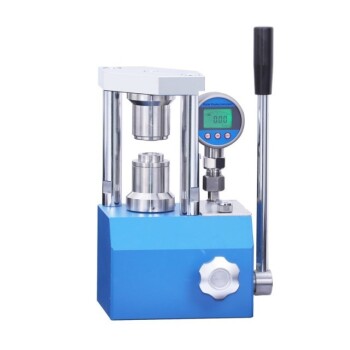
A piston pressurization device is strictly required to apply a controlled compressive force to the loose sand sample. This force is necessary to counteract the high angular acceleration generated by the Micro-CT sample stage, preventing the sand particles from shifting, rearranging, or displacing during the scanning process.
Core Takeaway Loose granular materials are inherently unstable when subjected to rotational forces. The piston pressurization device creates a "locked" state, ensuring that the microstructure captured in the image acts as a true representation of the sample during physical permeability testing.
The Physics of Granular Imaging
The Challenge of Rotation
Micro-CT scanning typically involves rotating the sample 360 degrees to capture X-ray projections from all angles.
This rotation introduces high angular acceleration. For solid objects, this is negligible, but for loose aggregates, these inertial forces are significant.
The Instability of Loose Sand
Unlike consolidated rock or cemented materials, loose sand lacks internal cohesion.
Without external confinement, the individual grains are free to move. When the sample stage accelerates, the particles naturally want to shift or fly outward due to inertia.
The Function of the Piston Device
Applying Compressive Force
The piston device applies a slight compressive force to the top of the sand column.
This force increases the inter-particle friction. It effectively "clamps" the grains against one another without crushing them.
Preventing Particle Rearrangement
This clamping force acts as a counterweight to the rotational forces of the scanner.
It strictly prevents particle displacement. By holding the grains in a fixed position, the device ensures the sample remains static relative to the detector throughout the entire scan.
Ensuring Scientific Validity
Preserving the "Test State"
The primary goal of this scanning is often to analyze the sand's properties during permeability testing.
Permeability is determined by the specific arrangement of pores and grains. If the grains shift during the scan, the pore network changes.
Accurate Microstructural Representation
The piston ensures the image captures the sample exactly as it exists physically.
If the sample were allowed to settle or rearrange, the resulting 3D model would represent a different material state than what was physically tested, rendering the data useless.
Common Pitfalls to Avoid
The Risk of Motion Artifacts
If you omit the piston or apply insufficient pressure, particles will move during the scan.
In Micro-CT, even microscopic movement results in motion artifacts. These appear as blurring or doubling of edges in the final image, making quantitative analysis impossible.
Over-Compression
While the primary reference emphasizes the need for a "slight" force, applying too much pressure is also a risk.
Excessive force can crush grains or artificially reduce porosity. The goal is stabilization, not compaction beyond the parameters of the permeability test.
Making the Right Choice for Your Goal
To ensure your Micro-CT data is valid and actionable, consider the following based on your specific objectives:
- If your primary focus is Image Clarity: Ensure the piston applies enough force to totally immobilize the grains against the specific rotation speed of your scanner.
- If your primary focus is Permeability Correlation: Calibrate the piston's compressive force to match the confinement pressure used during your physical flow experiments exactly.
Using a piston pressurization device is the only way to bridge the gap between dynamic scanning conditions and static sample integrity.
Summary Table:
| Feature | Purpose | Impact on Micro-CT Results |
|---|---|---|
| Compressive Force | Increases inter-particle friction | Prevents grain displacement and shifting |
| Inertia Counteraction | Offsets high angular acceleration | Eliminates motion artifacts and image blurring |
| Microstructure Locking | Maintains grain/pore arrangement | Ensures data matches physical permeability tests |
| Controlled Pressure | Stabilizes without crushing | Preserves original porosity and sample integrity |
Maximize the precision of your material analysis with KINTEK’s advanced laboratory solutions. KINTEK specializes in comprehensive laboratory pressing solutions, offering a versatile range of manual, automatic, heated, multifunctional, and glovebox-compatible models, alongside cold and warm isostatic presses specifically designed for demanding research environments like battery and geological studies. Whether you need to stabilize loose aggregates or prepare high-density samples, our equipment ensures the scientific validity of your data. Contact us today to find the perfect press for your lab!
References
- Bartłomiej Bodak, Maciej Sobótka. Insights Into Estimation of Sand Permeability: From Empirical Relations to Microstructure-based Methods. DOI: 10.2478/sgem-2024-0001
This article is also based on technical information from Kintek Solution Knowledge Base .
Related Products
- Manual Laboratory Hydraulic Press Lab Pellet Press
- Laboratory Hydraulic Press Lab Pellet Press Machine for Glove Box
- Laboratory Hydraulic Split Electric Lab Pellet Press
- Automatic Laboratory Hydraulic Press for XRF and KBR Pellet Pressing
- Laboratory Hydraulic Pellet Press for XRF KBR FTIR Lab Press
People Also Ask
- How does a laboratory manual hydraulic press assist in powder canning? Maximize Density and Structural Integrity
- What is the primary objective of using a laboratory manual hydraulic press at 20 MPa? Achieve Perfect Green Body Shaping
- What is the primary purpose of manual lab hydraulic pellet presses? Achieve High-Precision Sample Preparation for Spectroscopy
- What is the primary purpose of a manual lab hydraulic pellet press? Ensure Accurate Sample Prep for XRF and FTIR
- What are common lab pellet press issues? Expert Troubleshooting Guide for Reliable Material Research