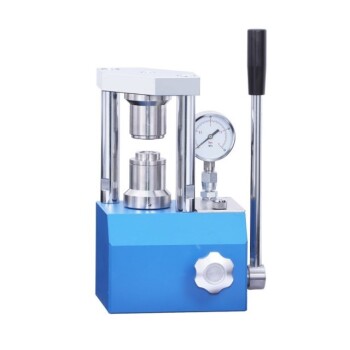
The primary advantages of using a sealed Swagelok-type battery device are superior environmental isolation and high-temperature physical stability. specifically for fluoride-ion applications. This hardware creates a controlled testing environment that protects reactive components from the atmosphere while maintaining structural integrity at temperatures up to 170 °C. Furthermore, it applies essential mechanical pressure to minimize interfacial resistance, ensuring accurate data over long-term cycling.
By combining a high-integrity hermetic seal with consistent mechanical loading, Swagelok-type cells effectively eliminate environmental variables and contact issues. This provides the reliable hardware support necessary to accurately study the thermal stability and cycle life of sensitive fluoride-ion cathode materials.
Ensuring Environmental and Thermal Integrity
Superior Sealing Performance
Fluoride-ion batteries rely on exchange reactions that are highly sensitive to atmospheric interference. A sealed Swagelok-type device uses a robust sealing mechanism to effectively isolate internal components from the external environment. This prevents side reactions caused by moisture or oxygen, ensuring that observed performance data reflects the true chemistry of the materials.
High-Temperature Stability
Fluoride-ion testing often requires elevated temperatures to facilitate ion mobility. These devices feature high-temperature resistant structures and stainless steel current collectors capable of maintaining physical stability at temperatures as high as 170 °C. This thermal resilience allows researchers to push the boundaries of testing without hardware failure.
Long-Term Cycling Reliability
The combination of a hermetic seal and thermal resistance supports extended testing durations. The device ensures that environmental factors do not interfere with the battery chemistry over long periods, enabling reliable study of cycle life (e.g., up to 120 cycles).
Optimizing the Electrochemical Interface
Continuous Mechanical Pressure
Beyond environmental protection, these devices provide stable physical support through continuous mechanical pressure, typically around 5 MPa for solid-state configurations. This pressure is critical for maintaining tight contact between the cathode active material and the electrolyte.
Reducing Interfacial Impedance
Applying consistent stack pressure significantly reduces the interface impedance between the electrolyte and the electrodes. By minimizing this resistance, the device improves the battery's rate performance and capacity utilization, allowing for a more accurate assessment of the material's potential.
Managing Volume Changes
During charge and discharge cycles, battery materials often undergo volume expansion and contraction. The mechanical pressure provided by the fixture helps maintain the structural integrity of the electrochemical interface, preventing delamination or loss of contact that could lead to premature failure.
Understanding the Trade-offs
Lab-Scale vs. Commercial Form Factors
While Swagelok cells are the gold standard for material characterization and fundamental research, they do not perfectly replicate the form factor of commercial pouch or cylindrical cells. The ratio of inactive casing weight to active material is extremely high, meaning energy density calculations based on the total cell weight will be skewed compared to practical applications.
Fixed Pressure Limitations
While the device applies pressure, it is often a "passive" load derived from torque or springs, rather than an actively controlled variable hydraulic system found in advanced specialized fixtures. As the battery materials expand significantly, the internal pressure may fluctuate, potentially altering the test conditions slightly compared to a system that actively maintains a set pressure (e.g., 1–17 MPa range) dynamically.
Making the Right Choice for Your Goal
To maximize the value of your testing setup, align the equipment capabilities with your specific research objectives:
- If your primary focus is Thermal Stability: Rely on the device's ability to maintain physical integrity and sealing at 170 °C to stress-test materials without environmental contamination.
- If your primary focus is Interface Kinetics: Utilize the consistent mechanical pressure to minimize impedance and isolate the intrinsic electrochemical performance of the solid-state interface.
- If your primary focus is Cycle Life: Leverage the superior sealing to perform extended cycling (100+ cycles) confident that capacity fade is due to material degradation, not atmospheric leaks.
Use this hardware to isolate the fundamental chemistry of your materials, eliminating the noise of environmental interference and poor physical contact.
Summary Table:
| Feature | Advantage | Benefit for Fluoride-Ion Testing |
|---|---|---|
| Hermetic Sealing | Isolates reactive materials | Prevents side reactions from moisture/oxygen |
| Thermal Resistance | Stable up to 170 °C | Enables high-temperature ion mobility studies |
| Mechanical Load | ~5 MPa Stack Pressure | Reduces interfacial impedance & maintains contact |
| Durability | Stainless steel collectors | Supports long-term cycling (120+ cycles) |
Elevate Your Battery Research with KINTEK Precision
At KINTEK, we specialize in comprehensive laboratory pressing and testing solutions tailored for advanced energy storage research. Whether you are developing fluoride-ion systems or solid-state batteries, our expertise in manual, automatic, heated, and glovebox-compatible models ensures your materials are tested under perfect conditions.
Why choose KINTEK?
- Versatile Solutions: From standard Swagelok-type cells to high-pressure cold and warm isostatic presses.
- Optimized Performance: Maintain consistent mechanical pressure (1–17 MPa) and thermal stability for accurate kinetics.
- Expert Support: We help researchers minimize interfacial resistance and eliminate environmental variables.
Contact KINTEK today for a customized laboratory solution and ensure your data reflects the true potential of your battery chemistry.
References
- Vanita Vanita, Oliver Clemens. Insights into the first multi-transition-metal containing Ruddlesden–Popper-type cathode for all-solid-state fluoride ion batteries. DOI: 10.1039/d4ta00704b
This article is also based on technical information from Kintek Press Knowledge Base .
Related Products
- Button Battery Sealing Press Machine for Lab
- Manual Button Battery Sealing Machine for Battery Sealing
- Laboratory Hydraulic Press Lab Pellet Press Button Battery Press
- Lab Button Battery Tablet Press Sealing Mold
- Carbide Lab Press Mold for Laboratory Sample Preparation
People Also Ask
- What role does a laboratory sealing machine play in coin cell prep? Ensure Data Integrity with Precision Crimping
- Why is a high-precision battery sealing machine necessary for sodium-ion full cells? Ensure Accurate Research Results
- What is the function of a coin cell packaging machine? Ensure Superior Sealing for Solid-State Battery Assembly
- Why is a laboratory coin cell crimper essential? Achieve Precise Pressure for Reliable Electrochemical Data
- How does a laboratory coin cell sealing machine ensure the reliability of sodium-ion battery testing results?