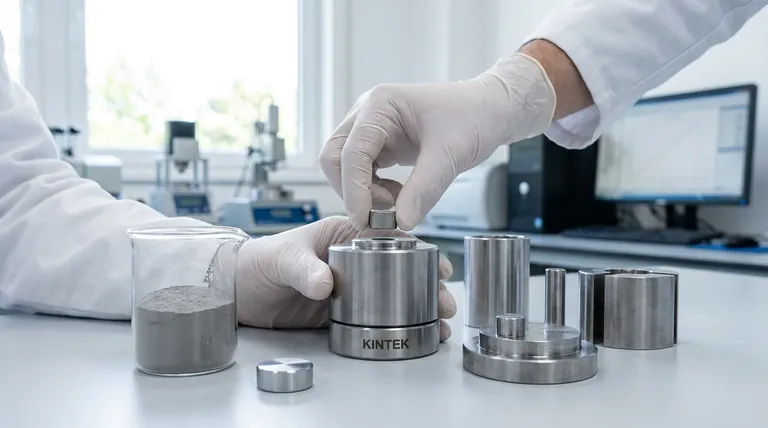
The Signal and the Noise
Imagine a materials scientist staring at an X-ray fluorescence (XRF) spectrum. The data is noisy, the peaks are ill-defined, and the results are inconclusive. The multi-million dollar spectrometer is working perfectly. The material sample is pure. Yet, the experiment is a failure.
The problem isn't in the advanced sensor or the complex algorithm. It's in the handful of dust being analyzed.
Raw powders are, by their nature, chaotic. They are a collection of unevenly sized particles with vast empty spaces between them. When you try to measure such a sample, you are measuring this chaos. The instrument's beam scatters unpredictably, creating noise that obscures the truth you are looking for.
This is the fundamental battle in so many labs: the struggle to find the signal within the noise. The laboratory pellet press is the primary weapon in this fight.
Forging Order from Chaos
A lab press doesn't just squeeze powder. It imposes order on a disordered system. It transforms a loose, unreliable material into a standardized, dense solid—a pellet—with a uniform surface.
This act of transformation is the cornerstone of accurate data.
Taming Light and X-Rays for Spectroscopy
Techniques like FTIR and XRF are conversations. A machine sends a beam of energy (the question) and listens for the sample's response. A loose powder mumbles its reply. Its uneven surface acts like a choppy sea, scattering the incoming beam in a thousand directions.
A dense, flat pellet, however, is like a calm, glassy lake. It provides a perfectly smooth, homogenous surface that reflects and fluoresces predictably.
- Reproducibility: Every measurement is taken from a near-identical surface.
- Accuracy: The signal-to-noise ratio skyrockets, revealing subtle peaks that were once buried in statistical garbage.
- Clarity: The data becomes clean, sharp, and, most importantly, trustworthy.
Revealing Microscopic Truths
For techniques like Scanning Electron Microscopy (SEM) or X-ray Diffraction (XRD), creating a dense pellet is the critical first step. You cannot polish a powder to a mirror finish for imaging, nor can you reliably analyze the crystalline structure of a loose aggregate.
The press creates a solid foundation that can then be prepared for deeper analysis, ensuring that what you see under the microscope is the material's true internal structure, not just a surface artifact.
The Press as an Instrument of Discovery
While its role in sample preparation is crucial, the press is more than just a supporting actor. It is an instrument of discovery in its own right, allowing us to understand how materials behave at their physical limits.
The Art of Compaction
How does a material respond to immense pressure? Will it form a stable, dense solid or will it crack and fail?
This is a vital question in fields from metallurgy to pharmaceuticals. Researchers use lab presses to study a material's compressibility and final density. This data is essential for designing everything from ceramic engine components that withstand extreme forces to pharmaceutical tablets that dissolve at the correct rate.
Prototyping the Future, One Pellet at a Time
The press is also a miniature factory for innovation. In research labs, it's used to fabricate the tiny, functional components that could define our future.
- Battery Electrodes: The density of an electrode directly impacts its energy storage capacity and lifespan.
- Solid-State Fuel Cells: Creating dense, uniform ceramic membranes is key to their efficiency.
- Catalyst Beds: Forming powdered catalysts into pellets allows researchers to test their performance in prototype chemical reactors.
Each pellet is a hypothesis made tangible, a small-scale test of a big idea.
The Human Element: Mastering the Process
A high-quality lab press provides control, but insight comes from the operator. Creating the perfect pellet is a craft that blends science with a methodical approach.
The Discipline of Precision
The process itself demands discipline. The die set that shapes the pellet must be meticulously cleaned. The ghost of a previous sample—a few stray milligrams of a different material—can completely contaminate the next one, sending research down a dead-end path for weeks.
The Paradox of Pressure
Pressure is not a simple "more is better" variable. Applying too much force can be just as bad as too little. It can induce a phase change in the material's crystal structure, meaning you are no longer analyzing the substance you started with. Finding that perfect balance—enough pressure to create a stable pellet, but not so much that you alter its nature—is key.
This is where the design of the equipment becomes critical. A well-engineered press provides the fine control and consistent pressure needed to navigate this narrow path to success.
Aligning Equipment with Ambition
Ultimately, the goal dictates the tool. Creating simple pellets for routine XRF analysis has different demands than pressing sensitive materials under controlled heat for polymer research.
This is why a range of solutions exists. High-throughput labs benefit from KINTEK's automatic lab presses, which deliver unmatched consistency and speed. Researchers developing advanced composites rely on heated lab presses to simulate manufacturing conditions. And for materials sensitive to uniaxial pressure, isostatic presses provide uniform compaction from all directions.
The humble laboratory press is the unsung hero that bridges the gap between chaotic raw materials and the clean, reliable data that drives science forward. It is the first, and perhaps most important, step on the path from a question to a discovery.
If your research depends on turning powder into proof, ensuring the quality of your sample preparation is the most critical investment you can make. Contact Our Experts
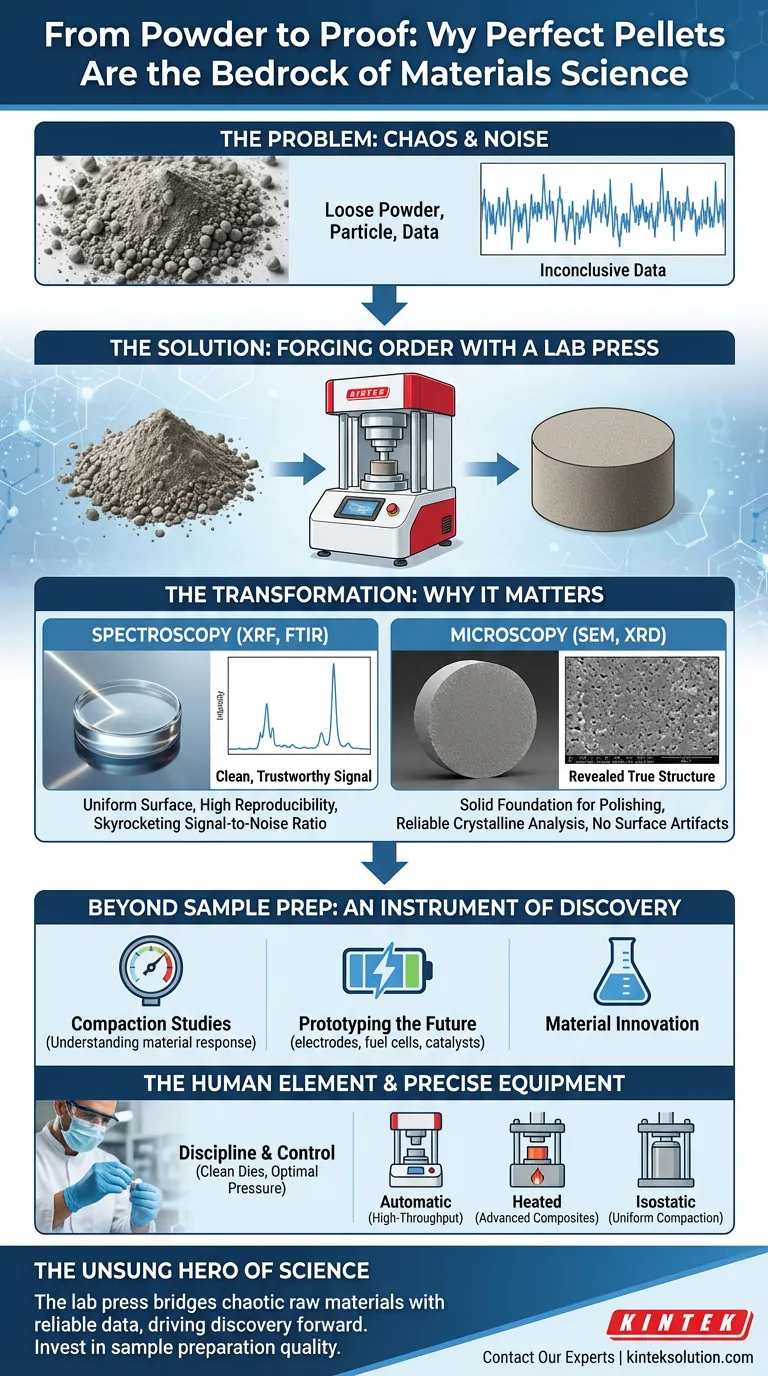
Visual Guide
Related Products
- 24T 30T 60T Heated Hydraulic Lab Press Machine with Hot Plates for Laboratory
- Manual Heated Hydraulic Lab Press with Integrated Hot Plates Hydraulic Press Machine
- Laboratory Hydraulic Pellet Press for XRF KBR FTIR Lab Press
- Lab Infrared Press Mold for Laboratory Applications
- Laboratory Hydraulic Press Lab Pellet Press Machine for Glove Box
Related Articles
- The Invisible Forge: Why the Laboratory Press is the Soul of Nano-Composites
- The Architecture of Slow: Why Physical Precision Dictates Chemical Destiny
- The Architecture of Density: Why Pressure is the Silent Architect of Solid-State Batteries
- The Physics of Transparency: Why Pressure is the Silent Architect of Spectroscopic Clarity
- The Architecture of Certainty: Why the Laboratory Press is the Anchor of Material Science



















