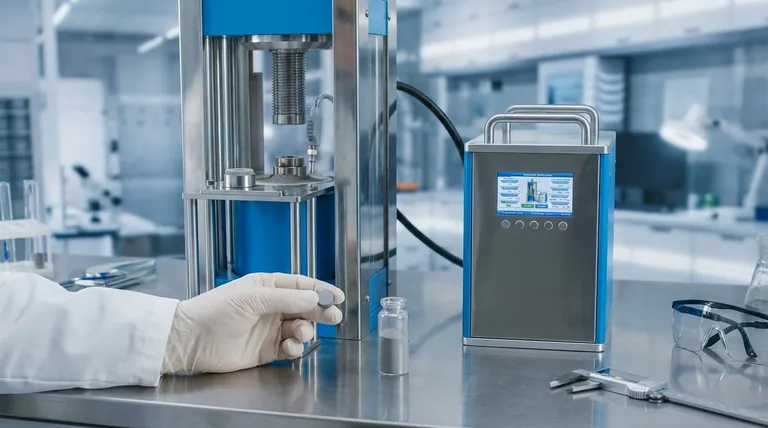
The Moment of Transformation
An engineer holds a vial of gray powder. In theory, it's a breakthrough—a new material that could store more energy, charge faster, and last longer. But right now, it's just dust.
The gap between a promising powder and a functional, testable battery electrode is vast. The bridge across that gap is a laboratory press. This machine does more than just shape material; it imposes a specific, engineered order on microscopic chaos, transforming loose potential into tangible performance.
This process of compaction is where the theoretical science of materials meets the physical reality of engineering.
The Physics of Compaction: More Than Just Squeezing
A pellet press is an instrument of precision. Its primary job is to fundamentally re-engineer the internal architecture of the electrode material through the careful application of force.
Building Density, Brick by Brick
The most critical function is increasing density. Compacting the powder forces more active material into the same volume. Think of it like packing a suitcase—the more efficiently you arrange the contents, the more you can fit inside.
This directly increases a battery's volumetric energy density, the crucial metric that determines how much power can be stored in a given space. It's the reason your smartphone can be thin and an electric car can have a long range.
Closing the Gaps for Electron Flow
On a microscopic level, loose powder is full of empty space. These voids are roadblocks for the ions and electrons that need to move freely for a battery to work efficiently.
Applying pressure minimizes these voids, forcing particles into intimate contact. This creates a highly efficient electrical and ionic network, much like paving a bumpy dirt road. The result is lower internal resistance, which enables faster charging and discharging with less energy lost as heat.
The Mandate for Uniformity
In research, comparison is everything. To know if a new material formula is truly better, you must eliminate all other variables.
A high-quality lab press creates electrodes with a precise and uniform thickness. This consistency ensures that any observed difference in electrochemical performance comes from the material itself, not from random variations in electrode geometry. It is the foundation of reliable data.
The Psychological Battle: Navigating Material Limits
Using a press isn't about applying maximum force. It's a nuanced negotiation with the physical properties of the material itself. More is not always better.
The Paradox of Pressure: Strength vs. Fragility
Every material has a breaking point. While high pressure builds density, excessive pressure can be destructive. It can fracture the delicate structures of the active material particles, permanently damaging their ability to store and release energy.
The engineer's challenge is to find the sweet spot—the maximum pressure a material can withstand that delivers the greatest benefit without causing harm. It’s a battle between the pursuit of density and the preservation of integrity.
The Stubbornness of "Spring-Back"
Materials are not perfectly malleable. After immense pressure is applied and then released, the compacted pellet will try to expand slightly, an effect known as "spring-back" or elastic recovery.
This isn't a failure of the machine; it's a fundamental property of matter that must be anticipated and compensated for. Achieving the final target density means applying enough initial pressure to overcome the material's inherent desire to bounce back.
The Supporting Cast: Binders and Material Nature
The behavior under pressure is also dictated by the full recipe. The type and amount of binder—the glue holding the powder together—dramatically influences compaction. Brittle materials like silicon behave very differently from softer materials like graphite, each requiring a unique strategy.
A Press for Every Purpose
The role of a lab press adapts to the goal at hand, serving as a versatile engine for both innovation and quality control.
Accelerating Discovery in the Lab
For researchers, the ability to quickly press a small pellet of a new formula is transformative. It allows for rapid screening of materials without the need for complex slurry-coating processes. This dramatically shortens the R&D cycle, allowing scientists to test more ideas, fail faster, and innovate quicker.
The Gatekeeper of Production
In an industrial setting, the press is a gatekeeper. Technicians take samples from large batches of electrode powder and press them to verify that the material meets the required density and mechanical standards. This simple check prevents costly errors before a batch is committed to the full production line.
A Strategy for Every Goal
Your objective dictates your pressing strategy. The same machine can be used for different outcomes by mastering its application.
| Goal | Pressing Strategy |
|---|---|
| Maximize Energy Density | Achieve maximum compaction without fracturing the active material. |
| Rapid R&D Screening | Create highly consistent and repeatable pellets for reliable data. |
| Industrial Quality Control | Verify that each batch meets specified density and mechanical standards. |
Ultimately, mastering the art and science of electrode pressing is fundamental to creating reliable, high-performance energy storage. It requires equipment that offers not just force, but precision, control, and repeatability.
KINTEK's range of automatic lab presses, isostatic presses, and heated lab presses are engineered to meet these exacting demands. By providing the precise control needed to navigate the fine line between compaction and destruction, we empower researchers and engineers to turn promising powders into powerful realities. To achieve superior consistency and unlock the full potential of your materials, Contact Our Experts.
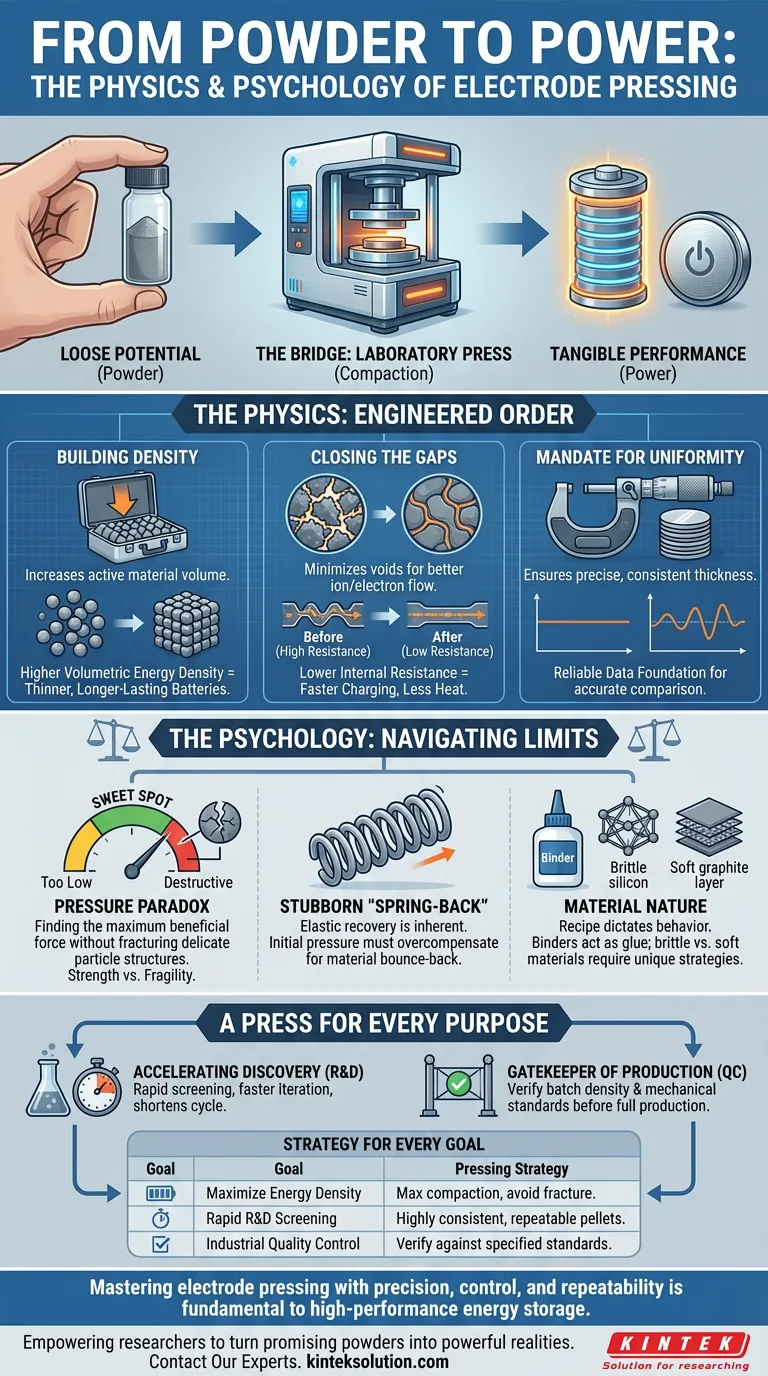
Visual Guide
Related Products
- Laboratory Hydraulic Split Electric Lab Pellet Press
- Automatic Laboratory Hydraulic Press for XRF and KBR Pellet Pressing
- Lab XRF Boric Acid Powder Pellet Pressing Mold for Laboratory Use
- XRF KBR Plastic Ring Lab Powder Pellet Pressing Mold for FTIR
- Automatic Laboratory Hydraulic Press Lab Pellet Press Machine
Related Articles
- The Physics of Transparency: Why Pressure is the Silent Architect of Spectroscopic Clarity
- The Architecture of Density: Why Pressure is the Silent Architect of Solid-State Batteries
- The Anatomy of Repeatability: Deconstructing the Modern Laboratory Press
- The Physics of Trust: A Disciplined Approach to Laboratory Press Safety and Reliability
- The Three-Body Problem of Pellet Pressing: Material, Machine, and Method



















