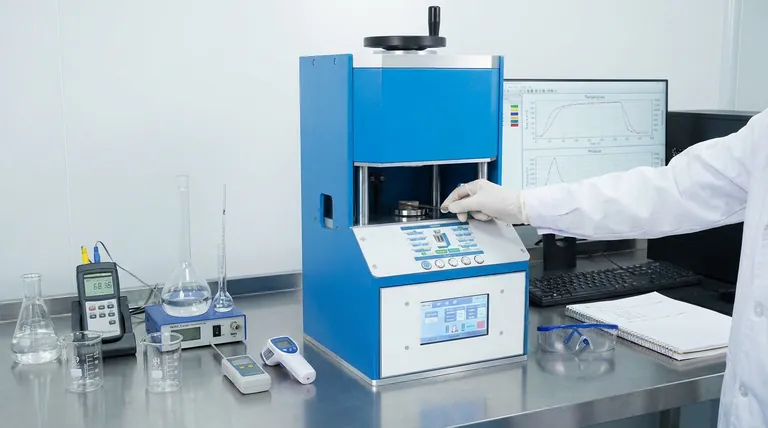
The Illusion of Power
A new 50-ton laboratory press arrives on the loading dock. It feels substantial, powerful. There's a certain satisfaction in knowing you have a machine capable of exerting immense force. This feeling, however, is a psychological trap.
In materials science, polymer research, and sample preparation, raw power is meaningless. The central challenge isn't about achieving the highest possible tonnage or temperature; it's about achieving the correct conditions, perfectly and repeatably. The most powerful press in the world is useless if it cannot deliver a precise pressure at a stable temperature, time and time again.
The real goal is not force, but trust. Trust in your instrument. Trust in your results.
The Physicist's Question: Force or Pressure?
Engineers often start by asking, "How many tons do I need?" This is the wrong first question. The scientifically relevant question is, "What pressure does my sample require?"
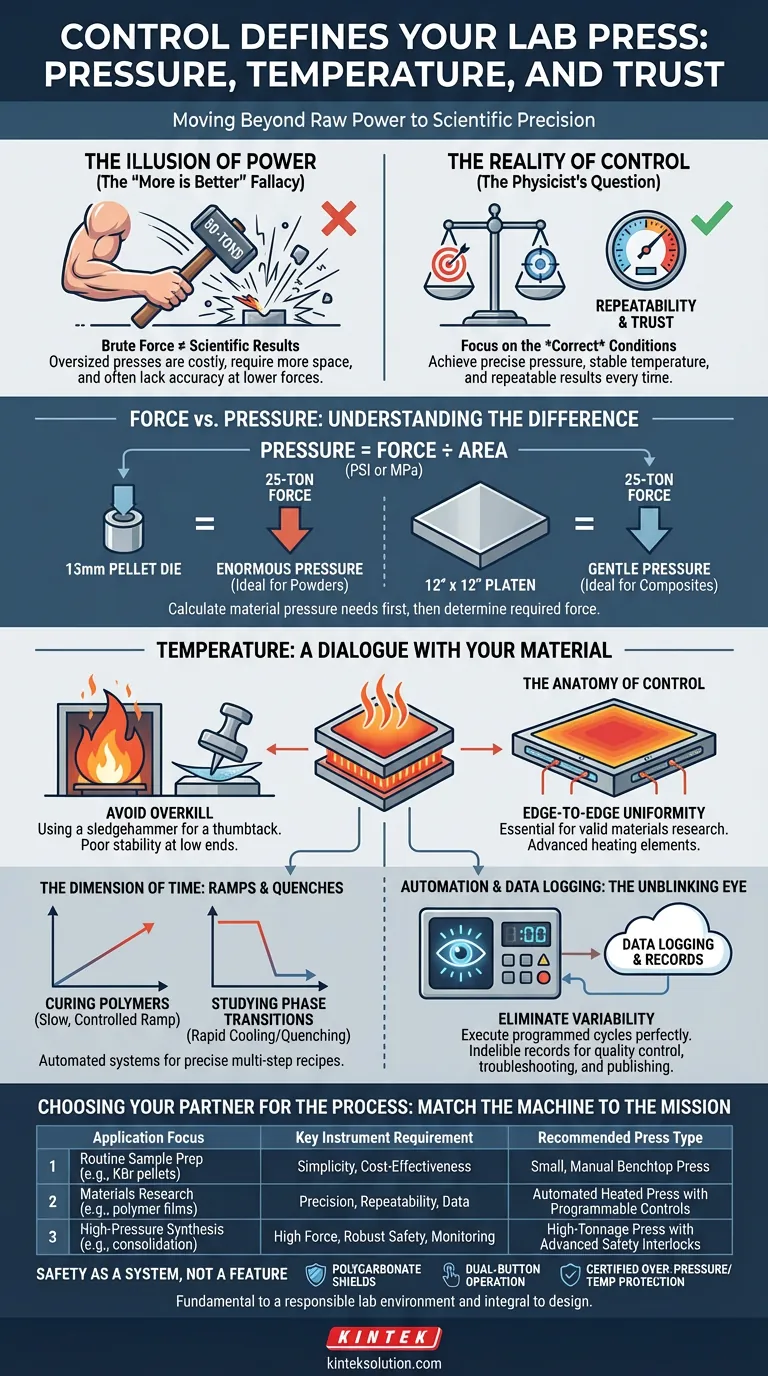
Pressure is force distributed over an area (PSI or MPa). A stiletto heel concentrates a person's entire weight onto a tiny point, generating immense pressure. The same person wearing snowshoes distributes that weight, creating very little pressure.
Your lab press works the same way.
- A 25-ton force applied to a small 13mm pellet die creates enormous pressure, ideal for compacting powders.
- That same 25-ton force spread across a large 12" x 12" platen for a composite laminate results in a much lower, more gentle pressure.
Understanding this distinction is fundamental. You must calculate the pressure your material needs first, and then determine the force required based on your sample's area.
Temperature: A Dialogue with Your Material
Heat is not just a setting; it's a conversation with your material. The temperature you apply speaks to its molecular structure, instructing it to melt, cure, or transition from a glassy to a rubbery state.
To have a successful conversation, you need nuanced control.
- Avoid Overkill: A press designed for 500°C may have poor stability and control at 80°C. It's like using a sledgehammer to tap in a thumbtack. Select a range that comfortably covers your needs without being excessive.
- Consider the Interface: The platens are where the transfer of heat and force occurs. They must be large enough for your sample, but remember that oversized platens on a small sample can sometimes lead to less accurate control at the low end of the press's force range.
From Brute Force to Scientific Instrument: The Anatomy of Control
What separates a simple hydraulic shop press from a true scientific instrument is its nervous system: the control architecture. This is where repeatability is born.
The Pursuit of Uniformity
A sample doesn't care about the number on the digital display. It experiences the actual temperature and pressure across its entire surface. Non-uniform heating across the platen can ruin an experiment, causing one part of a polymer film to cure improperly while another part degrades.
High-quality heated lab presses, like those from KINTEK, are engineered with advanced heating elements and thermal distribution designs to ensure edge-to-edge temperature uniformity. This is a non-negotiable requirement for valid materials research.
The Dimension of Time: Ramps and Quenches
For many modern materials, the rate of heating and cooling is as critical as the final temperature.
- Curing Polymers: Often requires a slow, controlled temperature ramp to manage the exothermic reaction.
- Studying Phase Transitions: May require rapid cooling (quenching) to lock in a specific crystalline structure.
Manual control is simply not precise enough for this. Automated systems that allow you to program multi-step recipes of pressure and temperature changes are essential for process development and creating repeatable outcomes.
The Unblinking Eye: Automation and Data Logging
Human operators introduce variability. An automated press eliminates it. It executes a programmed cycle with perfect fidelity every time, hitting pressure and temperature setpoints without hesitation or error.
Furthermore, integrated data logging acts as the press's own lab notebook. It provides an indelible record of the exact conditions your sample experienced, which is invaluable for quality control, troubleshooting, and publishing your findings.
The Cognitive Biases of Specification
Selecting a press is also a psychological exercise, where we must be aware of our own biases.
- The "More is Better" Fallacy: It's tempting to buy a 50-ton press "just in case." But an oversized press is more expensive, consumes more space, and, critically, often has worse control accuracy at the lower forces you actually use day-to-day. Match the machine to the mission.
- Safety as a System, Not a Feature: A high-tonnage, high-temperature press stores a tremendous amount of energy. Safety features like physical polycarbonate shields, dual-button operation, and certified over-pressure/over-temperature protection are not optional add-ons. They are fundamental to a responsible lab environment and are integral to the design of any reputable machine.
Choosing Your Partner for the Process
Ultimately, your application dictates the ideal instrument. The right choice is a partnership between your scientific goal and the machine's capability.
| Application Focus | Key Instrument Requirement | Recommended Press Type |
|---|---|---|
| Routine Sample Prep (e.g., KBr pellets for FTIR) |
Simplicity, cost-effectiveness | A small, manual benchtop press |
| Materials Research (e.g., polymer films, composites) |
Precision, repeatability, data | An automated heated press with programmable controls |
| High-Pressure Synthesis (e.g., material consolidation) |
High force with robust safety and precise monitoring | High-tonnage press with advanced safety interlocks |
The journey from a raw material to a validated result relies on a chain of trusted instruments. Your lab press is a critical link in that chain. It should not be a source of uncertainty, but a bastion of reliability.
For a laboratory press engineered to deliver the precise control and repeatability your research demands, Contact Our Experts.
Visual Guide
Related Products
- 24T 30T 60T Heated Hydraulic Lab Press Machine with Hot Plates for Laboratory
- Manual Heated Hydraulic Lab Press with Integrated Hot Plates Hydraulic Press Machine
- Laboratory Hydraulic Pellet Press for XRF KBR FTIR Lab Press
- Lab Infrared Press Mold for Laboratory Applications
- Laboratory Hydraulic Press Lab Pellet Press Machine for Glove Box
Related Articles
- The Invisible Forge: Why the Laboratory Press is the Soul of Nano-Composites
- The Architecture of Slow: Why Physical Precision Dictates Chemical Destiny
- The Architecture of Density: Why Pressure is the Silent Architect of Solid-State Batteries
- The Physics of Transparency: Why Pressure is the Silent Architect of Spectroscopic Clarity
- The Architecture of Certainty: Why the Laboratory Press is the Anchor of Material Science



















