
The Invisible Friction of Materials Science
In the laboratory, we often focus on the chemistry of the "green compact"—the ratio of precursors, the molarity of the activator, the curing temperature.
But there is a silent architect in every successful geopolymer foam experiment: the mold.
Precision in material science isn't just about what you put into the mix. It is about the constraints you place upon it. When dealing with geopolymer foams, those constraints are both chemical and physical.
If the mold fails, the science fails.
The Chemical Battleground
Geopolymer chemistry is inherently aggressive. To create the porous, cementitious structures required for advanced insulation or filtration, researchers must utilize high-alkalinity environments.
Standard molding materials often succumb to this "chemical fatigue." They pit, they corrode, and they contaminate the very sample they are meant to protect.
High-strength stainless steel is the engineer’s answer to this hostility.
- Corrosion Resistance: It remains inert against high-pH activators.
- Structural Integrity: It maintains a "mirror-finish" internal surface despite repeated exposure.
- Thermal Stability: It provides a constant volume during the critical 24-hour room-temperature curing phase.
The Calculus of Secondary Cutting
In many labs, the "hidden cost" of research is labor. When a sample is molded into a bulk shape and then cut to size, three things are lost: time, material, and structural integrity.
The "near-net-shape" philosophy argues that the molding stage should be the final stage of shaping. High-strength steel molds allow for direct pressing to exact specifications.
By matching the mold diameter exactly to the intended housing or substrate, you eliminate "secondary cutting."
This isn't just a matter of convenience. For specialized or expensive formulations, reducing material waste is a financial imperative. In the world of high-performance foams, waste is more than just trash; it is lost data and lost capital.
The Mirror in the Machine
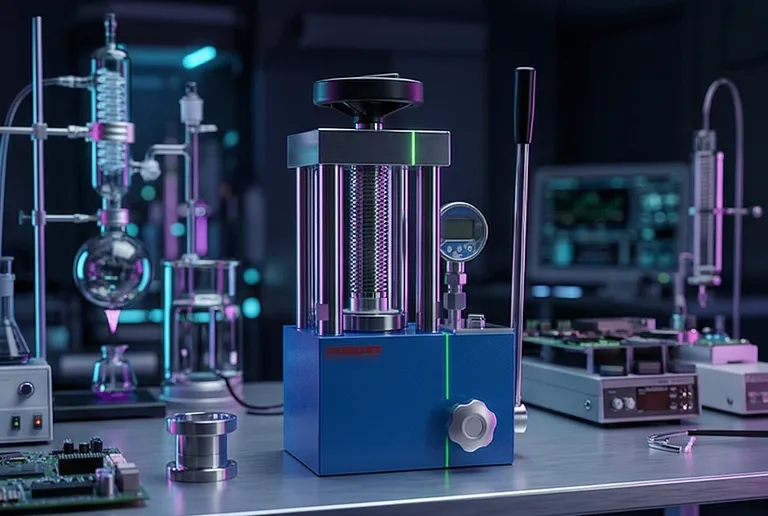
Surface quality is often mistaken for aesthetics. In geopolymer foams, surface quality is actually a proxy for structural health.
When a cured sample is ejected from a mold, friction is the enemy. A rough mold wall creates "drag," which manifests as micro-cracks on the surface of the foam. These cracks are the seeds of structural failure under stress.
High-strength dies provide the hardness necessary to maintain a smooth, polished internal wall.
- Lower Ejection Force: Reduces the mechanical stress on the "green" sample.
- Effortless Demolding: Prevents the foam from adhering to the walls.
- Geometric Precision: Ensures the sample fits perfectly into testing jigs without air gaps or uneven contact.
Understanding the Strategic Trade-offs
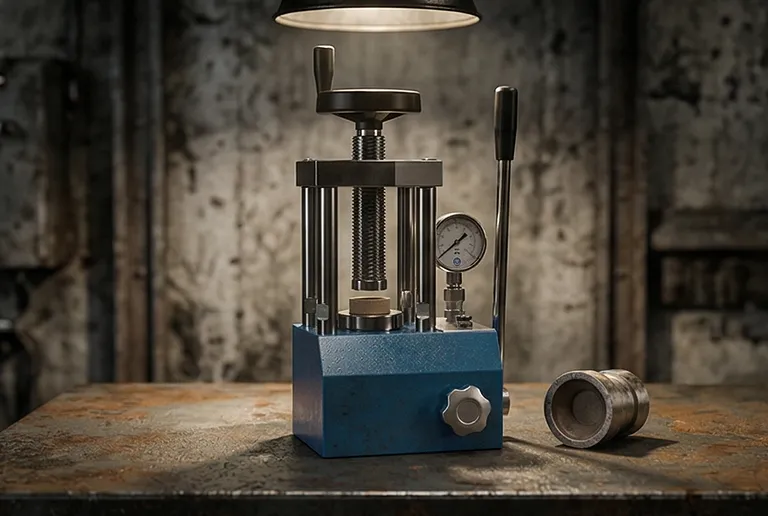
Every technical choice involves a psychological hurdle. For many labs, the hurdle for stainless steel is the initial fabrication cost.
| Factor | Stainless Steel Molds | Plastic/Silicone Alternatives |
|---|---|---|
| Initial Investment | High (Requires precision machining) | Low (Disposable or castable) |
| Durability | Infinite cycles if maintained | Limited; prone to warping/tearing |
| Dimensional Accuracy | Sub-millimeter precision | Variable due to material "creep" |
| Process Speed | High (No secondary cutting) | Low (Post-processing required) |
The logic of high-strength molds follows the Housel-ian principle of "paying the price, not the fine." You pay the price upfront for a precision tool to avoid the "fine" of ruined samples and inconsistent data later.
Mastering the Pressing Environment
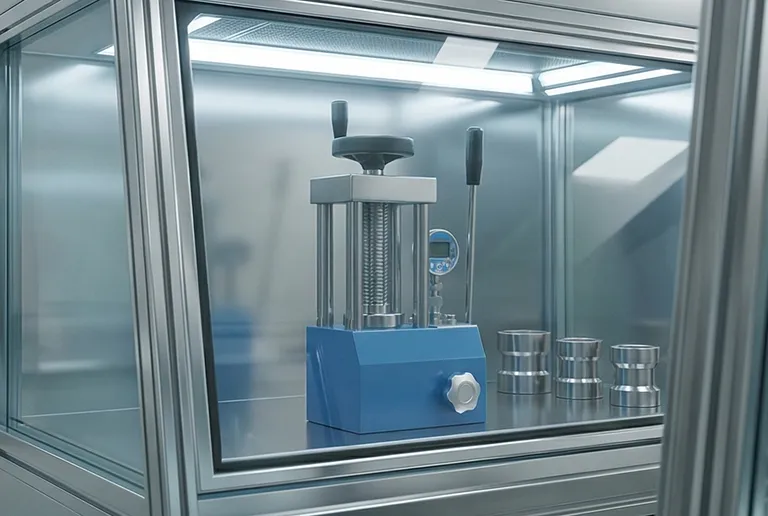
The mold is only as effective as the force applied to it. In battery research and advanced geopolymer studies, the synergy between the mold and the laboratory press is what creates a reproducible result.
Whether you are using a Manual Lab Press for quick iterations or a Cold Isostatic Press (CIP) for uniform densification, the mold acts as the bridge between raw energy and refined form.
At KINTEK, we understand that the mold and the press are a single system. Our solutions are designed to handle the hundreds of Megapascals (MPa) required to shape the future of materials science.
- Manual & Automatic Presses: For consistent, repeatable pressure application.
- Heated & Isostatic Models: For when the environment is as critical as the force.
- Glovebox Compatibility: Ensuring precision even in controlled atmospheres.
Precision isn't an accident; it is the result of choosing the right constraints.
To explore how our high-precision molds and pressing systems can refine your research outcomes, Contact Our Experts
Related Products
- XRF KBR Steel Ring Lab Powder Pellet Pressing Mold for FTIR
- Lab Anti-Cracking Press Mold
- Lab Polygon Press Mold
- Lab Round Bidirectional Press Mold
- Special Shape Lab Press Mold for Laboratory Applications
Related Articles
- The Physics of Transparency: Mastering the Matrix in FTIR Starch Analysis
- The Three-Body Problem of Pellet Pressing: Material, Machine, and Method
- The Silent Symmetry: Why Homogeneity is the Soul of the Pressed Pellet
- The Physics of Letting Go: Why Boron Nitride is the Silent Guardian of Heated Pressing
- The Discipline of the Form Factor: Why Precision Assembly Dictates the Fate of Cellulose Membranes



















