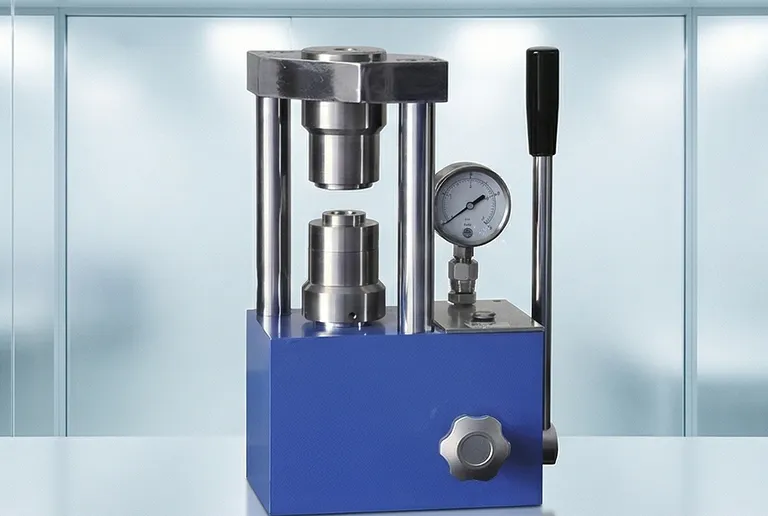
The Invisible War at 600°C
In the world of high-temperature metallurgy, heat is both the builder and the destroyer. When you press aluminum and steel fibers together, you aren't just shaping material; you are managing a violent chemical attraction.
Without a mediator, the aluminum matrix becomes "hungry." At elevated temperatures, it seeks to diffuse into the steel of your mold, creating a permanent metallurgical bond.
This isn't just a stuck part. It is a system failure. The "sacrificial interface"—usually graphite paste—is the only thing standing between a successful composite and a ruined $10,000 tool.
The Chemistry of Separation
Inhibiting the Intermetallic Reaction
Aluminum is notoriously reactive. When it reaches its softening point, it begins to trade atoms with the iron in the steel mold. This creates brittle intermetallic compounds.
Graphite acts as a chemically inert carbon barrier. It refuses to participate in the dance. By providing a stable partition, it ensures the aluminum remains within the composite and the steel remains in the mold.
The Physics of the "Lamellar Slide"
Graphite’s power isn't just chemical; it’s structural. Imagine a deck of cards thrown on a hardwood floor. The cards slide over one another with almost zero resistance.
On a molecular level, graphite behaves the same way. This lamellar structure allows the solidified part to eject with minimal force, preventing "galling"—the microscopic tearing of metal surfaces that shortens mold life.
The Engineer’s Trade-off: Precision vs. Excess
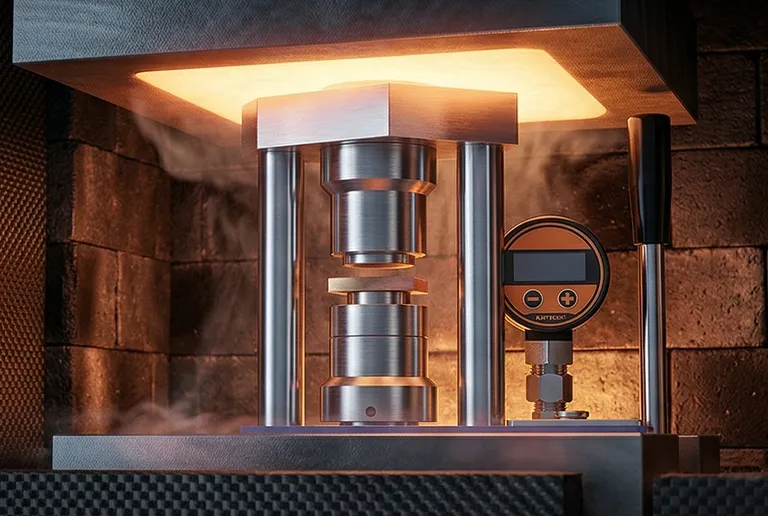
In engineering, there is a psychological trap: if some is good, more must be better. With interface materials, this logic is dangerous.
- The Contamination Risk: Excessive graphite can migrate into the aluminum matrix. This alters the local chemistry, potentially compromising corrosion resistance.
- The Uniformity Crisis: An uneven application creates "hot spots." Where the paste is thin, the part sticks. Where it is thick, the surface pits.
- Pressure Displacement: Under the extreme loads of a hydraulic press, the paste can be squeezed out. If the pressure exceeds the load-bearing capacity of the carbon layer, direct metal-to-metal contact is inevitable.
Systematic Performance Metrics
| Function | Primary Mechanism | Key Benefit |
|---|---|---|
| Chemical Barrier | Prevents Al diffusion into steel | Inhibits intermetallic bonding |
| Mechanical Lubricant | Lamellar sliding structure | Reduces ejection force & friction |
| Tool Protection | Physical carbon partition | Prevents galling and mold wear |
| Thermal Support | Bridges microscopic air gaps | Ensures uniform heat distribution |
The Hardware: Where Theory Meets Force
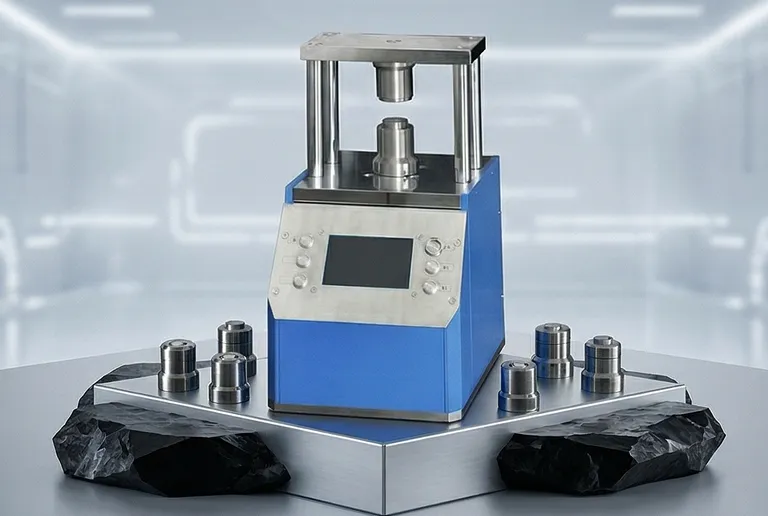
A sacrificial interface is only as effective as the machine that governs it. If your press cannot maintain a precise, uniform load, the graphite layer will fail regardless of its quality.
Consistency in hot pressing requires a system that understands the nuances of thermal expansion and pressure dwell times. Whether you are working in a glovebox for battery research or performing high-throughput metallurgy, the equipment must be an extension of the material science.
At KINTEK, we design laboratory pressing solutions that respect these boundaries. Our range of manual, automatic, and isostatic presses—including heated and multifunctional models—is engineered to provide the stability required for sensitive interface materials to do their job.
Mastering the interface is the difference between a laboratory experiment and a repeatable industrial process.
To refine your pressing precision and protect your investment in high-performance tooling, Contact Our Experts
Related Products
- Automatic High Temperature Heated Hydraulic Press Machine with Heated Plates for Lab
- Heated Hydraulic Press Machine with Heated Plates for Vacuum Box Laboratory Hot Press
- Heated Hydraulic Press Machine With Heated Plates For Vacuum Box Laboratory Hot Press
- Automatic Heated Hydraulic Press Machine with Hot Plates for Laboratory
- Laboratory Manual Heated Hydraulic Press Machine with Hot Plates
Related Articles
- The Architecture of Slow: Why Physical Precision Dictates Chemical Destiny
- The Architecture of Certainty: Why the Laboratory Press is the Anchor of Material Science
- The Vanishing Boundary: The Hidden Thermodynamics of LTCC Lamination
- The Alchemy of 160°C: Why Precision Pressing is the Silent Backbone of Rubber Science
- The Invisible Forge: Why the Laboratory Press is the Soul of Nano-Composites



















