The Hidden Fragility of Material Science
In the world of polymer engineering, we often obsess over the "recipe"—the precise ratio of carbon nanotubes to raw elastomer. Yet, the most sophisticated chemistry remains inert without the proper environment to manifest.
A rubber nanocomposite, before vulcanization, is a chaotic assembly of molecular chains. It is viscous, unstable, and structurally purposeless. To transform this substance into a resilient, three-dimensional network, we don't just need heat; we need a controlled, synergistic environment of thermal energy and mechanical force.
This is where the electrically heated plate press and the steel mold move from "tools" to "architects."
The Thermal Threshold: Beyond Just "Hot"
Vulcanization is not a suggestion; it is a chemical ultimatum. To trigger cross-linking agents like sulfur or peroxides, the material must cross a specific thermal threshold—typically 160°C.
Activating the Molecular Dance
At this precise temperature, the viscous plastic begins its metamorphosis. The heat provides the kinetic energy required for individual rubber molecular chains to bridge together. Without a stable thermal field, this reaction is stuttered, leading to "soft spots" where the chemistry simply didn't happen.
The Problem with Gradients
In a poorly calibrated press, the edges are cooler than the center. This creates a thermal gradient. For the engineer, this is a nightmare: a single sample with varying cross-linking densities. The material may look uniform to the eye, but under mechanical stress, the areas of lower density act as structural "fault lines," leading to premature failure.
Mechanical Force: The War Against the Void
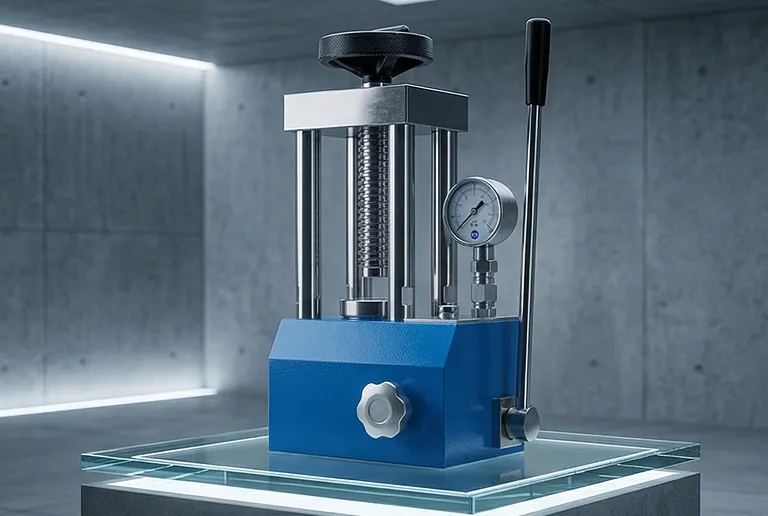
If heat handles the chemistry, pressure handles the physics. Applying high hydraulic pressure—often reaching 1500 psi—serves a singular, critical purpose: the total expulsion of air.
The Psychology of Density
We fear what we cannot see. Micro-bubbles (voids) trapped within a nanocomposite are invisible saboteurs. Under pressure, these bubbles are forced out, ensuring the structural density is maximized.
Geometric Fidelity
Standardization is the bedrock of scientific proof. Whether testing for the Oxygen Index (LOI) or Micro-combustion Calorimetry, the dimensions (e.g., 50 x 10 x 4 mm) must be absolute. Steel molds provide the rigid constraint necessary to ensure that every sample is an identical twin of the last.
| Component | Technical Role | Systemic Benefit |
|---|---|---|
| Heated Plates | Uniform 160°C Thermal Field | Homogeneous cross-linking density |
| Hydraulic Pressure | 1500 psi Mechanical Load | Elimination of voids and micro-bubbles |
| Steel Molds | Hardened Geometric Constraint | Repeatable, standardized sample volume |
| Polished Finish | Surface Interface Control | Low roughness for accurate measurement |
The Cost of the "Almost Correct"

In material research, "close enough" is a dangerous fallacy. Minor deviations in the pressing process lead to systemic failures that are often misattributed to the material's composition.
- Over-Vulcanization: Leaving a sample in the press too long makes it brittle. You haven't improved the network; you've choked it, reducing elasticity and ruining the nanocomposite's potential.
- Material Flash: Excessive pressure without precision mold sealing leads to "leakage." This drop in internal pressure results in inconsistent density, skewing your mechanical data.
- Surface Irregularities: A rough mold surface isn't just an aesthetic flaw; it creates stress concentrators that cause samples to snap during tensile testing earlier than they should.
Engineering the Standard
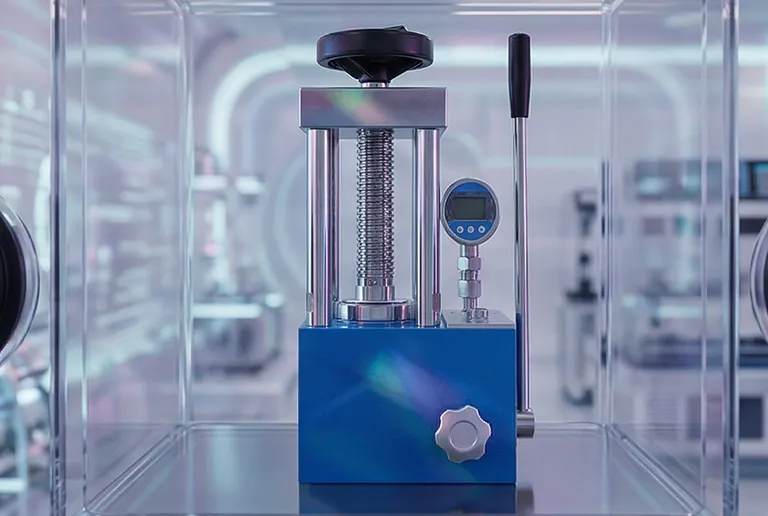
The goal of using high-end pressing solutions is to remove the "human element" and the "mechanical variable" from the equation. When the heat is perfectly uniform and the pressure is absolute, the only variable left is your chemistry.
At KINTEK, we understand that the integrity of your research depends on the stability of your environment. Our suite of laboratory pressing solutions—from manual and automatic heated presses to advanced isostatic systems—is designed to provide the "engineer’s romance": the perfect alignment of force and temperature.
Whether you are pioneering new battery interfaces in a glovebox or perfecting the flame retardancy of a new elastomer, the press is the foundation of your data’s credibility.
Related Products
- Automatic High Temperature Heated Hydraulic Press Machine with Heated Plates for Lab
- Manual Heated Hydraulic Lab Press with Integrated Hot Plates Hydraulic Press Machine
- Heated Hydraulic Press Machine With Heated Plates For Vacuum Box Laboratory Hot Press
- 24T 30T 60T Heated Hydraulic Lab Press Machine with Hot Plates for Laboratory
- Automatic Heated Hydraulic Press Machine with Heated Plates for Laboratory
Related Articles
- The Architecture of Slow: Why Physical Precision Dictates Chemical Destiny
- The Architecture of Certainty: Why the Laboratory Press is the Anchor of Material Science
- The Vanishing Boundary: The Hidden Thermodynamics of LTCC Lamination
- The Alchemy of 160°C: Why Precision Pressing is the Silent Backbone of Rubber Science
- The Invisible Forge: Why the Laboratory Press is the Soul of Nano-Composites