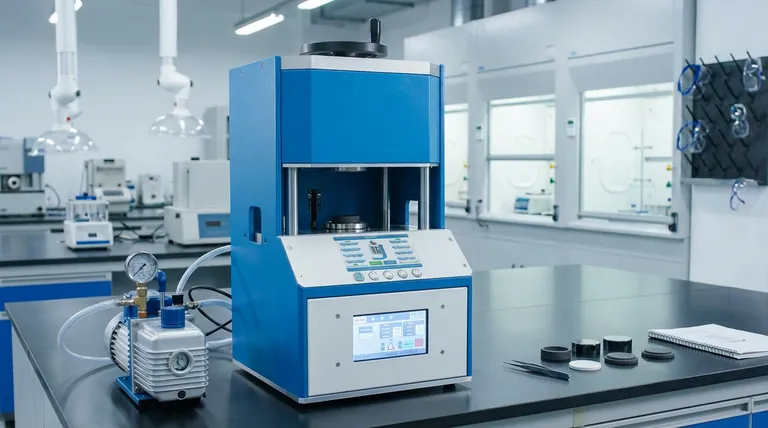
You’ve spent days, maybe even weeks, preparing your material. The powder is milled to perfection, the mold is precisely engineered. You run the hot press cycle, meticulously following your temperature and pressure profile. And then comes the moment of truth.
The component you pull out of the chamber looks perfect, but it cracks under a fraction of its expected load. Or worse, it simply crumbles as you handle it. It’s a frustratingly common story in materials science: a cycle of adjusting pressure, tweaking temperature, and re-running tests, only to get the same disappointing, inconsistent results.
The Endless Cycle of Trial and Error
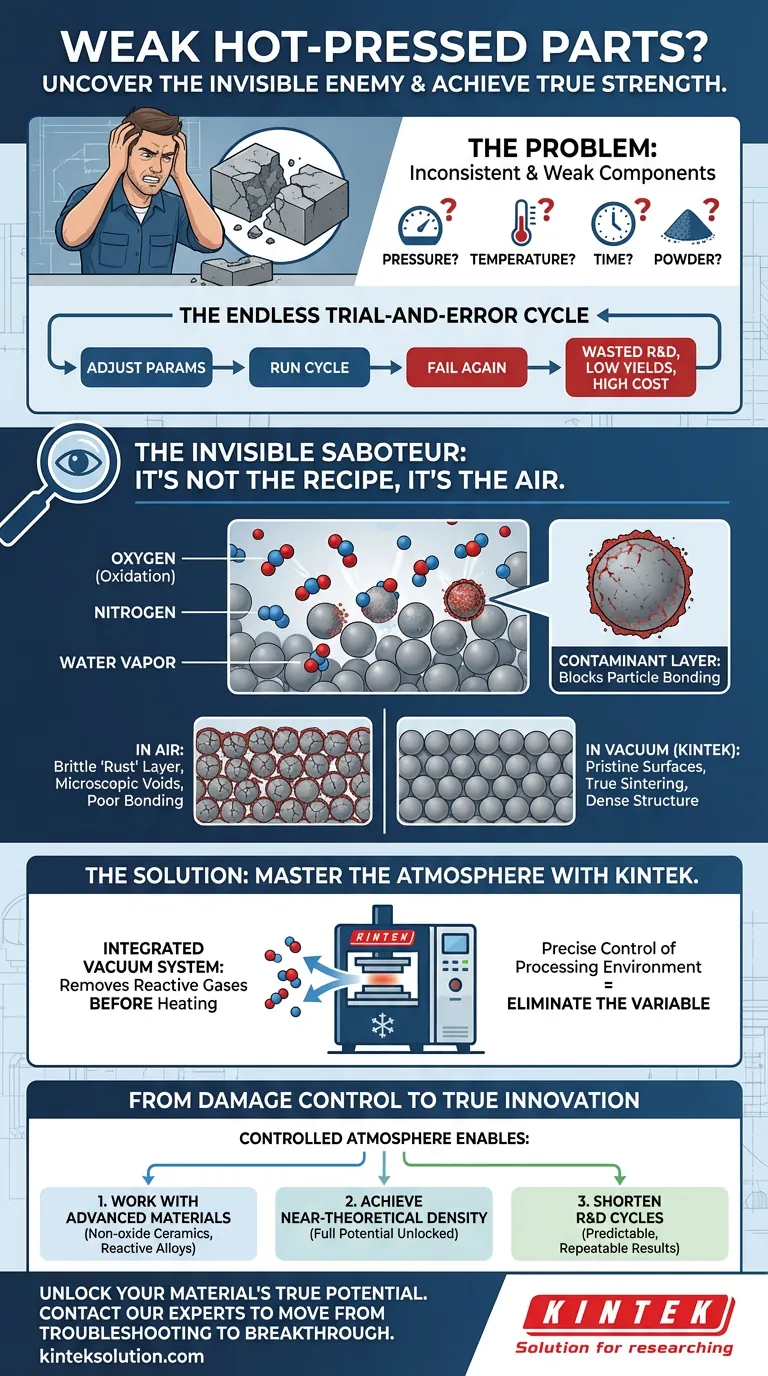
If this sounds familiar, you're not alone. When a hot-pressed part fails, the usual suspects are immediately rounded up:
- "Maybe the pressure wasn't high enough?"
- "Did we hold it at peak temperature for long enough?"
- "Perhaps the heating rate was too fast."
- "Let's re-mill the starting powder to be even finer."
While logical, these adjustments often feel like shots in the dark. This isn't just an academic problem; it has serious commercial consequences. For R&D teams, it means project delays, missed milestones, and wasted budget on failed experiments. For manufacturers, it translates directly to low production yields, high scrap rates, and the risk of shipping unreliable products that could fail in the field. The costs—both financial and reputational—are very real.
But what if the problem has nothing to do with your pressure, temperature, or powder? What if the culprit is something you can't even see?
The Invisible Saboteur: It's Not Your Recipe, It's the Air
The moment you seal your sample in the press chamber, you also trap an invisible enemy: air. At room temperature, air is harmless. But under the extreme heat of hot pressing—often exceeding 1000°C—it becomes a highly reactive poison for many advanced materials.
A Microscopic Case of Rust
At these temperatures, the oxygen in the air aggressively attacks the surface of your material particles. This process, oxidation, creates a brittle, microscopic layer of "rust" on each particle. Air also contains nitrogen and water vapor, which can form similarly undesirable nitride and hydride layers.
This contaminant layer acts like a microscopic coat, preventing the clean, direct contact needed for particles to bond. Sintering, the process where particles fuse to form a dense solid, is fundamentally blocked.
This is the real reason your parts fail. It doesn't matter how much pressure you apply; you're simply crushing contaminated particles against each other, not fusing them into a strong, unified structure. The result is a part riddled with microscopic voids and weak points, leading to low density, high porosity, and poor mechanical strength.
A Tool Designed for Purity: Mastering the Pressing Environment
Once you understand that the atmosphere is the problem, the solution becomes clear. You don't need more pressure; you need a pristine environment. To achieve the high density and strength your material is capable of, you must remove the reactive gases from the chamber.
This is where the right tool becomes critical. It's not about having a press that can just get hot and squeeze hard. It's about having a system that gives you total control over the processing atmosphere.
Our KINTEK heated lab presses are the direct result of understanding this fundamental challenge. They are engineered not just for precision temperature and pressure, but for creating the ideal chemical environment.
- The Root Cause: Oxidation from Air. Our integrated, high-performance vacuum systems are designed to efficiently remove reactive gases like oxygen and water vapor from the chamber before the critical heating phase begins.
- The Flawed Result: Poor Bonding. By creating a vacuum, a KINTEK press ensures your material particles remain pristine. This allows for true, effective sintering, enabling the formation of a dense, high-integrity structure with minimal voids.
- The Common Struggle: Inconsistency. With precise atmospheric control—whether a deep vacuum for highly reactive metals or an inert gas backfill for less sensitive materials—you eliminate the biggest variable in the process. The result is not just one successful part, but repeatable, reliable outcomes, press after press.
From Damage Control to True Innovation
When you no longer have to fight this invisible enemy, your entire focus shifts. Instead of spending your time troubleshooting basic failures, your team is freed up to achieve what was previously out of reach.
With a controlled atmosphere, you can now:
- Confidently work with advanced materials like non-oxide ceramics, reactive metal alloys, and high-performance composites that are impossible to process in air.
- Achieve near-theoretical density, unlocking the full mechanical, thermal, and electrical potential of your materials.
- Drastically shorten your R&D cycle by eliminating the guesswork and achieving predictable results the first time.
- Scale your laboratory breakthroughs to pilot production with the confidence that your process is stable and repeatable.
Ultimately, solving the atmosphere problem moves your work from damage control to genuine innovation.
Your material challenge is unique, and achieving optimal results requires a deep understanding of both the material and the process. If you are tired of fighting for consistent results and are ready to unlock the true potential of your materials, our experts are here to help. We can help you configure a system perfectly matched to your specific goals. Let's discuss how to move your project from troubleshooting to breakthrough. Contact Our Experts.
Visual Guide
Related Products
- Automatic High Temperature Heated Hydraulic Press Machine with Heated Plates for Lab
- Heated Hydraulic Press Machine with Heated Plates for Vacuum Box Laboratory Hot Press
- Automatic Heated Hydraulic Press Machine with Hot Plates for Laboratory
- Heated Hydraulic Press Machine With Heated Plates For Vacuum Box Laboratory Hot Press
- Laboratory Manual Heated Hydraulic Press Machine with Hot Plates
Related Articles
- The Architecture of Slow: Why Physical Precision Dictates Chemical Destiny
- The Architecture of Certainty: Why the Laboratory Press is the Anchor of Material Science
- The Vanishing Boundary: The Hidden Thermodynamics of LTCC Lamination
- The Alchemy of 160°C: Why Precision Pressing is the Silent Backbone of Rubber Science
- The Invisible Forge: Why the Laboratory Press is the Soul of Nano-Composites



















