
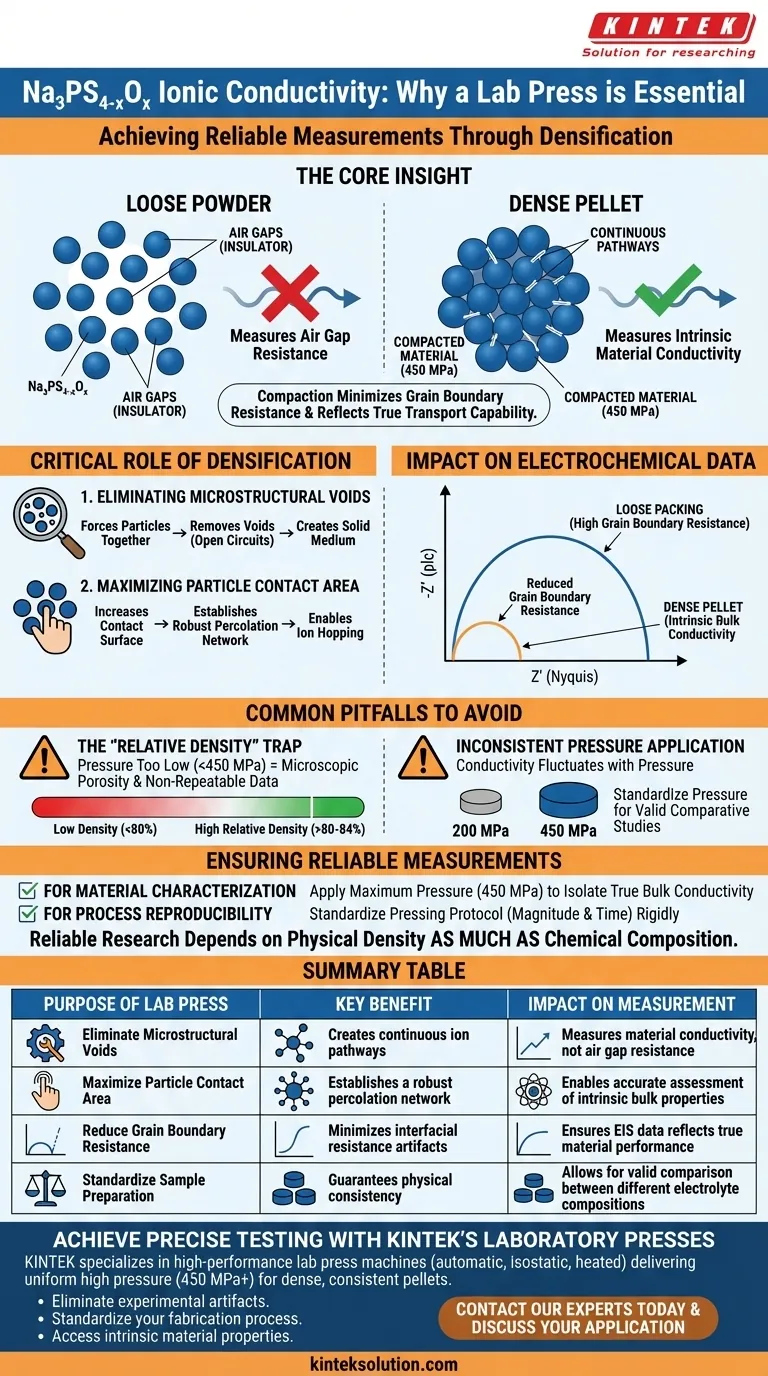
** The application of mechanical pressure via a laboratory press is a fundamental requirement** for valid ionic conductivity measurements of Na₃PS₄₋ₓOₓ. Loose powder contains significant voids filled with air, which acts as an electrical insulator. By compacting the material into a dense pellet—often using pressures up to 450 MPa—you eliminate these voids to create the continuous physical pathways necessary for ions to move.
The Core Insight Measuring loose powder measures the resistance of air gaps, not the material itself. Compacting the electrolyte minimizes grain boundary resistance, ensuring that your data reflects the intrinsic ionic transport capability of the Na₃PS₄₋ₓOₓ crystal structure rather than the quality of your packing method.
The Critical Role of Densification
Eliminating Microstructural Voids
In its synthesized form, Na₃PS₄₋ₓOₓ exists as a loose collection of particles. The space between these particles (porosity) creates a barrier to ion flow.
Because ions cannot jump across air gaps, these voids act as open circuits in your measurement. A laboratory press forces particles together, mechanically removing these voids to create a solid, continuous medium.
Maximizing Particle Contact Area
Ionic conductivity in solid-state electrolytes relies on the hopping of ions from one crystal lattice to another. This requires intimate physical contact between particles.
High-pressure compaction increases the surface area where particles touch. This maximization of contact area is the physical mechanism that establishes a robust percolation network for ion transport.
Impact on Electrochemical Data
Reducing Grain Boundary Resistance
Total resistance in a solid electrolyte is the sum of the resistance within the grains (bulk) and the resistance at the interfaces between grains (grain boundary).
In a loosely packed sample, grain boundary resistance is artificially high due to poor contact. Compacting the pellet significantly reduces this specific resistance component. This allows Electrochemical Impedance Spectroscopy (EIS) to distinguish between the material's actual performance and artifacts caused by sample preparation.
Accessing Intrinsic Properties
The goal of your measurement is to characterize the Na₃PS₄₋ₓOₓ material, not the geometry of the sample.
If the sample is not sufficiently dense, the measured conductivity will be lower than the material's theoretical limit. Densification ensures the resulting data represents the intrinsic bulk conductivity, making it a reliable metric for comparing different electrolyte compositions.
Common Pitfalls to Avoid
The "Relative Density" Trap
Simply pressing the pellet is not enough; you must achieve a specific relative density threshold. References suggest that for similar electrolytes, achieving high relative density (e.g., above 80-84%) is mandatory.
If the pressure applied is too low (e.g., significantly below the recommended 450 MPa for this specific material), the pellet may look solid but still contain microscopic porosity. This leads to non-repeatable data where conductivity fluctuates based on slight variations in hand-tightening or low-pressure application.
Inconsistent Pressure Application
Ionic conductivity values are highly sensitive to the exact pressure used during fabrication.
Comparing a pellet pressed at 200 MPa to one pressed at 450 MPa will yield different conductivity results, even if the chemical composition is identical. Failing to standardize the pressure parameter renders comparative studies invalid.
Ensuring Reliable Measurements
If your primary focus is Material Characterization:
- Apply the maximum recommended pressure (up to 450 MPa for Na₃PS₄₋ₓOₓ) to minimize grain boundary effects and isolate the material's true bulk conductivity.
If your primary focus is Process Reproducibility:
- Standardize your pressing protocol (pressure magnitude and hold time) rigidly across all samples to ensure that variations in data result from chemical changes, not physical inconsistency.
Reliable solid-state battery research depends on the understanding that the physical density of the electrolyte is just as critical to performance as its chemical composition.
Summary Table:
| Purpose of Lab Press | Key Benefit | Impact on Measurement |
|---|---|---|
| Eliminate Microstructural Voids | Creates continuous ion pathways | Measures material conductivity, not air gap resistance |
| Maximize Particle Contact Area | Establishes a robust percolation network | Enables accurate assessment of intrinsic bulk properties |
| Reduce Grain Boundary Resistance | Minimizes interfacial resistance artifacts | Ensures EIS data reflects true material performance |
| Standardize Sample Preparation | Guarantees physical consistency | Allows for valid comparison between different electrolyte compositions |
Achieve precise and reproducible solid-state electrolyte testing with KINTEK's laboratory presses.
Your research on materials like Na₃PS₄₋ₓOₓ demands reliable data. Inconsistent pellet density leads to invalid conductivity results, hindering your development. KINTEK specializes in high-performance lab press machines—including automatic, isostatic, and heated presses—designed to deliver the uniform high pressure (up to 450 MPa and beyond) required to fabricate dense, consistent pellets.
We help you:
- Eliminate experimental artifacts caused by poor sample preparation.
- Standardize your fabrication process for trustworthy, comparable results.
- Access intrinsic material properties by minimizing grain boundary resistance.
Stop compromising your data. Let our expertise in laboratory pressing solutions support your critical material characterization work.
Contact our pressing experts today to discuss your specific application and ensure the integrity of your measurements.
Visual Guide
Related Products
- Laboratory Hydraulic Press 2T Lab Pellet Press for KBR FTIR
- Laboratory Hydraulic Press Lab Pellet Press Button Battery Press
- Laboratory Hydraulic Press Lab Pellet Press Machine for Glove Box
- Laboratory Split Manual Heated Hydraulic Press Machine with Hot Plates
- Laboratory Hydraulic Pellet Press for XRF KBR FTIR Lab Press
People Also Ask
- What is the role of a laboratory pressure machine and KBr in FTIR? Master Sample Preparation for Flame Retardants
- What is the role of a laboratory hydraulic press in high-loading NCM811 cathode prep for solid-state batteries?
- Why is a laboratory hydraulic press necessary for sample preparation? Precise Pelleting for Spiro Heterocyclic Analysis
- What role does a laboratory hydraulic press play in reaction pellets? Optimizing Lunar Soil and Metal Fuel Density
- How does the high-pressure pressing from a laboratory hydraulic press affect the anisotropy of Bi2Te3? Optimize Now



















