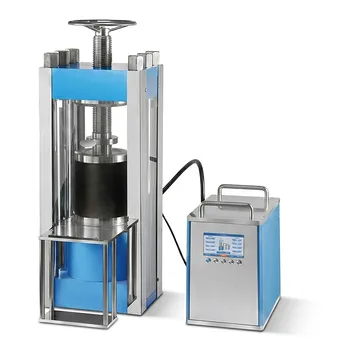
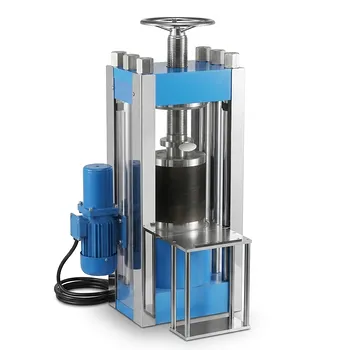
Heated lab presses are the central engine of polymer development, utilized primarily to induce high-pressure conditions for polymerization reactions and precise sample fabrication. By simultaneously applying controlled heat and mechanical force, these instruments transform monomers into long-chain polymers, accelerate reaction rates, and shape materials into uniform films or test specimens for critical analysis.
The core value of a heated lab press lies in its ability to bridge the gap between chemical synthesis and physical application. It allows researchers to manipulate the molecular weight distribution and microscopic morphology of a polymer, ensuring the final material meets specific performance standards before industrial scaling.
Driving Chemical Synthesis and Polymerization
Accelerating Reaction Kinetics
In the synthesis phase, heated lab presses are used to create high-pressure environments essential for polymerization.
By compressing monomers under heat, researchers can significantly accelerate polymerization rates, moving from raw chemical ingredients to solid polymer chains more efficiently than at ambient pressures.
Controlling Molecular Architecture
The application of uniform pressure does more than just speed up the process; it influences the structure of the material.
High-pressure reactors within these presses allow for the control of molecular weight distribution. This precision ensures the resulting polymer possesses the desired mechanical and thermal properties inherent to its chemical design.
Material Characterization and Sample Preparation
Creating Thin Films for Analysis
One of the most frequent uses of these presses is the preparation of thin, uniform polymer films.
These films are critical for transmission IR spectroscopy, mechanical testing, and packaging studies. The press consolidates the material to a specific thickness and density, creating an ideal substrate for optical and physical measurement.
Standardizing Mechanical Test Specimens
To determine physical properties like tensile strength, flexure, and impact resistance, samples must meet international standards.
Lab presses mold common polymers—such as PE, PP, PS, and ABS—into standardized plaques or "dog bones." This ensures that data derived from testing is accurate, reproducible, and comparable across different laboratories.
Facilitating Spectroscopic Study
Beyond mechanical testing, compression-molded samples are vital for chemical analysis.
Researchers use these presses to create pellets or films specifically for XRF analysis and color testing. The uniformity provided by the press eliminates surface irregularities that could skew sensor readings.
Advanced R&D and Process Simulation
Simulating Industrial Molding
A heated laboratory press acts as a scaled-down version of massive industrial machinery.
It allows engineers to simulate hot-pressing, laminating, and composite bonding processes in a controlled environment. This capability is crucial for troubleshooting manufacturing issues without the expense of stopping a production line.
Controlling Microstructure and Crystallinity
The performance of a polymer is heavily dictated by its internal crystal structure.
By accurately adjusting heating plate distribution and cooling rates, researchers can finely control crystallization behavior and phase separation. This allows for the manipulation of the material's microscopic morphology to achieve specific strength or flexibility goals.
Studying Rheological Behavior
Understanding how a polymer flows and deforms is essential for processing.
These presses facilitate the study of polymer rheology and phase transition kinetics by subjecting materials to thermoplastic or thermosetting cycles. This data helps predict how the material will behave during injection molding or extrusion.
Understanding the Trade-offs
Precision vs. Volume
While indispensable for research, lab presses are designed for accuracy, not throughput. They are excellent for producing a handful of perfect test specimens but are not suitable for high-volume production runs.
Thermal Management Sensitivity
The quality of the sample is entirely dependent on the precision of the thermal management system.
If the cooling rate is not strictly controlled, the polymer may warp or develop uneven crystallinity. This introduces variables that can render subsequent mechanical testing invalid.
Material Limitations
While versatile, these presses have operational limits, typically reaching temperatures around 500 °C.
Researchers must ensure their material's degradation point does not overlap with the processing temperature, particularly when working with advanced ceramics or high-performance thermoplastics.
Making the Right Choice for Your Goal
To maximize the utility of a heated lab press, align its application with your specific developmental stage:
- If your primary focus is Chemical Synthesis: Utilize the press to apply high pressure to monomers, accelerating reaction rates and narrowing molecular weight distribution.
- If your primary focus is Material Analysis: Use the press to fabricate standardized thin films and plaques for IR spectroscopy, XRF analysis, and ISO-standard mechanical testing.
- If your primary focus is Process Engineering: Leverage the machine to simulate industrial hot-pressing cycles, testing lamination bonds and crystallization rates before scaling up.
The heated lab press is not just a molding tool; it is a precision instrument for defining the relationship between processing conditions and polymer performance.
Summary Table:
| Application Category | Key Functions & Benefits |
|---|---|
| Chemical Synthesis | Accelerates polymerization kinetics and controls molecular weight distribution. |
| Sample Preparation | Fabricates uniform thin films for IR/XRF analysis and standardized test specimens. |
| Process Simulation | Mimics industrial hot-pressing, laminating, and composite bonding at lab scale. |
| Material Science | Fine-tunes crystallinity, phase separation, and rheological behavior studies. |
Elevate Your Polymer Research with KINTEK Precision
Unlock the full potential of your material development with KINTEK’s industry-leading laboratory pressing solutions. Whether you are accelerating polymerization or preparing standardized specimens for critical analysis, our equipment delivers the precision your lab demands.
Why choose KINTEK?
- Comprehensive Range: We offer manual, automatic, heated, and multifunctional models.
- Specialized Applications: Glovebox-compatible designs and advanced isostatic presses (CIP/WIP) for battery and polymer research.
- Unmatched Control: Superior thermal management to ensure uniform crystallinity and repeatable results.
Ready to scale your innovation from the benchtop to production? Contact our experts today to find your perfect press solution!
Related Products
- 24T 30T 60T Heated Hydraulic Lab Press Machine with Hot Plates for Laboratory
- Automatic Heated Hydraulic Lab Press 120x120mm Plate Fully Automated Material Research Press
- Automatic Heated Hydraulic Lab Press with Programmable Touch Screen Controls and Precision Temperature Regulation
- Automatic Heated Hydraulic Lab Press Machine 200x200 Plate Size for Battery Research and Materials Science
- Manual Heated Hydraulic Lab Press with Integrated Hot Plates Hydraulic Press Machine
People Also Ask
- Function of a Laboratory Hydraulic Press with Heated Platens in SSE? Enhance Battery Density & Conductivity
- Why is a laboratory hydraulic press with heating plates required for PLA/TEC films? Achieve Precise Sample Integrity
- What role does a laboratory heated hydraulic press play in LTCC? Essential for High-Density Ceramic Lamination
- What is the primary function of a laboratory heated hydraulic press? Mastering Thermoplastic Carbon Fiber Composites
- What is the critical role of a laboratory heated hydraulic press? Mastering PVC Sample Prep for Testing