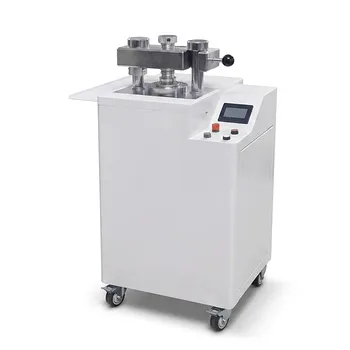
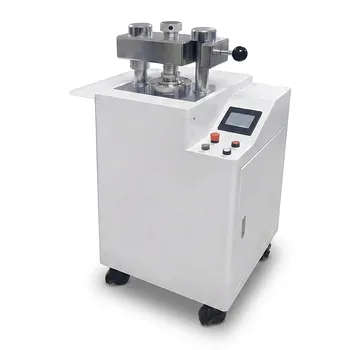
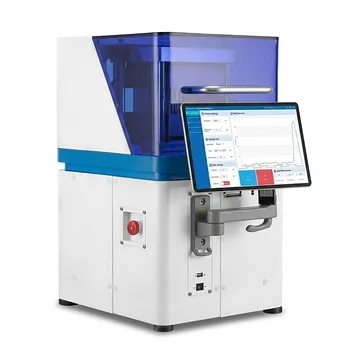
Hydraulic pellet presses serve as the critical bridge between raw material theory and practical application. In educational settings, these tools are utilized to teach the fundamentals of material properties and essential sample preparation techniques. In industrial contexts, their function shifts toward rigorous quality control, research and development (R&D), and the verification of materials against strict performance standards.
The utility of a hydraulic pellet press extends beyond simple compression; it is a precision instrument used to create uniform samples for spectroscopic analysis and to simulate extreme environmental conditions for material testing.
The Educational Role: Theory into Practice
Teaching Material Properties
For students, a hydraulic pellet press is often their first introduction to material science physics. Educators use these machines to demonstrate how substances react to compression, allowing students to observe phenomena such as elasticity, plasticity, and fracture points in real-time.
Mastering Sample Preparation
Beyond theory, students learn the critical importance of creating consistent, high-quality samples. By operating these presses, they gain hands-on experience in preparing materials for analysis, understanding that the quality of the data is directly dependent on the quality of the preparation.
The Industrial Role: Precision and Verification
Quality Control and Compliance
In industrial laboratories, pellet presses are indispensable for verifying that products meet specific manufacturing standards. They ensure consistency in production batches, particularly in sectors like food safety and pharmaceuticals, where uniform samples are required for nutritional or chemical analysis.
Advanced Spectroscopic Analysis
One of the most frequent industrial applications is the preparation of samples for X-ray fluorescence (XRF) and Fourier-transform infrared spectroscopy (FTIR). The press compacts powder mixtures into solid, stable pellets or thin films, which is a prerequisite for obtaining accurate, reproducible readings from these analytical instruments.
Material Science Research
Researchers use these presses to drive innovation in fields such as ceramics, powder metallurgy, and composites. By simulating high-pressure environments, scientists can evaluate strength and durability, ultimately guiding the development of new materials that can withstand extreme manufacturing and engineering demands.
Understanding the Trade-offs
Specificity of Equipment
It is crucial to distinguish between a laboratory pellet press and a general industrial hydraulic press. While general presses handle massive tasks like car crushing or metal forging, pellet presses are specialized for precision tasks like sample compaction and small-scale testing.
The Cost of Inconsistency
The primary pitfall in using these devices is operator error during the preparation phase. If the pressure applied is inconsistent or the die is loaded incorrectly, the resulting pellet will be flawed. In an industrial QC context, a flawed pellet leads to inaccurate spectroscopic data, which can trigger false positives or negatives regarding product quality.
Making the Right Choice for Your Goal
To maximize the utility of a hydraulic pellet press, align your usage with your specific objectives:
- If your primary focus is Education: Prioritize the workflow to teach students the correlation between pressure application and material deformation.
- If your primary focus is Analytical Research: Focus on the repeatability of pressure settings to ensure every sample pellet creates identical conditions for FTIR or XRF analysis.
- If your primary focus is Product Development: Utilize the press to test failure points, effectively pushing new composite materials to their limit to establish durability benchmarks.
Success with hydraulic pellet presses relies not just on the force applied, but on the precision and consistency of the operation.
Summary Table:
| Context | Primary Use Case | Key Benefits |
|---|---|---|
| Education | Material science instruction | Hands-on learning of elasticity, plasticity, and sample prep |
| Industrial QC | Product verification | Ensures batch consistency and compliance with standards |
| Analytical Lab | Spectroscopy (XRF/FTIR) | Creation of uniform pellets for accurate, reproducible data |
| R&D | Innovation & Testing | Simulating high-pressure environments for new composites |
Elevate Your Laboratory Precision with KINTEK
Whether you are shaping the next generation of scientists or driving industrial innovation in battery research, KINTEK provides the specialized pressing power you need. Our comprehensive range of laboratory solutions includes:
- Manual & Automatic Presses: Perfect for educational labs and high-throughput industrial QC.
- Heated & Multifunctional Models: Essential for advanced material research and composite testing.
- Specialized Isostatic Presses: Cold and warm options for superior material density and uniformity.
- Glovebox-Compatible Designs: Ensuring safety and precision for sensitive material handling.
Don't let inconsistent sample preparation compromise your analytical results. Partner with KINTEK for reliable, high-performance equipment tailored to your specific research goals.
Contact Our Experts Today to Find Your Perfect Pressing Solution
Related Products
- Laboratory Hydraulic Pellet Press for XRF KBR FTIR Lab Press
- Automatic Laboratory Hydraulic Press Lab Pellet Press Machine
- Laboratory Hydraulic Press Lab Pellet Press Machine for Glove Box
- Manual Laboratory Hydraulic Pellet Press Lab Hydraulic Press
- Automatic Laboratory Hydraulic Press for XRF and KBR Pellet Pressing
People Also Ask
- Laboratory Pellet Press for Solar PV Recycling: Ensuring High-Precision Material Analysis and Purity
- Why is a professional laboratory pellet press required for XRF of silica sand? Achieve +/- 0.10% Precision
- Why is precise pressure-holding control critical for biomass pellets? Master Your Densification Results
- What is the necessity of a laboratory pellet press for alcohol by-product fuels? Maximize Energy Density & Consistency
- What are the different types of pellet-making tools available for labs? Choose the Right Press for Your Sample