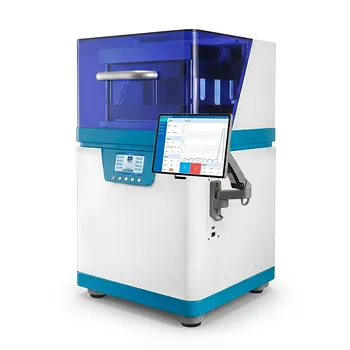
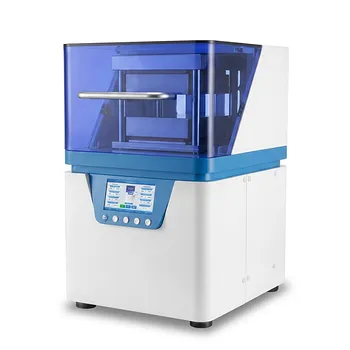
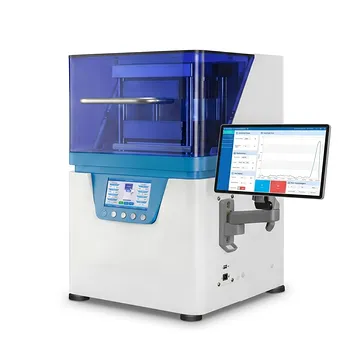
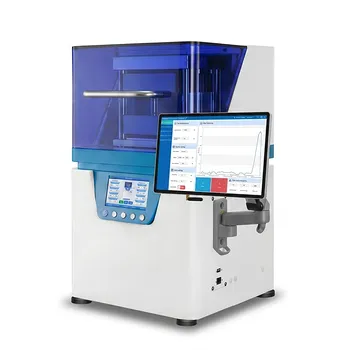
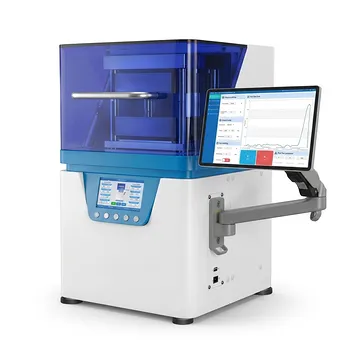
Hydraulic presses in laboratories are primarily utilized to compress materials into uniform pellets, thin films, or core samples for analytical testing. While they are critical for determining material strength through tension testing, their most frequent application involves preparing solid samples for spectroscopic techniques like FTIR and XRF to ensure consistent, reproducible data.
The core function of the hydraulic press is the elimination of experimental variables. By removing voids and ensuring uniform density, the press transforms raw, irregular powders into standardized optical-grade samples that yield accurate, noise-free analytical results.
Enhancing Spectral Acquisition via Homogeneity
The most common "surface need" for a laboratory press is preparing samples for spectroscopy. The "deep need" here is optical clarity and signal integrity.
FTIR Sample Preparation
For Fourier Transform Infrared (FTIR) spectroscopy, solid samples are often mixed with a matrix like Potassium Bromide (KBr).
The press compresses this mixture into a transparent pellet.
This process eliminates the scattering of infrared light caused by loose powder particles. The result is spectral data with a high signal-to-noise ratio and clear characteristic peaks, which are non-negotiable for accurate chemical structure characterization.
X-ray Fluorescence (XRF) Optimization
In XRF analysis, the press is used to bond materials—ranging from minerals to biological samples like ground hair—with a binder.
High pressure (often up to 15 tons) creates a dense, smooth surface.
A smooth, void-free surface is critical because it reduces X-ray scattering losses. This directly improves the emission efficiency of characteristic fluorescence radiation, enhancing the instrument's detection sensitivity.
Ion Beam Analysis Targets
Similar to XRF, ion beam analysis requires a stable target.
The press compacts homogenized powders into solid cylindrical pellets.
This high-density compaction ensures the target surface is flat and stable, which guarantees stable X-ray yields and reproducible experimental results.
Physical Characterization and Mechanical Testing
Beyond spectroscopy, hydraulic presses are vital for establishing physical baselines in material science.
Geological and Coal Analysis
In energy and geology sectors, the press compresses raw materials, such as coal, into cylindrical core samples with specific dimensions.
Precise pressure control ensures structural consistency.
By standardizing the density of the sample, the press eliminates measurement errors in porosity and adsorption capacity. If density were inconsistent, subsequent physical characterization experiments would be unrepeatable.
Tension and Durability Testing
As noted in the primary reference, the utility of the press extends to direct mechanical testing.
Materials are subjected to controlled tensile forces.
This allows engineers to determine the inherent strength and durability of a material. In this context, the sample is not being prepared for another machine; the pressing process is the test.
Understanding the Trade-offs
While hydraulic presses are powerful tools for standardization, misuse can lead to compromised data.
The Pressure Balance
Applying more pressure does not always equal a better sample.
Excessive pressure can cause pellets to fracture or induce structural changes in pressure-sensitive materials. Conversely, insufficient pressure leaves voids in the sample, resulting in light scattering and poor spectral quality.
Matrix Purity
In spectroscopic preparation, the press forces the sample and the matrix (e.g., KBr) into intimate contact.
Contamination becomes permanent.
Because the compression is so complete, any impurities in the binder or on the press die itself will be permanently integrated into the sample, creating artifacts in the final analysis.
Making the Right Choice for Your Goal
To maximize the utility of a hydraulic press, align your technique with your specific analytical objective.
- If your primary focus is FTIR Spectroscopy: Prioritize the transparency of the pellet to minimize light scattering and maximize peak clarity.
- If your primary focus is XRF or Ion Beam Analysis: Focus on achieving high density and a perfectly smooth surface to enhance detection sensitivity.
- If your primary focus is Material Physics (Coal/Geology): Ensure precise pressure holding to guarantee consistent density, which is required for accurate porosity data.
Success in laboratory analysis relies on the principle that better sample preparation yields better data.
Summary Table:
| Application Type | Analytical Technique | Key Benefit of Pressing |
|---|---|---|
| Spectroscopy | FTIR (KBr Pellets) | Eliminates light scattering for clear spectral peaks |
| Elemental Analysis | XRF / Ion Beam | Enhances detection sensitivity via smooth, dense surfaces |
| Material Science | Porosity & Adsorption | Ensures structural consistency for geological samples |
| Mechanical Testing | Tension & Durability | Determines material strength through controlled force |
Elevate Your Analytical Precision with KINTEK
Maximize your laboratory's potential with KINTEK’s comprehensive laboratory pressing solutions. Whether you are conducting cutting-edge battery research or complex geological analysis, our high-precision equipment ensures the sample homogeneity your data demands.
Our specialized range includes:
- Manual and Automatic Hydraulic Presses
- Heated and Multifunctional Models
- Glovebox-Compatible and Isostatic Presses (Cold/Warm)
Why choose KINTEK? We provide the tools to eliminate experimental variables, ensuring your samples yield high signal-to-noise ratios and reproducible results every time.
Contact KINTEK Experts Today to find the perfect press for your research needs!
Related Products
- Automatic Hydraulic Hot Press with Large Plate and Precision Temperature Control for Advanced Material Sample Preparation and Industrial Research
- Automatic Hydraulic Heat Press Machine with Multi Stage Programmable Control and Integrated Water Cooling Plate Size 180x180mm
- Automatic High Temperature Heated Hydraulic Press Machine with Heated Plates for Lab
- Automatic Heated Hydraulic Lab Press with Programmable Touch Screen Controls and Precision Temperature Regulation
- Manual Heated Hydraulic Lab Press with Integrated Hot Plates Hydraulic Press Machine
People Also Ask
- What are the specific features and applications of hydraulic hot press machines? Precision Solutions for Modern Labs
- How does an automatic hydraulic press operate? Achieve Precision and Consistency in Lab Pelleting
- What are the advantages and common applications of an automatic hydraulic press? Elevate Your Lab's Precision
- What is the technical significance of setting a precise dwell time? Achieve Peak Material Density and Stability
- When is an automatic hydraulic press more suitable than a manual press? Scale Your Lab with Precision & Speed