
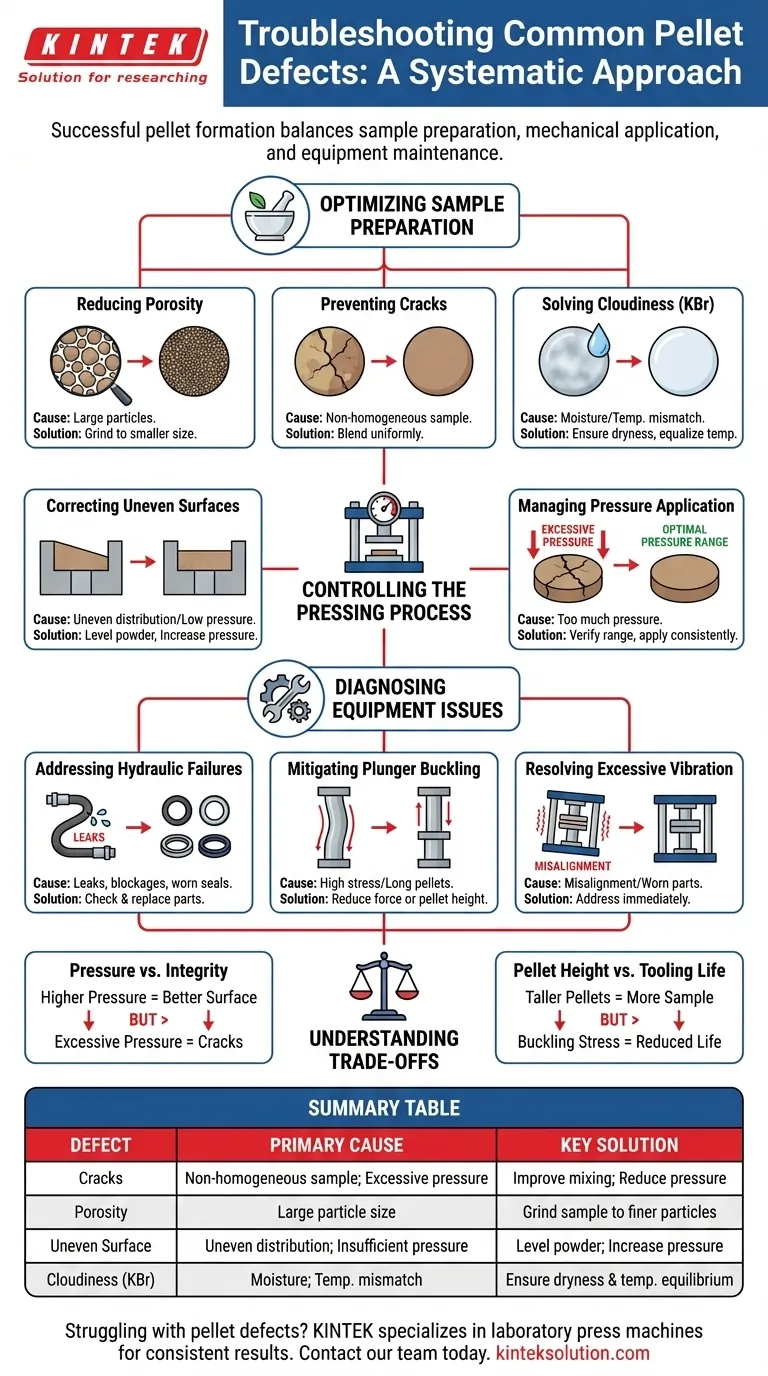
Troubleshooting pellet defects requires a systematic approach that addresses both sample preparation and mechanical application. Common physical defects like cracks are usually resolved by reducing applied pressure and improving sample homogeneity, while porosity and uneven surfaces are corrected by grinding particles to a smaller size and ensuring uniform distribution within the die.
Successful pellet formation is a balance of variables; most defects are not caused by the press itself, but by inconsistencies in particle size, moisture content, or sample distribution prior to compression.
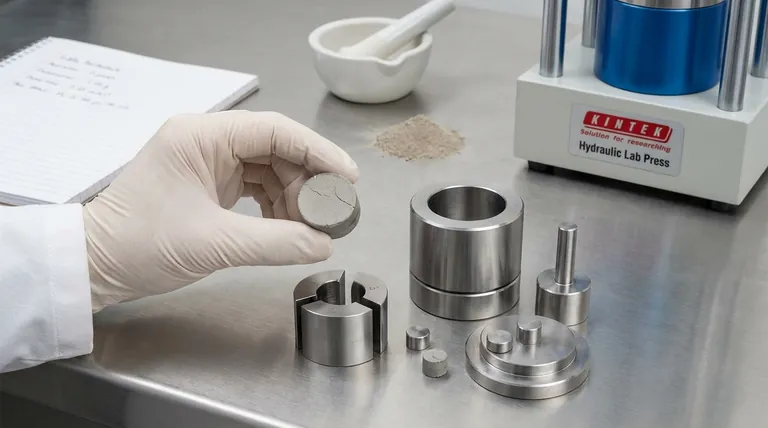
Optimizing Sample Preparation
The physical characteristics of your sample material are the primary determinants of pellet quality.
Reducing Porosity
Porosity, or the presence of voids within the pellet, often stems from particles that are too large to bond cohesively. To resolve this, ensure you use smaller particle sizes by grinding the sample more thoroughly. Finer particles pack together more densely, eliminating air gaps.
Preventing Cracks
Cracking is frequently a symptom of a non-homogeneous sample. If the sample is not well-mixed, stress concentrates in specific areas during compression, leading to fractures. Ensure the binder and sample are blended uniformly before placing them in the die.
Solving Cloudiness in KBr Pellets
If you are pressing Potassium Bromide (KBr) pellets for FTIR analysis and they appear cloudy, the culprit is almost always moisture. Ensure both the KBr powder and the pressing anvils are completely dry. Additionally, the powder and anvils must be at the same temperature to prevent condensation from forming during the process.
Controlling the Pressing Process
Even a perfect sample can fail if the mechanical application of force is inconsistent or incorrect.
Correcting Uneven Surfaces
An uneven pellet surface typically indicates that the sample was not distributed uniformly inside the die. Before pressing, carefully level the powder. If the distribution is flat but the surface remains uneven, the issue may be insufficient pressure, failing to fully consolidate the material.
Managing Pressure Application
Applying too much pressure is a leading cause of cracking. Verify that you are operating within the recommended pressure range for your specific material and die size. Conversely, if you cannot reach the desired pressure, verify the consistency of the application to ensure the load is applied smoothly.
Diagnosing Equipment Issues
When sample prep and pressure settings are correct but defects persist, the issue likely lies within the hardware.
Addressing Hydraulic Failures
If the press cannot reach or maintain pressure, investigate the hydraulic system immediately. Look for leaks in hoses or seals, and check for blockages. Worn-out hoses or seals are common failure points that require timely replacement to restore function.
Mitigating Plunger Buckling
High buckling stresses can occur in the plunger, particularly when pressing longer pellets. To mitigate this risk, reduce the applied force or decrease the pellet height. Alternatively, using a shorter or custom-made plunger can help handle the stress without buckling.
Resolving Excessive Vibration
Excessive vibration suggests internal mechanical issues, such as misalignment or worn parts. This must be addressed promptly. Ignoring vibration can lead to severe damage to the press and consistently poor pellet quality.
Understanding the Trade-offs
Achieving the perfect pellet often involves balancing competing factors.
Pressure vs. Integrity
Increasing pressure helps consolidate the pellet and smooth the surface, but crossing the threshold into excessive pressure causes the pellet to crack upon release. You must find the specific window where the material bonds without storing enough internal stress to fracture.
Pellet Height vs. Tooling Life
Pressing taller pellets allows for more sample material but significantly increases buckling stress on the plunger. Reducing pellet height protects your equipment and plunger integrity but restricts the amount of sample you can analyze in a single run.
Making the Right Choice for Your Goal
To ensure consistent results, align your troubleshooting strategy with your specific analytical priority.
- If your primary focus is Optical Clarity (e.g., KBr): Prioritize moisture control and temperature equilibrium between the powder and anvils to prevent cloudiness.
- If your primary focus is Structural Integrity: Focus on thorough mixing to ensure homogeneity and cap your pressure application to avoid cracking.
- If your primary focus is Equipment Longevity: Inspect seals regularly for leaks and reduce pellet height to minimize buckling stress on the plunger.
Mastering pellet pressing is less about force and more about the consistency of your preparation and the maintenance of your tools.
Summary Table:
| Defect | Primary Cause | Key Solution |
|---|---|---|
| Cracks | Non-homogeneous sample; Excessive pressure | Improve mixing; Reduce pressure |
| Porosity | Large particle size | Grind sample to finer particles |
| Uneven Surface | Uneven sample distribution; Insufficient pressure | Level powder in die; Increase pressure |
| Cloudiness (KBr) | Moisture; Temperature mismatch | Ensure complete dryness & temperature equilibrium |
Struggling with pellet defects? KINTEK specializes in laboratory press machines, including automatic lab presses, isostatic presses, and heated lab presses, designed to deliver the consistent, controlled pressure essential for flawless pellet formation. Our experts can help you select the right press and optimize your process for superior results. Contact our team today to discuss your specific application and achieve perfect pellets every time.
Visual Guide
Related Products
- Laboratory Hydraulic Split Electric Lab Pellet Press
- Laboratory Hydraulic Pellet Press for XRF KBR FTIR Lab Press
- Manual Laboratory Hydraulic Pellet Press Lab Hydraulic Press
- Automatic Laboratory Hydraulic Press Lab Pellet Press Machine
- Automatic Laboratory Hydraulic Press for XRF and KBR Pellet Pressing
People Also Ask
- What are the emerging trends in the design and materials of lab pellet presses? Modernize Your Lab Efficiency
- What are common lab pellet press issues? Expert Troubleshooting Guide for Reliable Material Research
- How do lab pellet presses support customization and flexibility? Optimize Your Sample Prep for Any Material
- What are the common operational types of lab pellet presses? Choosing the Right Manual, Automatic, or Hydraulic System
- Why use a laboratory pellet press for solid-state battery evaluation? Ensure Accuracy in Interface Stability Testing



















