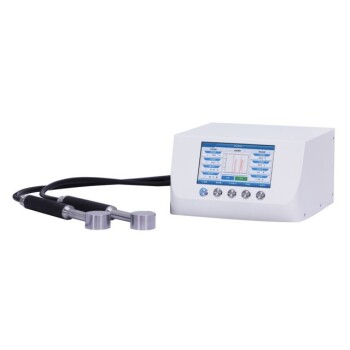
Constant temperature heating devices serve as the primary catalyst for breaking the bonds between contaminants and nanomaterials. By maintaining a precise thermal environment of 70°C in distilled water, these devices provide the exact energy required to trigger the desorption of physically adsorbed dye molecules. This controlled heating creates a repeatable framework for restoring the material's chemical activity without degrading its structure.
The core function of this technology is to facilitate the release of captured pollutants through stable thermal energy, allowing silver-iron nanocomposites to retain approximately 90% of their removal capacity after four cycles of reuse.
The Mechanics of Thermal Regeneration
Facilitating Desorption
The regeneration process relies on the application of heat to reverse the adsorption process. Constant temperature devices maintain the treatment solution—specifically distilled water—at a steady 70°C.
At this temperature, the kinetic energy provided is sufficient to overcome the weak physical forces holding dye molecules to the nanoparticle surface. This causes the contaminants to detach (desorb) effectively.
Restoring Active Sites
The primary goal of regeneration is to free up the material's active sites. Once the dye molecules are removed via thermal treatment, the specific locations on the nanocomposite that capture pollutants are exposed again.
Following the heating phase, the material undergoes separation and drying. This sequence ensures that the surface is clean and fully reactivated for the next round of filtration.
Performance Metrics and Stability
High Capacity Retention
The efficacy of this method is measured by how well the material performs after regeneration compared to its fresh state. Using constant temperature heating allows the silver-iron nanocomposites to maintain a very high level of performance.
Data indicates that these materials retain approximately 90% of their removal capacity. This high retention rate proves that the thermal treatment cleans the material without significantly damaging its functional properties.
Cycle Durability
Sustainability in nanotechnology relies on the ability to reuse materials multiple times. This heating method supports substantial cycle durability.
The 90% capacity retention holds true even after four consecutive cycles of reuse. This demonstrates that constant temperature heating is a viable long-term strategy for extending the lifecycle of silver-iron nanocomposites.
Understanding the Trade-offs
Physical vs. Chemical Adsorption
It is critical to note that this thermal method targets physically adsorbed molecules. Physical bonds are generally weaker and easier to break with moderate heat (70°C).
If contaminants were chemically bonded (chemisorption) to the silver-iron core, this temperature might be insufficient for regeneration, potentially requiring higher energy inputs or chemical solvents which could degrade the material.
Precision vs. Speed
Using a constant temperature device prioritizes stability and protection of the nanocomposite over rapid heating.
While raising the temperature might speed up desorption, excessive heat could alter the crystalline structure of the silver-iron composite or cause aggregation, permanently reducing its surface area and effectiveness.
Making the Right Choice for Your Project
When implementing regeneration protocols for nanocomposites, your heating strategy determines the material's lifespan.
- If your primary focus is material longevity: Adhere strictly to the 70°C limit, as this temperature balances effective cleaning with the preservation of the nanoparticle structure.
- If your primary focus is process efficiency: Ensure your workflow includes thorough separation and drying post-heating, as moisture retention can block the newly restored active sites.
Precise thermal control transforms single-use waste into a sustainable, multi-cycle resource.
Summary Table:
| Parameter | Specification/Detail | Impact on Regeneration |
|---|---|---|
| Optimal Temperature | 70°C | Facilitates desorption without structural degradation |
| Solvent Used | Distilled Water | Provides a clean medium for contaminant release |
| Target Mechanism | Physical Adsorption | Overcomes weak physical bonds to clear active sites |
| Performance Retention | ~90% Capacity | Ensures long-term material efficiency |
| Durability | 4+ Cycles | Demonstrates sustainability and cost-effectiveness |
Maximize Your Research Sustainability with KINTEK
Precise thermal control is the key to transforming laboratory waste into high-performance, reusable resources. At KINTEK, we specialize in comprehensive laboratory solutions designed for the most demanding applications in battery research and materials science.
Our extensive range of equipment includes:
- Manual, Automatic, and Heated Presses for precise sample preparation.
- Multifunctional and Glovebox-Compatible Models for sensitive environments.
- Cold and Warm Isostatic Presses to ensure material uniformity and density.
Whether you are regenerating silver-iron nanocomposites or developing next-generation energy storage, KINTEK provides the reliability and precision your lab deserves. Partner with KINTEK today and optimize your material performance — Contact us now!
References
- Nadia Bashir, Salma Shad. Green synthesis of silver and iron nano composites using aqueous extract of zanthoxylum armatum seeds and their application for removal of acid black 234 dye. DOI: 10.3389/ftox.2024.1288783
This article is also based on technical information from Kintek Solution Knowledge Base .
Related Products
- Automatic High Temperature Heated Hydraulic Press Machine with Heated Plates for Lab
- Infrared Heating Quantitative Flat Plate Mold for Precise Temperature Control
- Automatic Heated Hydraulic Press Machine with Hot Plates for Laboratory
- Automatic Heated Hydraulic Press Machine with Heated Plates for Laboratory
- Lab Double Plate Heating Mold for Laboratory Use
People Also Ask
- Function of a Laboratory Hydraulic Press with Heated Platens in SSE? Enhance Battery Density & Conductivity
- What are the requirements for electrode pressing with high-viscosity ionic liquids like EMIM TFSI? Optimize Performance
- How does a laboratory heated hydraulic press facilitate PBN sample prep for WAXS? Achieve Precise X-Ray Scattering
- What are the industrial applications of heated hydraulic presses? Master Heat & Force for Precision Manufacturing
- Why is a laboratory hydraulic press with heating plates required for PLA/TEC films? Achieve Precise Sample Integrity