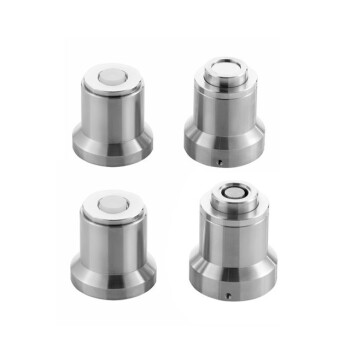
The precision and material properties of laboratory molding dies are the defining factors in briquette uniformity and structural integrity. High-precision dies impose exact geometric boundaries to ensure consistent density, while high-hardness die materials minimize wall friction, allowing pressure to transmit evenly to the powder's center.
Core Takeaway The quality of a briquette is largely determined by how effectively the molding die manages friction and pressure distribution. Harder, wear-resistant materials prevent energy loss at the walls, ensuring the pressure applied by the press actually consolidates the core of the material.
The Role of Die Material and Friction
The material composition of the die is not just about durability; it is a critical component of the pressure transmission process.
Minimizing Wall Friction Losses
When pressure is applied, powder particles naturally resist movement against the die walls. High-hardness, wear-resistant die materials significantly reduce this coefficient of friction.
Enhancing Pressure Transmission
By reducing drag at the walls, the die ensures that the force from the press is not wasted on the perimeter. This allows the pressure to be distributed more uniformly throughout the powder center.
Achieving Superior Surface Finish
Proper die materials facilitate smoother particle rearrangement at the interface. This results in briquettes with smooth surfaces and sharp edges, free from surface drag defects.
The Criticality of Dimensional Precision
Precision is about more than just the final shape; it dictates the internal mechanics of the briquette during formation.
Ensuring Uniform Density
A precision cylindrical mold acts as a strict constraint that forces particles to rearrange evenly. This geometric exactness ensures uniform pressure distribution within the powder bed.
Preventing Density Gradients
When pressure is uniform, the density remains consistent from the surface to the core. This consistency eliminates density gradients, which are weak points where structural failures often originate.
Understanding the Trade-offs: Common Defects
Ignoring the quality of the die leads to specific, predictable failures in the final product.
The Risk of Delamination
If the die material causes excessive wall friction, the outer shell of the briquette densifies faster than the center. This differential creates internal stress, leading to delamination defects (layers separating) upon ejection.
Micro-Cracks and Bursting
Inconsistent density caused by poor die precision creates internal tension. During subsequent drying or combustion phases, these imperfections manifest as micro-cracks or can cause the briquette to burst entirely.
Making the Right Choice for Your Goal
Selecting the right die configuration depends on the specific requirements of your end product.
- If your primary focus is Visual Quality and Dimensions: Prioritize high-precision geometric boundaries to ensure sharp edges and consistent appearance across batches.
- If your primary focus is Structural Integrity and Strength: Prioritize high-hardness, low-friction die materials to eliminate air pockets and prevent delamination or bursting during use.
The die is not merely a container; it is an active participant in the physics of densification.
Summary Table:
| Factor | Impact on Quality | Key Benefit |
|---|---|---|
| Material Hardness | Reduces wall friction losses | Ensures pressure reaches the powder core |
| Surface Finish | Smoother particle rearrangement | Sharp edges and defect-free surfaces |
| Dimensional Precision | Eliminates density gradients | Prevents internal stress and structural failure |
| Friction Control | Uniform energy distribution | Avoids delamination and micro-cracking |
Elevate Your Sample Preparation with KINTEK
Precision starts with the right equipment. KINTEK specializes in comprehensive laboratory pressing solutions, offering manual, automatic, heated, multifunctional, and glovebox-compatible models, as well as cold and warm isostatic presses. Whether you are conducting advanced battery research or material science studies, our high-precision molding dies and robust presses ensure uniform density and flawless structural integrity for every briquette.
Ready to eliminate delamination and improve your research accuracy? Contact us today to find the perfect pressing solution!
References
- Vitaly KULIKOV, Pavel Kovalev. Manufacture of briquettes from ball bearing steel pulverized metal waste without prior cleaning by cold pressing. DOI: 10.36547/ams.31.3.2228
This article is also based on technical information from Kintek Solution Knowledge Base .
Related Products
- Assemble Lab Cylindrical Press Mold for Laboratory Use
- Lab Ring Press Mold for Sample Preparation
- Lab XRF Boric Acid Powder Pellet Pressing Mold for Laboratory Use
- Lab Heat Press Special Mold
- Lab Cylindrical Press Mold with Scale
People Also Ask
- What is the purpose of incorporating cartridge heaters into a lab press mold for MLCC block compression? Optimize Results
- What is the function of a pressing tool in thermoplastic panels? Master Precision Shaping & Fusion Bonding
- Why is precise cooling management of the lab press mold necessary? Protect Core Integrity in Thermoforming
- Why is a high-performance laboratory molding press critical for in-situ electrolyte formation? Unlock Battery Success
- How does the geometry of laboratory molds influence mycelium-based composites? Optimize Density and Strength