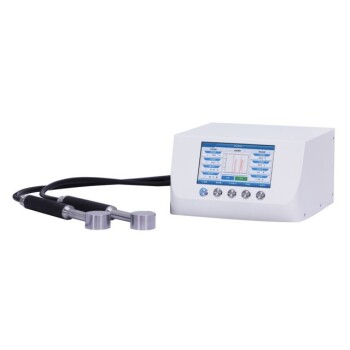
A high-precision heating stage functions as the critical driver for structural evolution in germanium-based thin films. By delivering stable and controllable thermal energy, specifically at activation temperatures such as 723 K or 823 K, this equipment forces the lattice reorganization necessary to transform the material's physical properties. This process is essential for converting an amorphous matrix into a highly ordered, conductive state.
Post-treatment thermal activation uses precise heat to promote grain growth and eliminate internal defects, resulting in a dramatic reduction in electrical resistivity and a significant boost to the Seebeck coefficient.
The Physics of Thermal Activation
Driving Lattice Reorganization
The primary function of a high-precision heating stage is to provide the energy required to reorganize the lattice structure.
Without this thermal input, the deposited germanium-based film often remains in an amorphous or disordered state.
The heating stage drives the atomic rearrangement necessary to create a structured, crystalline matrix.
Promoting Grain Growth
At specific activation temperatures, the thermal energy facilitates grain growth within the material.
This growth replaces the disordered structure with larger, more uniform crystalline regions.
This structural evolution is the physical foundation for improved electronic performance.
Balancing Vacancies and Defects
High-precision heating is essential for balancing the distribution of vacancies within the film.
The thermal process actively promotes the elimination of defects that naturally occur during deposition.
By removing these imperfections, the heating stage clears the path for efficient electron transport.
Impact on Material Performance
Drastic Reduction in Resistivity
The structural ordering induced by the heating stage has a profound impact on electrical conductivity.
As the amorphous matrix transforms into an ordered structure, the thin film resistivity decreases significantly.
Data indicates that this process can reduce resistivity by several orders of magnitude.
Enhancement of the Seebeck Coefficient
Beyond basic conductivity, the thermal treatment is critical for improving the Seebeck coefficient.
This parameter is a key indicator of a material's thermoelectric efficiency.
A significant enhancement in this coefficient proves that the heating stage has successfully optimized the material's energy conversion potential.
Critical Process Controls
The Necessity of Temperature Precision
The effectiveness of this process relies heavily on achieving specific activation temperatures, such as 723 K or 823 K.
Because the process requires specific energy thresholds to drive lattice changes, imprecise heating can lead to suboptimal activation.
A high-precision stage ensures stable thermal delivery, preventing the inconsistencies that occur with fluctuating heat sources.
Optimizing Your Thermal Process
To maximize the utility of your germanium-based thin films, align your heating strategy with your specific performance metrics.
- If your primary focus is Electrical Conductivity: Ensure your heating stage can sustain stable temperatures to drive the lattice ordering required to drop resistivity by orders of magnitude.
- If your primary focus is Thermoelectric Efficiency: Target specific activation temperatures (e.g., 723 K or 823 K) to maximize the Seebeck coefficient through defect elimination.
Precise thermal control is not merely a treatment step; it is the defining factor in unlocking the full potential of germanium-based materials.
Summary Table:
| Feature | Impact on Germanium Thin Films | Benefit to Material Performance |
|---|---|---|
| Lattice Reorganization | Converts amorphous matrix to crystalline | Significant reduction in electrical resistivity |
| Grain Growth Promotion | Replaces disordered structures with larger grains | Enhanced electron transport and stability |
| Defect Elimination | Balances vacancy distribution | Increased Seebeck coefficient and efficiency |
| Thermal Precision | Stable delivery at 723 K or 823 K | Consistent, repeatable material properties |
Elevate Your Thin Film Research with KINTEK
Unlocking the full potential of germanium-based materials requires the uncompromising thermal precision that only professional-grade equipment can provide. KINTEK specializes in comprehensive laboratory solutions, offering manual, automatic, heated, and multifunctional systems designed for the most demanding research environments.
Whether you are focused on reducing resistivity for semiconductor applications or maximizing the Seebeck coefficient for battery and thermoelectric research, our high-precision heating stages ensure stable, repeatable results. Contact us today to discover how our heating plates and pressing solutions can optimize your material activation process and drive your innovation forward.
References
- Piotr Markowski, Eugeniusz Prociów. Post-Processing Thermal Activation of Thermoelectric Materials Based on Germanium. DOI: 10.3390/en18010065
This article is also based on technical information from Kintek Solution Knowledge Base .
Related Products
- Infrared Heating Quantitative Flat Plate Mold for Precise Temperature Control
- Automatic High Temperature Heated Hydraulic Press Machine with Heated Plates for Lab
- 24T 30T 60T Heated Hydraulic Lab Press Machine with Hot Plates for Laboratory
- Lab Polygon Press Mold
People Also Ask
- How do precision temperature-controlled heating plates function in electrolyte thermal stability storage experiments?
- What is the importance of a precision temperature-controlled heating module? Ensure Aluminum-Cadmium Thermal Stability
- How does heating platen precision affect rubber specimens? Achieve uniform density and reliable testing results.
- How are thin polymer films produced for spectroscopic analysis? Expert Guide to Heat and Low-Pressure Methods
- What accessories and field services can be used to optimize the capabilities of presses? Maximize Your Lab Performance