
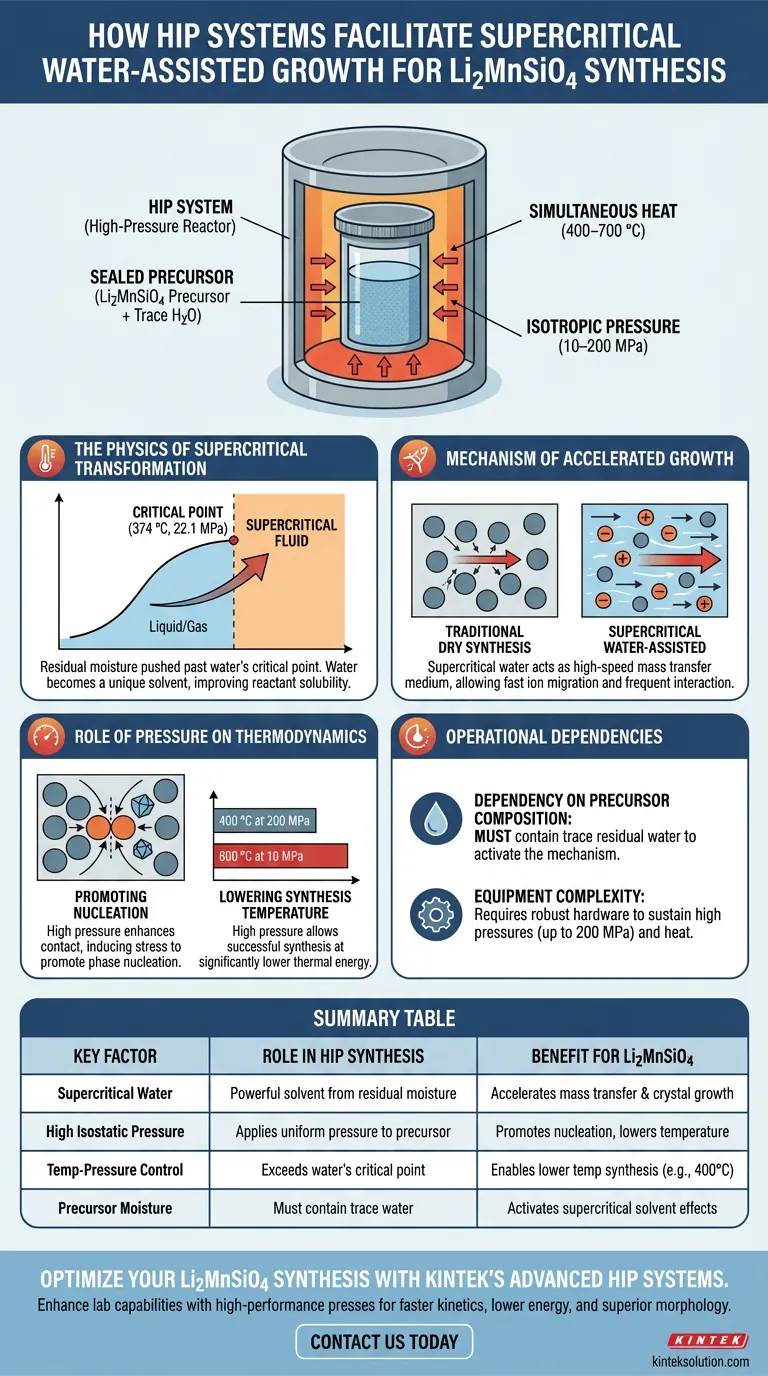
A Hot Isostatic Pressing (HIP) system acts as a high-pressure reactor that facilitates supercritical water-assisted growth by subjecting a sealed precursor to simultaneous heat and isotropic pressure. When the precursor contains trace amounts of residual water, the HIP system pushes the internal environment past water's critical point (374 °C and 22.1 MPa). This transforms the residual moisture into a supercritical fluid, which serves as a powerful solvent and mass transfer medium to accelerate the crystallization of Li2MnSiO4.
By leveraging the unique properties of supercritical water as a solvent, HIP enables the synthesis of Li2MnSiO4 with faster diffusion kinetics and at significantly lower temperatures than conventional solid-state methods.
The Physics of the Supercritical Transformation
Reaching the Critical Point
The primary function of the HIP system in this context is to create an environment that exceeds specific physical thresholds.
Standard synthesis methods often evaporate moisture, but HIP treats the sealed sample within a closed system.
By applying temperatures between 400–700 °C and pressures between 10–200 MPa, the system forces any trace residual water present in the precursor beyond its critical point of 374 °C and 22.1 MPa.
Creating a Supercritical Solvent
Once these conditions are met, the water behaves neither as a distinct liquid nor a gas, but as a supercritical fluid.
This fluid possesses unique properties that make it a highly effective solvent.
It drastically improves the solubility of reactants that might otherwise remain solid and immobile in a traditional dry synthesis.
Mechanism of Accelerated Growth
Enhanced Mass Transfer
The presence of supercritical water significantly accelerates the migration of reactant ions.
It acts as a high-speed medium for mass transfer, allowing ions to move freely and interact more frequently.
This increased mobility directly promotes the rapid growth of Li2MnSiO4 crystals.
Synergistic Diffusion Kinetics
The HIP system provides a synergistic effect by combining this solvent activity with high isotropic pressure.
This combination accelerates the diffusion kinetics of the solid-state reaction.
Consequently, the system produces high-yield Li2MnSiO4 with controlled particle size and morphology.
The Role of Pressure on Thermodynamics
Promoting Nucleation
Beyond the water-assisted mechanism, the mechanical pressure applied by the HIP system plays a direct role in phase formation.
High pressure enhances the physical contact between reactant particles.
This induces stress concentration at contact points, which promotes the nucleation of the new Li2MnSiO4 phase.
Lowering Synthesis Temperatures
Increasing pressure within the HIP system inversely affects the temperature required for synthesis.
High pressure allows for successful synthesis at significantly lower thermal energy levels.
For example, Li2MnSiO4 can be synthesized at 400 °C under 200 MPa, whereas a much higher temperature of 600 °C is required if the pressure is only 10 MPa.
Understanding the Operational Dependencies
Dependency on Precursor Composition
The "supercritical water-assisted growth" mechanism is entirely dependent on the initial state of the material.
The precursor must contain trace amounts of residual water for this specific mechanism to activate.
Without this moisture, the HIP system functions purely as a dry pressure vessel, losing the solvent benefits of the supercritical fluid.
Equipment Complexity
Achieving the benefits of this mechanism requires robust hardware capable of sustaining extreme environments.
The system must safely maintain pressures up to 200 MPa while simultaneously heating the chamber.
This makes the process more equipment-intensive than standard ambient-pressure calcination methods.
Making the Right Choice for Your Goal
To maximize the efficiency of your Li2MnSiO4 synthesis, consider the following parameters:
- If your primary focus is Energy Efficiency: Utilize higher pressures (up to 200 MPa) to drastically lower the required synthesis temperature to roughly 400 °C.
- If your primary focus is Reaction Speed: Ensure your precursor retains trace residual water to activate the supercritical fluid mechanism, which accelerates ion migration and crystal growth.
By precisely controlling the pressure-temperature ratio and precursor moisture, you can dictate the reaction kinetics and final morphology of the material.
Summary Table:
| Key Factor | Role in HIP Synthesis | Benefit for Li2MnSiO4 |
|---|---|---|
| Supercritical Water | Acts as a powerful solvent from residual moisture | Accelerates mass transfer and crystal growth |
| High Isostatic Pressure | Applies uniform pressure to the sealed precursor | Promotes nucleation and lowers required temperature |
| Temperature-Pressure Control | Exceeds water's critical point (374°C, 22.1 MPa) | Enables synthesis at 400°C vs. 600°C in conventional methods |
| Precursor Moisture | Must contain trace water for mechanism activation | Determines whether supercritical solvent effects are achieved |
Optimize Your Li2MnSiO4 Synthesis with KINTEK's Advanced HIP Systems
Are you looking to enhance your laboratory's material synthesis capabilities? KINTEK specializes in high-performance lab press machines, including automatic lab presses, isostatic presses, and heated lab presses designed for precision and efficiency. Our HIP systems enable:
- Faster reaction kinetics through supercritical water-assisted growth
- Lower energy consumption by reducing synthesis temperatures
- Superior crystal morphology with controlled pressure and temperature settings
Ideal for research labs focusing on battery materials, ceramics, and advanced composites, KINTEK's equipment ensures reliable, reproducible results. Contact us today to discuss how our HIP solutions can meet your specific needs → Get in Touch
Visual Guide
Related Products
- Warm Isostatic Press for Solid State Battery Research Warm Isostatic Press
- Automatic High Temperature Heated Hydraulic Press Machine with Heated Plates for Lab
- Automatic Heated Hydraulic Press Machine with Heated Plates for Laboratory
- Automatic Heated Hydraulic Press Machine with Hot Plates for Laboratory
- Manual Heated Hydraulic Lab Press with Integrated Hot Plates Hydraulic Press Machine
People Also Ask
- Why must composite cathodes be sealed in vacuum lamination bags for WIP? Ensure Battery Stability and Density
- What is the function of elastic molds in warm isostatic pressing? Achieve Uniform Density in Composite Particles
- How do sacrificial volume materials (SVM) maintain microchannels in isostatic pressing? Ensure Structural Integrity
- What is the mechanism of a Warm Isostatic Press (WIP) on cheese? Master Cold Pasteurization for Superior Safety
- What is the significance of temperature control in Warm Isostatic Pressing? Unlock Uniform Densification and Process Stability



















