
A hydraulic press multiplies force by leveraging the physical relationship between pressure, force, and surface area within a closed fluid system. When a small mechanical force is applied to a small piston, it creates internal pressure that is transmitted to a much larger piston; because the second piston has a vastly larger surface area, that same pressure generates a proportionally massive output force capable of shaping or crushing heavy materials.
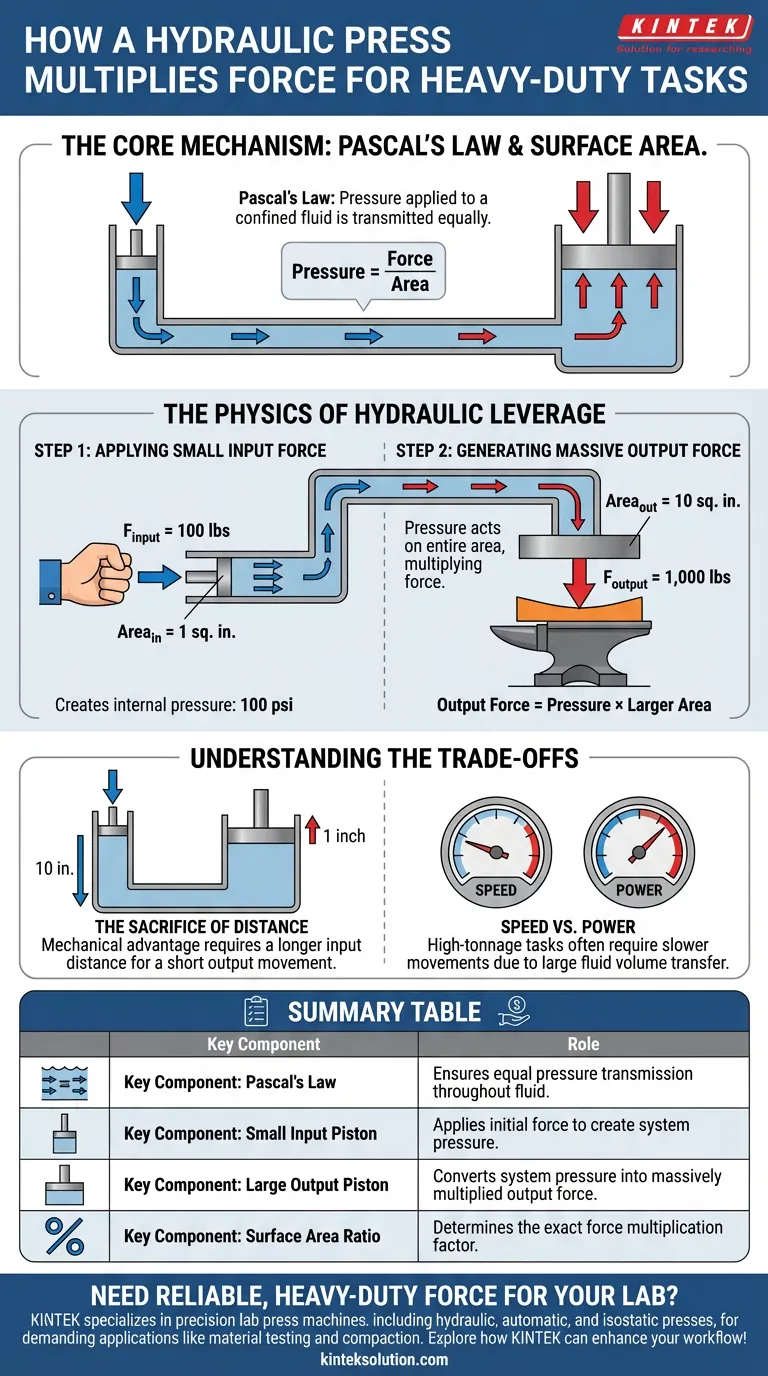
The Core Mechanism: The system relies on Pascal’s Law, which states that pressure applied to a confined fluid is transmitted equally in all directions. By maintaining constant pressure but increasing the surface area where that pressure acts, the press transforms a modest input effort into a multi-ton compressive force.
The Physics of Hydraulic Leverage
To understand how a press turns a small movement into heavy-duty power, you must look at the interplay between the fluid and the pistons.
The Foundation: Pascal’s Law
The operation is governed by a principle of fluid mechanics known as Pascal's Law.
It states that any pressure change occurring in a confined incompressible fluid (like hydraulic oil) is transmitted undiminished throughout the fluid.
This means the pressure intensity established at the pump is exactly the same as the pressure intensity arriving at the main cylinder.
The Surface Area Differential
The actual multiplication of force occurs because of the size difference between the input and output cylinders.
Pressure is defined as Force divided by Area.
If you apply pressure to a large piston with a massive surface area, the total force generated is the pressure multiplied by that entire area.
A Practical Example
Imagine the input piston has an area of 1 square inch, and the output piston has an area of 10 square inches.
If you apply 100 pounds of force to the small piston, you generate 100 psi (pounds per square inch) of pressure.
When that 100 psi reaches the larger 10-square-inch piston, it pushes against every single square inch, resulting in a total output force of 1,000 pounds.
Driving the Anvil
This magnified force drives the press's ram or anvil downward.
The hydraulic cylinder extends, forcing the anvil onto the workpiece with the accumulated tonnage.
This allows the machine to easily perform tasks like compacting, metal forming, or shearing that would be impossible with manual force.
Understanding the Trade-offs
While a hydraulic press seems to generate "free" energy, it strictly adheres to the laws of physics. Gaining force requires a sacrifice elsewhere.
The Sacrifice of Distance
Mechanical advantage always requires a trade-off between force and distance.
To move the large, heavy-duty piston a very short distance, the small input piston must move a much longer distance.
Using the previous example: to move the large piston up by 1 inch, you might need to push the small piston down by 10 inches.
Speed vs. Power
Because of the fluid volume required to move the large piston, these presses can operate slowly.
The pump must move a significant volume of fluid from the small reservoir to fill the expanding cavity of the large cylinder.
High-tonnage tasks generally require slower, deliberate movements to allow this fluid transfer to generate the necessary pressure.
Making the Right Choice for Your Goal
When evaluating hydraulic systems for a specific task, understanding the relationship between the pump (input) and the cylinder (output) is vital.
- If your primary focus is maximum crushing power: Prioritize a system with a high ratio between the master cylinder (input) and the slave cylinder (output) to maximize force multiplication.
- If your primary focus is speed and efficiency: Look for a system with a higher flow rate pump, acknowledging that you may need a larger motor to maintain high pressure at higher speeds.
The hydraulic press demonstrates that you do not need massive input energy to do heavy work, provided you have the mechanical advantage of surface area on your side.
Summary Table:
| Key Component | Role in Force Multiplication |
|---|---|
| Pascal's Law | Ensures pressure is transmitted equally throughout the confined hydraulic fluid. |
| Small Input Piston | Applies initial force to create system pressure. |
| Large Output Piston | Converts the system pressure into a massively multiplied output force. |
| Surface Area Ratio | The ratio of the piston areas determines the exact multiplication factor of the force. |
Need reliable, heavy-duty force for your lab?
KINTEK specializes in precision lab press machines, including hydraulic presses, designed to deliver the consistent, high-tonnage force required for demanding applications like material testing, compaction, and sample preparation. Our automatic lab presses, isostatic presses, and heated lab presses are engineered for accuracy and durability, serving the exacting needs of laboratories worldwide.
Explore how a KINTEK lab press can enhance your workflow and results. Contact our experts today for a personalized solution!
Visual Guide
Related Products
- Automatic High Temperature Heated Hydraulic Press Machine with Heated Plates for Lab
- Manual Heated Hydraulic Lab Press with Integrated Hot Plates Hydraulic Press Machine
- Heated Hydraulic Press Machine with Heated Plates for Vacuum Box Laboratory Hot Press
- Laboratory Hydraulic Press 2T Lab Pellet Press for KBR FTIR
- Laboratory Hydraulic Press Lab Pellet Press Machine for Glove Box
People Also Ask
- Function of a Laboratory Hydraulic Press with Heated Platens in SSE? Enhance Battery Density & Conductivity
- What are the requirements for electrode pressing with high-viscosity ionic liquids like EMIM TFSI? Optimize Performance
- How does a laboratory heated hydraulic press facilitate PBN sample prep for WAXS? Achieve Precise X-Ray Scattering
- What are the industrial applications of heated hydraulic presses? Master Heat & Force for Precision Manufacturing
- Why is a laboratory hydraulic press with heating plates required for PLA/TEC films? Achieve Precise Sample Integrity



















