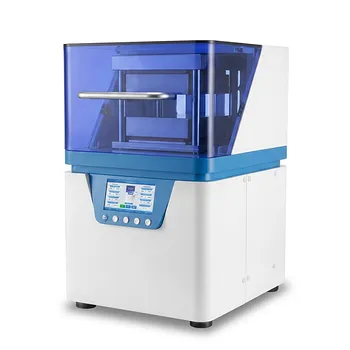
The electrically heated plate press facilitates SBR nanocomposite production by providing the simultaneous thermal energy and mechanical pressure required to transform raw rubber into a cross-linked elastomer. This equipment maintains a stable environment—often around 160°C—within steel molds to trigger vulcanizing agents like sulfur or dicumyl peroxide. The result is a chemically stable, three-dimensional molecular network that defines the final physical and thermal properties of the material.
The core function of the plate press is to provide precise, uniform control over the physical variables that drive chemical cross-linking. By balancing heat and hydraulic pressure, the press ensures the SBR matrix achieves maximum structural density and dimensional accuracy.
The Role of Thermal Energy in Vulcanization
Activating the Chemical Cross-linking Process
The primary function of the electrical heating elements is to raise the temperature of the SBR compound to a specific activation threshold. This heat triggers the vulcanizing agents, such as dicumyl peroxide or sulfur, which initiate the formation of bridges between rubber molecular chains.
Ensuring a Uniform Thermal Field
High-precision presses maintain a stable thermal field across the entire plate surface to prevent localized under-curing or over-curing. This uniformity is critical for nanocomposites, as it ensures that the cross-linking density is consistent throughout the material matrix.
Defining the Transformation to Elastomer
Under sustained high temperatures, the SBR compound undergoes a transition from a plasticized state to a three-dimensional network structure. This chemical transformation is what imparts elasticity, high strength, and thermal resistance to the finished nanocomposite.
The Impact of Hydraulic Pressure on Molding
Eliminating Internal Voids and Air Bubbles
The continuous application of high pressure (often reaching 1500 psi) forces air out of the rubber mixture. By eliminating internal bubbles, the press ensures the production of a dense specimen that is free from structural defects.
Achieving High Structural Density
Pressure ensures that the SBR matrix and the nano-fillers are tightly packed, which is essential for the material's mechanical integrity. This high structural density is a prerequisite for accurate testing of properties like flame retardancy and tensile strength.
Facilitating Precision Molding
When the SBR is placed in steel molds, the pressure forces the material to conform exactly to the mold's geometry. This results in standardized test samples with low surface roughness and precise dimensions, such as the 50 x 10 x 4 mm specimens required for oxygen index testing.
Understanding the Trade-offs and Pitfalls
The Risk of Thermal Degradation
While heat is necessary for vulcanization, excessive exposure or uneven temperature spikes can lead to thermal degradation. If the temperature is too high or the duration too long, the SBR molecular chains may begin to break down, compromising the nanocomposite's mechanical properties.
Pressure Imbalances and Dimensional Flaws
If the hydraulic pressure is not uniform across the plates, the resulting samples may exhibit variable thickness or internal stresses. These inconsistencies can lead to skewed results during performance testing, particularly in high-precision laboratory environments.
Vulcanization Time Sensitivity
Determining the ideal vulcanization time is a delicate balance; under-curing leaves the material tacky and weak, while over-curing makes it brittle. The press must provide highly repeatable cycles to ensure that every batch of SBR nanocomposite meets the same quality standards.
How to Apply This to Your Project
To achieve the best results with SBR nanocomposites, your approach to using a plate press should align with your specific material requirements and testing goals.
- If your primary focus is Dimensional Accuracy: Utilize high-grade steel molds and maintain maximum hydraulic pressure to ensure the SBR conforms perfectly to the required geometry with zero internal voids.
- If your primary focus is Thermal Stability: Prioritize a press with a high-precision thermal field to ensure uniform cross-linking, which is vital for the material’s performance in high-temperature environments.
- If your primary focus is Standardized Testing: Carefully calibrate the vulcanization time and temperature (e.g., 160°C) to produce specimens with low surface roughness and stable spatial cross-linking density.
By mastering the interplay of temperature and pressure, you can ensure that SBR nanocomposites reach their full potential for structural integrity and high-performance applications.
Summary Table:
| Process Variable | Role in Vulcanization/Molding | Benefit to SBR Nanocomposite |
|---|---|---|
| Thermal Energy | Activates vulcanizing agents (Peroxide/Sulfur) | Forms a stable 3D molecular network |
| Hydraulic Pressure | Eliminates internal air bubbles and voids | Ensures high structural density and strength |
| Thermal Uniformity | Prevents localized under-curing or over-curing | Ensures consistent cross-linking density |
| Steel Molds | Defines specimen geometry and dimensions | Produces standardized, low-roughness samples |
Transform Your Polymer Research with KINTEK
Achieve the highest standards of structural integrity in your SBR nanocomposites with KINTEK’s comprehensive laboratory pressing solutions. Specifically designed to meet the rigorous demands of battery research and advanced materials science, our equipment provides the precise thermal and mechanical control necessary for perfect vulcanization.
Our value to your laboratory:
- Diverse Equipment Range: From manual and automatic to heated and multifunctional models.
- Specialized Applications: Glovebox-compatible designs and both cold and warm isostatic presses.
- Precision Performance: Maintain stable thermal fields and high hydraulic pressure for defect-free specimens.
Ready to enhance your lab's efficiency and sample accuracy? Contact our experts at KINTEK today to find the perfect pressing solution for your project!
References
- Przemysław Rybiński, Agnieszka Katarzyna Pająk. Thermal stability and flammability of butadiene–styrene rubber nanocomposites. DOI: 10.1007/s10973-012-2498-9
This article is also based on technical information from Kintek Solution Knowledge Base .
Related Products
- Automatic High Temperature Heated Hydraulic Press Machine with Heated Plates for Lab
- Automatic Heated Hydraulic Press Machine with Hot Plates for Laboratory
- Automatic Heated Hydraulic Press Machine with Heated Plates for Laboratory
- Cylindrical Lab Electric Heating Press Mold for Laboratory Use
- Automatic Hydraulic Hot Press with Large Plate and Precision Temperature Control for Advanced Material Sample Preparation and Industrial Research
People Also Ask
- What are the requirements for electrode pressing with high-viscosity ionic liquids like EMIM TFSI? Optimize Performance
- What are the primary functions of a hydraulic press with heated platens in TP-RTM? Master Composite Manufacturing
- Why is a heated laboratory hydraulic press necessary for PVC test specimens? Ensure Precise Tensile & Rheology Data
- Why is a laboratory hydraulic press with heating plates required for PLA/TEC films? Achieve Precise Sample Integrity
- How does a laboratory heated hydraulic press facilitate PBN sample prep for WAXS? Achieve Precise X-Ray Scattering