
The application of pressure is the decisive variable determining the structural integrity and analytical utility of a pressed pellet. If you apply insufficient force, the resulting pellet will be loose and porous, compromising its stability; conversely, excessive force introduces internal stress that causes the pellet to crack or shatter.
Achieving high-quality pellets requires finding a "Goldilocks" zone of pressure—typically between 15 and 20 tons—where the sample binds firmly without accumulating destructive internal stress. This balance is essential for ensuring accurate, repeatable analytical results.
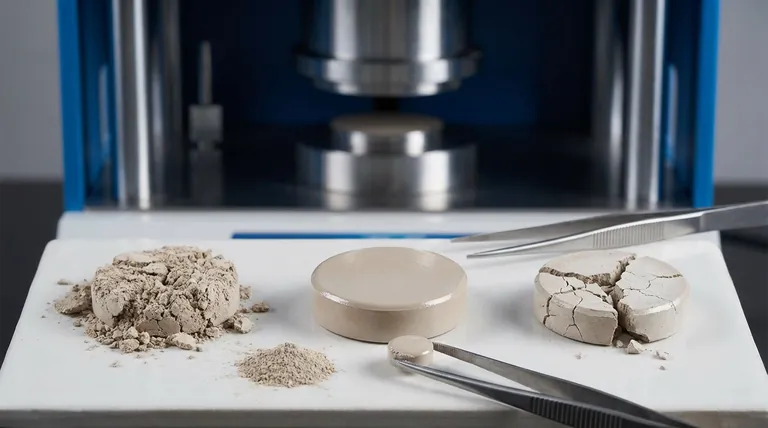
The Mechanics of Pressure Application
The Consequence of Insufficient Force
When the pressure applied is too low, the particles within the sample fail to pack together tightly.
This results in a loose and porous pellet that lacks the physical cohesion necessary for handling or analysis.
Porous surfaces can also negatively impact analytical sensitivity, leading to inconsistent data readings.
The Dangers of Excessive Force
It is a common misconception that more pressure always equals a better pellet.
Applying too much pressure creates stored elastic energy within the sample.
When the load is removed, this internal stress is released, causing the pellet to crack, cap, or completely shatter.
Identifying the Optimal Range
For the majority of sample types, there is a standard pressure window that yields the best results.
The optimal pressure typically ranges from 15 to 20 tons, depending on the specific equipment and sample material.
Staying within this range generally ensures the pellet is dense enough to hold together but not so stressed that it fractures.
Understanding the Trade-offs
Pressure Cannot Fix Poor Preparation
While pressure is critical, it cannot compensate for other preparation errors.
Factors such as particle size and binder choice are equally important to the final quality of the pellet.
If your powder is too coarse or the dilution ratio is incorrect, even the perfect amount of pressure will fail to produce a viable sample.
The Risk of Cross-Contamination
High-pressure environments can increase the risk of material adhering to the die set.
If the die is not cleaned thoroughly between pressings, sample-to-sample cross-contamination will occur.
This renders the pellet useless for high-sensitivity trace analysis, regardless of its structural quality.
Making the Right Choice for Your Goal
To consistently produce high-quality pellets, you must view pressure as one part of a holistic preparation strategy.
- If your primary focus is Structural Integrity: Target a pressure range of 15 to 20 tons to balance density with stress relief.
- If your primary focus is Sample Consistency: Standardize your particle size and binder ratio before adjusting the pressure settings.
Precision in pressure application converts a loose powder into a reliable analytical standard.
Summary Table:
| Pressure Level | Effect on Pellet Quality | Result |
|---|---|---|
| Too Low (<15 tons) | Insufficient particle bonding | Loose, porous pellet; poor stability and inconsistent data |
| Optimal (15-20 tons) | Balanced density and stress relief | Dense, cohesive pellet; ideal for accurate analysis |
| Too High (>20 tons) | High internal stress buildup | Cracked or shattered pellet; sample destruction |
Ready to achieve perfect pellets and reliable analytical results every time?
KINTEK specializes in high-performance lab press machines, including automatic lab presses, isostatic presses, and heated lab presses, designed to deliver the precise pressure control your laboratory demands. Our equipment helps you consistently produce high-integrity pellets, eliminating the guesswork and ensuring your sample preparation supports accurate, repeatable analysis.
Contact our experts today to find the ideal lab press for your specific application and enhance your sample preparation workflow.
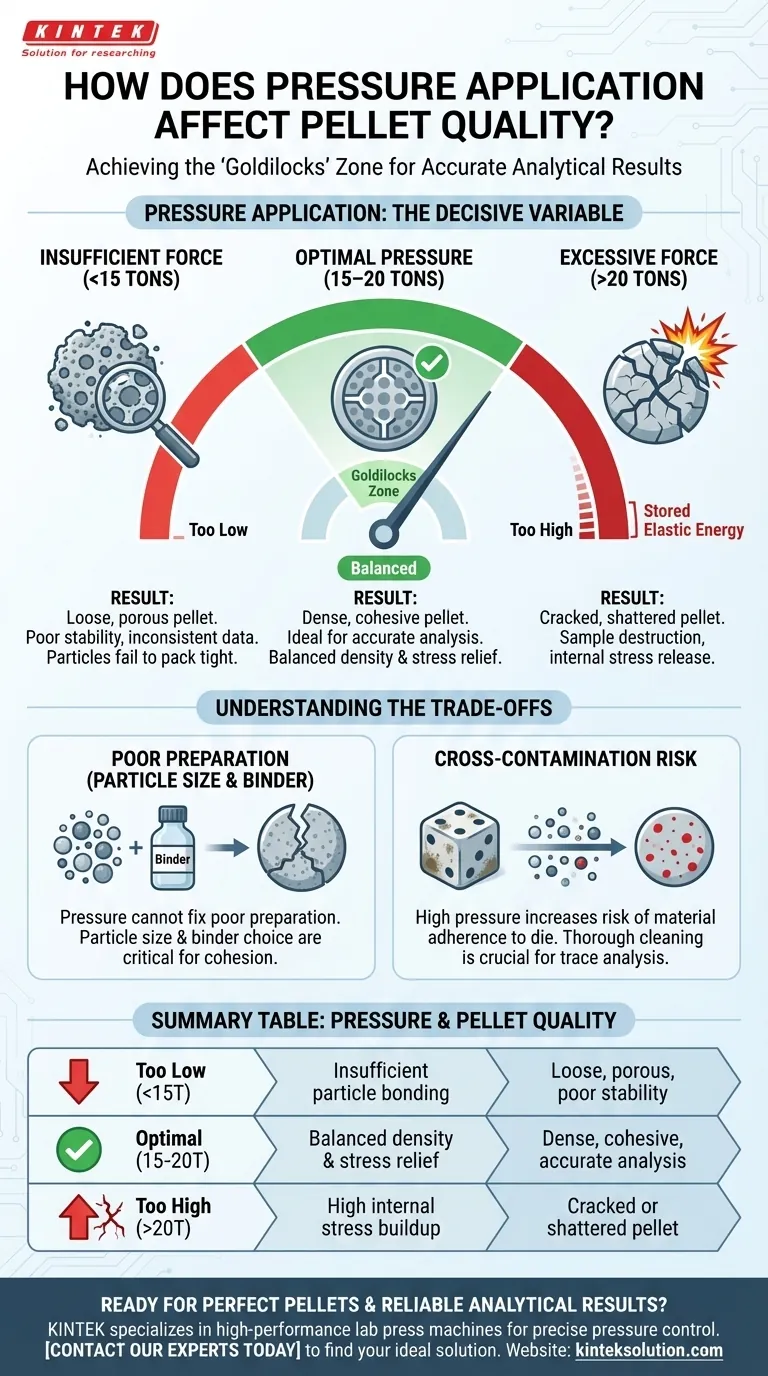
Visual Guide
Related Products
- Laboratory Hydraulic Press 2T Lab Pellet Press for KBR FTIR
- Automatic Laboratory Hydraulic Press Lab Pellet Press Machine
- Manual Laboratory Hydraulic Pellet Press Lab Hydraulic Press
- Automatic Laboratory Hydraulic Press for XRF and KBR Pellet Pressing
- Laboratory Hydraulic Pellet Press for XRF KBR FTIR Lab Press
People Also Ask
- What is the role of a laboratory pressure machine and KBr in FTIR? Master Sample Preparation for Flame Retardants
- What is the role of a laboratory hydraulic press in high-loading NCM811 cathode prep for solid-state batteries?
- Why is a laboratory hydraulic press necessary for sample preparation? Precise Pelleting for Spiro Heterocyclic Analysis
- What role does a laboratory hydraulic press play in reaction pellets? Optimizing Lunar Soil and Metal Fuel Density
- What role does a laboratory hydraulic press play in perovskite R&D? Essential for High-Density Material Synthesis


















