
The addition of high-strength polyester fibers creates a composite material that fundamentally resolves the inherent brittleness of Li6PS5Cl ceramic electrolytes. When combined with hot pressing, these fibers form a reinforcing skeleton that inhibits crack propagation, resulting in a mechanically robust pellet capable of being processed into ultra-thin films without fracturing.
By integrating a fibrous structural network within the ceramic matrix during the hot-pressing stage, you can produce self-supporting electrolyte films less than 100 micrometers thick that possess the durability required to withstand real-world operational stresses.
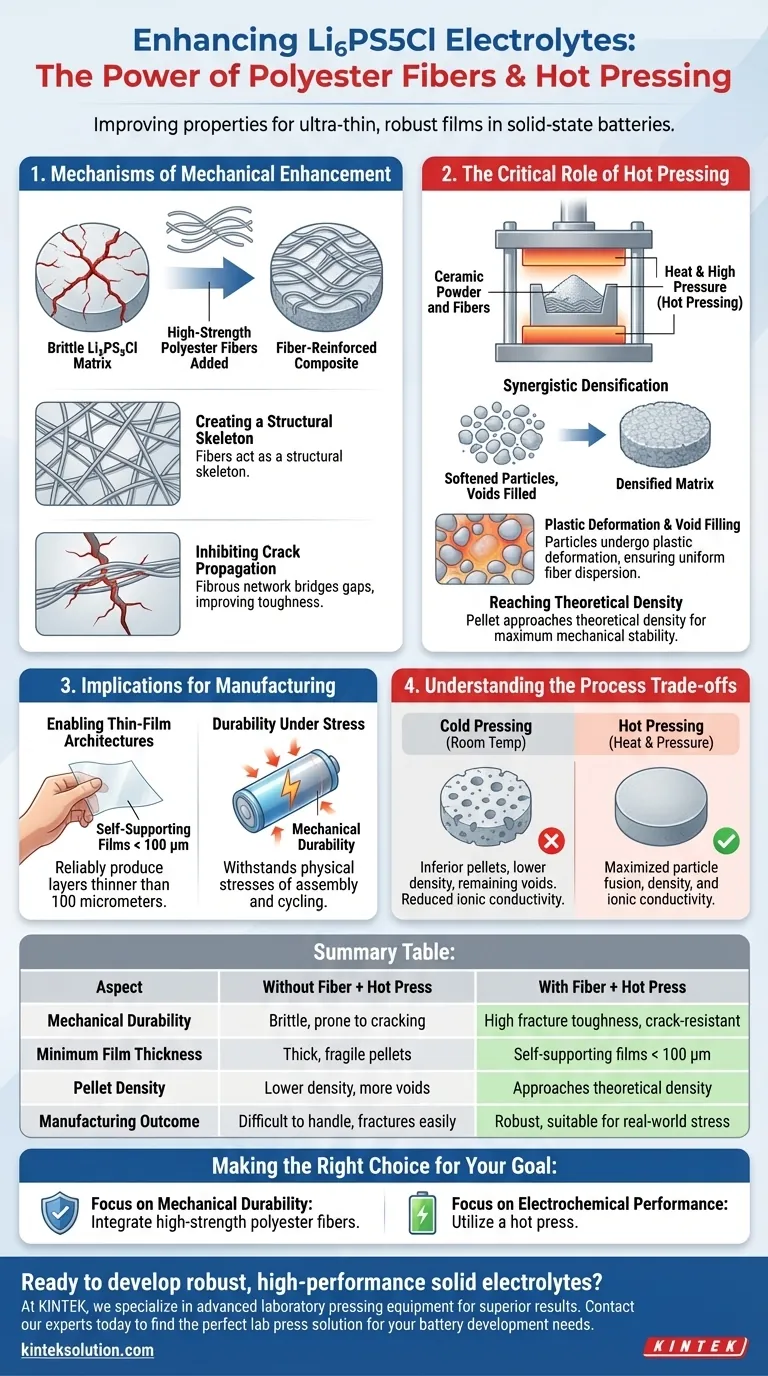
Mechanisms of Mechanical Enhancement
Creating a Structural Skeleton
The primary function of polyester fibers within the Li6PS5Cl matrix is to act as a structural skeleton. Because the ceramic material is naturally brittle, it is prone to catastrophic failure under stress.
Inhibiting Crack Propagation
This fibrous network effectively inhibits the formation and spread of cracks. Instead of a fracture traveling cleanly through the ceramic, the fibers bridge the gaps, dramatically improving both compressive strength and fracture toughness.
The Critical Role of Hot Pressing
Synergistic Densification
While fibers provide structure, the hot pressing process is essential for matrix integrity. Applying heat alongside high pressure softens the surface of the ceramic powder particles.
Plastic Deformation and Void Filling
This thermal softening allows the particles to undergo plastic deformation more easily than they would at room temperature. The particles fuse together effectively, filling voids and ensuring the fibers are uniformly dispersed within a dense ceramic matrix.
Reaching Theoretical Density
The result of this process is an electrolyte pellet that approaches its theoretical density. This high density is crucial for maximizing the mechanical stability provided by the fibers.
Implications for Manufacturing
Enabling Thin-Film Architectures
The combined strength and toughness allow for the production of self-supporting electrolyte films. Manufacturers can reliably produce layers thinner than 100 micrometers, a critical threshold for high-energy-density batteries.
Durability Under Stress
These reinforced films are not just easier to handle during assembly; they possess the mechanical durability to withstand the physical stresses of battery operation and cycling.
Understanding the Process Trade-offs
The Limitations of Cold Pressing
It is important to note that adding fibers alone is insufficient if the processing method is flawed. Relying on room-temperature cold pressing often results in inferior pellets with lower density and remaining voids.
Performance Dependencies
Without the heat induced by hot pressing, the ceramic particles do not fuse completely. This leads to reduced ionic conductivity and cycling performance, undermining the mechanical benefits introduced by the fibers.
Making the Right Choice for Your Goal
To optimize your solid-state electrolyte fabrication, consider your primary constraints:
- If your primary focus is mechanical durability: Integrate high-strength polyester fibers to act as a crack-inhibiting skeleton, enabling the creation of tough, self-supporting films.
- If your primary focus is electrochemical performance: Ensure you utilize a hot press rather than a cold press to maximize particle fusion, density, and ionic conductivity.
By simultaneously leveraging fiber reinforcement and thermal densification, you can engineer a solid electrolyte that balances structural integrity with high-performance ion transport.
Summary Table:
| Aspect | Without Fiber + Hot Press | With Fiber + Hot Press |
|---|---|---|
| Mechanical Durability | Brittle, prone to cracking | High fracture toughness, crack-resistant |
| Minimum Film Thickness | Thick, fragile pellets | Self-supporting films < 100 µm |
| Pellet Density | Lower density, more voids | Approaches theoretical density |
| Manufacturing Outcome | Difficult to handle, fractures easily | Robust, suitable for real-world stress |
Ready to develop robust, high-performance solid electrolytes?
At KINTEK, we specialize in providing the advanced laboratory pressing equipment you need to achieve superior results. Our heated lab presses and isostatic presses are engineered to deliver the precise combination of heat and pressure critical for densifying composite materials like fiber-reinforced Li6PS5Cl, ensuring maximum ionic conductivity and mechanical strength in your final product.
Let us help you optimize your R&D and manufacturing process. Contact our experts today to find the perfect lab press solution for your battery development needs.
Visual Guide
Related Products
- Automatic High Temperature Heated Hydraulic Press Machine with Heated Plates for Lab
- Heated Hydraulic Press Machine with Heated Plates for Vacuum Box Laboratory Hot Press
- Automatic Heated Hydraulic Press Machine with Hot Plates for Laboratory
- Heated Hydraulic Press Machine With Heated Plates For Vacuum Box Laboratory Hot Press
- Laboratory Manual Heated Hydraulic Press Machine with Hot Plates
People Also Ask
- Function of a Laboratory Hydraulic Press with Heated Platens in SSE? Enhance Battery Density & Conductivity
- What are the requirements for electrode pressing with high-viscosity ionic liquids like EMIM TFSI? Optimize Performance
- How does a laboratory heated hydraulic press facilitate PBN sample prep for WAXS? Achieve Precise X-Ray Scattering
- What are the industrial applications of heated hydraulic presses? Master Heat & Force for Precision Manufacturing
- Why is a laboratory hydraulic press with heating plates required for PLA/TEC films? Achieve Precise Sample Integrity



















