
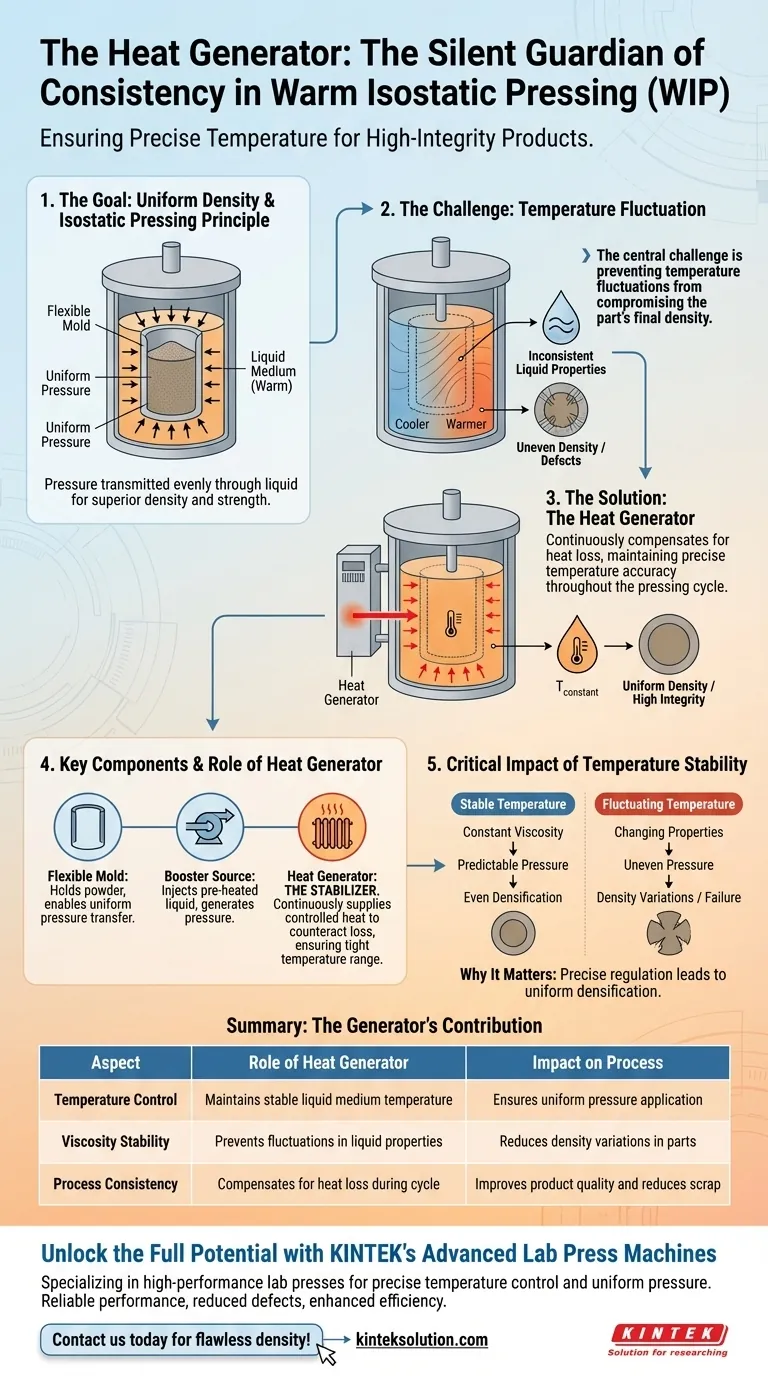
The heat generator is the silent guardian of consistency in the Warm Isostatic Pressing (WIP) process. Its primary function is not just to create heat, but to maintain the precise temperature accuracy of the liquid medium throughout the entire pressing cycle. By continuously compensating for heat loss, it ensures that the pressure applied to the powder is perfectly uniform, which is critical for producing a high-integrity final product.
The central challenge in Warm Isostatic Pressing is preventing temperature fluctuations in the liquid medium from compromising the part's final density. The heat generator directly solves this by ensuring the liquid's properties remain constant, guaranteeing uniform pressure application from start to finish.
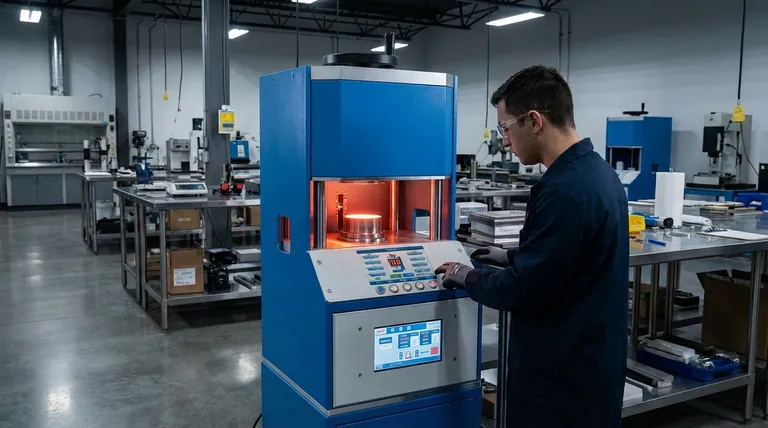
Understanding the Goal: Uniform Density
The Principle of Isostatic Pressing
Isostatic pressing works by placing a powdered material inside a flexible mold. This mold is then submerged in a liquid medium, and immense pressure is applied to the liquid.
Because the pressure is transmitted evenly through the liquid, it acts on the powder from all directions simultaneously. This eliminates voids and air pockets, resulting in a product with superior density, strength, and dimensional accuracy.
The Role of the Liquid Medium
The liquid, typically water or a specialized oil, is the pressure-transmitting medium. Its physical properties, especially its viscosity, directly influence how effectively and uniformly that pressure is transferred to the flexible mold.
The Importance of "Warm" Pressing
The "Warm" in WIP refers to heating the liquid medium to a specific temperature, often to achieve an optimal viscosity. A consistent viscosity is essential for predictable and even pressure application.
The Key Components of the WIP System
The WIP process relies on several components working in concert. Understanding each role clarifies the unique contribution of the heat generator.
The Flexible Mold
The flexible mold, or envelope die, is what holds the powder. Its flexibility is key, as it allows the hydraulic pressure from the liquid to be applied uniformly to the entire surface of the powder compact.
The Booster Source
After the liquid is heated, the booster source is responsible for injecting it into the sealed pressing chamber. It generates and maintains the required pressure and flow rate to fill the chamber and compress the part efficiently.
The Heat Generator: The Stabilizer
While the liquid is pre-heated before injection, the system naturally loses heat to the surrounding environment and machinery during the pressing cycle. The heat generator's job is to counteract this loss.
It continuously supplies a controlled amount of heat to the liquid medium, ensuring the temperature stays within a very tight, pre-defined range throughout the process.
The Critical Impact of Temperature Stability
Failing to maintain a stable temperature has direct and negative consequences on the quality of the final part.
Why Constant Temperature Matters
A stable temperature ensures the liquid medium's viscosity remains constant. When viscosity is constant, the pressure transfer is perfectly uniform and predictable. This leads to even densification of the powdered material.
The Consequence of Fluctuation
If the temperature drops, the liquid's properties change. This can lead to uneven pressure distribution across the part's surface.
Such inconsistencies create variations in density, introduce internal stresses, and can ultimately result in a weak or failed component that must be scrapped.
How the Generator Prevents Failure
The heat generator acts as a precision regulator. By constantly monitoring and adjusting the heat supplied to the medium, it guarantees that the conditions at the end of the pressing cycle are identical to the conditions at the beginning, ensuring uniformity.
Applying This to Your Process
Your specific goals will determine where you focus your attention regarding the system's thermal management.
- If your primary focus is product quality and consistency: Your top priority is verifying that the heat generator can maintain the liquid's temperature within the narrow specified range for the entire duration of the press cycle.
- If your primary focus is process optimization: Ensure the initial heating of the liquid is efficient, allowing the heat generator to focus solely on maintaining temperature rather than performing the bulk heating, which improves cycle times.
- If your primary focus is troubleshooting defects: Unexplained variations in part density should immediately lead you to investigate the performance and accuracy of the heat generator and its control system.
Ultimately, mastering the thermal dynamics of the process via the heat generator is fundamental to unlocking the full potential of Warm Isostatic Pressing.
Summary Table:
| Aspect | Role of Heat Generator | Impact on Process |
|---|---|---|
| Temperature Control | Maintains stable liquid medium temperature | Ensures uniform pressure application |
| Viscosity Stability | Prevents fluctuations in liquid properties | Reduces density variations in parts |
| Process Consistency | Compensates for heat loss during cycle | Improves product quality and reduces scrap |
Unlock the Full Potential of Your Laboratory with KINTEK's Advanced Lab Press Machines
Struggling with inconsistent results in your material processing? KINTEK specializes in high-performance lab press machines, including automatic lab presses, isostatic presses, and heated lab presses designed to deliver precise temperature control and uniform pressure for superior outcomes. Our equipment ensures reliable performance, reduces defects, and enhances efficiency in your research or production workflows.
Ready to achieve flawless density and quality in your materials? Contact us today to discuss how our solutions can meet your specific laboratory needs and drive your success!
Visual Guide
Related Products
- Warm Isostatic Press for Solid State Battery Research Warm Isostatic Press
- Electric Lab Cold Isostatic Press CIP Machine
- Automatic Lab Cold Isostatic Pressing CIP Machine
- Manual Cold Isostatic Pressing CIP Machine Pellet Press
- Electric Split Lab Cold Isostatic Pressing CIP Machine
People Also Ask
- Why must composite cathodes be sealed in vacuum lamination bags for WIP? Ensure Battery Stability and Density
- How do sacrificial volume materials (SVM) maintain microchannels in isostatic pressing? Ensure Structural Integrity
- What is the function of elastic molds in warm isostatic pressing? Achieve Uniform Density in Composite Particles
- What is the process involved in warm isostatic pressing? Mastering Uniform Density with WIP Technology
- What are the advantages of using a Warm Isostatic Press (WIP) for batteries? Achieve Superior Interface Contact



















