
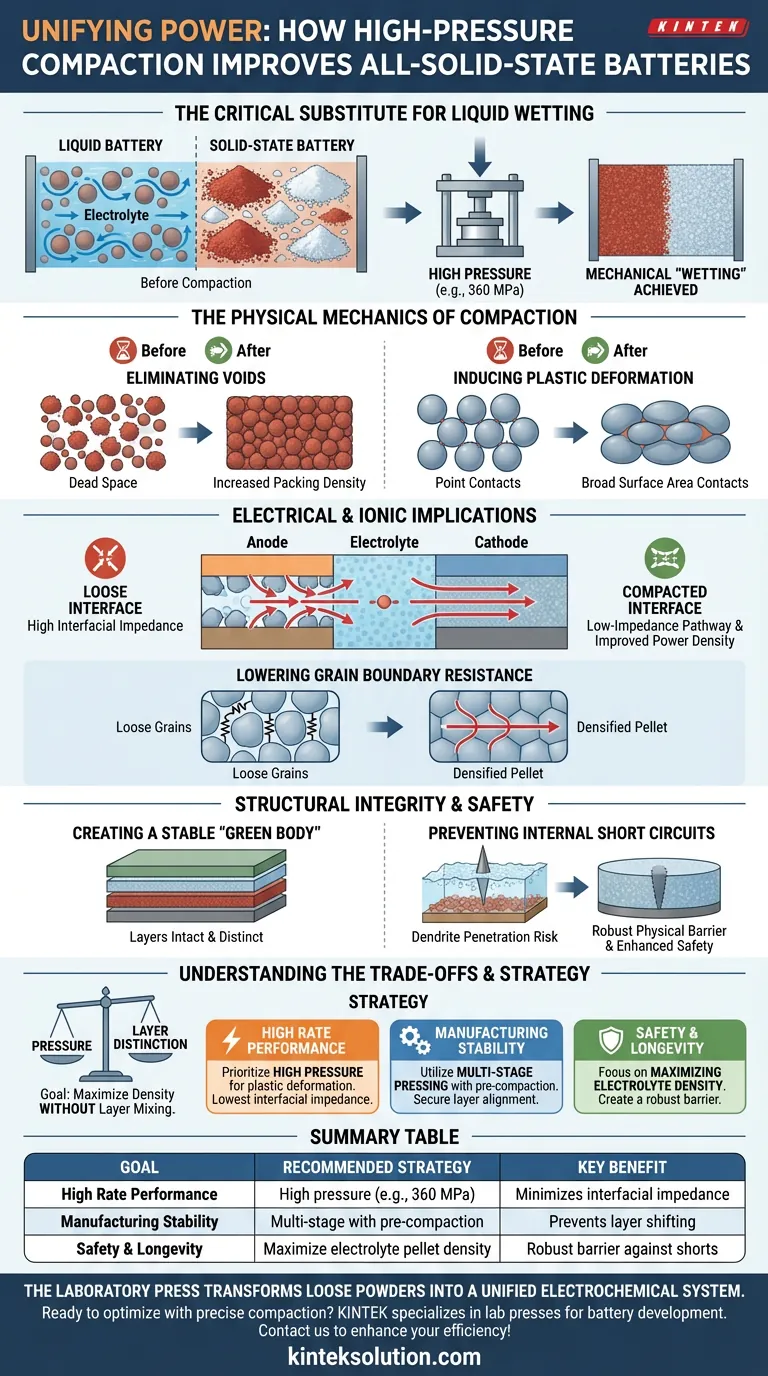
High-pressure compaction acts as the critical physical substitute for liquid wetting in all-solid-state batteries. By applying significant force via a laboratory press, you mechanically eliminate voids and induce plastic deformation in the materials, creating the continuous, solid-to-solid contact required for ions to move.
The Core Insight In liquid batteries, the electrolyte naturally wets the electrode surfaces to facilitate ion flow. In solid-state batteries, this "wetting" must be mechanically engineered through high-pressure compaction, which densifies components to minimize resistance and unlock high rate performance.
The Physical Mechanics of Compaction
Eliminating Microscopic Voids
The primary adversary in solid-state batteries is "dead space." Without compaction, gaps exist between powder particles where ions cannot travel.
A laboratory press physically squeezes these voids out of existence. This increases the overall packing density of the battery components, ensuring that the active material and electrolyte are not just touching, but are structurally integrated.
Inducing Plastic Deformation
Mere contact is often insufficient; the materials must conform to one another. High pressure (e.g., 360 MPa) forces the solid electrolyte and cathode materials to undergo plastic deformation.
This deformation flattens the particles against each other, turning point contacts into broad surface area contacts. This creates a seamless, cohesive interface that mimics the continuity of a liquid system.
Electrical and Ionic Implications
Reducing Interfacial Impedance
The interface between the electrode and the solid electrolyte is where resistance is typically highest. If this interface is loose or porous, the battery suffers from high impedance.
Compaction minimizes this interfacial resistance. By creating a tight, continuous bond between layers, the press establishes a low-impedance pathway that allows for the rapid transport of ions, directly improving power density.
Lowering Grain Boundary Resistance
Resistance also occurs within the electrolyte layer itself, between individual grains of powder.
By densifying the powder into a solid pellet (such as with Li10GeP2S12/LGPS), the press reduces grain boundary resistance. This ensures that the electrolyte layer functions as a unified conductor rather than a collection of loose particles.
Structural Integrity and Safety
Creating a Stable "Green Body"
Before final sintering, materials are often "pre-compacted" to create a green body. This step increases density and prevents the layers from mixing or shifting during handling.
This mechanical stability is crucial for manufacturing, ensuring that the defined layers of anode, electrolyte, and cathode remain distinct and intact throughout the assembly process.
Preventing Internal Short Circuits
A loose or poorly compacted electrolyte structure is prone to dendrite penetration or structural failure.
A highly dense, well-compacted electrolyte pellet acts as a robust physical barrier. This density helps prevent the formation of internal short circuits, significantly enhancing the safety and reliability of the final battery cell.
Understanding the Trade-offs
While pressure is beneficial, the application must be precise. The goal is to achieve maximum density without compromising the structural distinction between layers.
The Risk of Layer Displacement
During the assembly of multi-layer stacks, incorrect pressure application can lead to layer shifting. Pre-compaction steps are specifically designed to lock layers in place to prevent interlayer mixing, which would degrade performance.
Balancing Deformation and Integrity
The pressure must be high enough to deform the material plastically (to remove voids) but controlled enough to maintain the geometry of the cell. The process relies on finding the specific pressure point (e.g., 360 MPa for final assembly vs. lower pressures for pre-compaction) that maximizes contact area while maintaining layer definition.
Making the Right Choice for Your Goal
To optimize your solid-state battery assembly, align your pressing strategy with your specific performance targets:
- If your primary focus is High Rate Performance: Prioritize pressures high enough (e.g., 360 MPa) to induce plastic deformation, ensuring the lowest possible interfacial impedance for rapid ion flow.
- If your primary focus is Manufacturing Stability: Utilize a multi-stage pressing protocol with pre-compaction to secure layer alignment and prevent material shifting before the final high-pressure step.
- If your primary focus is Safety and Longevity: Focus on maximizing the density of the electrolyte pellet to eliminate voids and create a robust barrier against short circuits.
Ultimately, the laboratory press transforms a collection of loose powders into a unified electrochemical system, determining the upper limit of your battery's efficiency.
Summary Table:
| Goal | Recommended Pressing Strategy | Key Benefit |
|---|---|---|
| High Rate Performance | High pressure (e.g., 360 MPa) for plastic deformation | Minimizes interfacial impedance for rapid ion flow |
| Manufacturing Stability | Multi-stage pressing with pre-compaction | Prevents layer shifting and ensures alignment |
| Safety & Longevity | Maximize electrolyte pellet density | Creates a robust barrier against short circuits |
Ready to optimize your solid-state battery research with precise compaction? KINTEK specializes in lab press machines (including automatic, isostatic, and heated lab presses) designed to meet the exacting demands of laboratory-scale battery development. Our equipment delivers the high pressures and controlled force necessary to achieve the dense, low-impedance interfaces critical for your all-solid-state battery performance. Contact us today to discuss how our presses can enhance your efficiency and accelerate your breakthroughs!
Visual Guide
Related Products
- Laboratory Hydraulic Press 2T Lab Pellet Press for KBR FTIR
- Laboratory Hydraulic Press Lab Pellet Press Button Battery Press
- Laboratory Hydraulic Press Lab Pellet Press Machine for Glove Box
- Laboratory Split Manual Heated Hydraulic Press Machine with Hot Plates
- Laboratory Hydraulic Pellet Press for XRF KBR FTIR Lab Press
People Also Ask
- What is the role of a laboratory pressure machine and KBr in FTIR? Master Sample Preparation for Flame Retardants
- What is the role of a laboratory hydraulic press in high-loading NCM811 cathode prep for solid-state batteries?
- What role does a laboratory hydraulic press play in reaction pellets? Optimizing Lunar Soil and Metal Fuel Density
- Why is a laboratory hydraulic press necessary for sample preparation? Precise Pelleting for Spiro Heterocyclic Analysis
- How are hydraulic presses utilized in laboratory settings? Precision Sample Prep & Material Testing Solutions



















