
The hot-pressing process improves interfacial contact by simultaneously applying heat and mechanical pressure to eliminate physical voids between the cathode and the solid-state electrolyte. By softening the polymer binder and forcing material flow, it transforms a loose, porous boundary into a dense, seamless solid-solid interface that drastically lowers resistance.
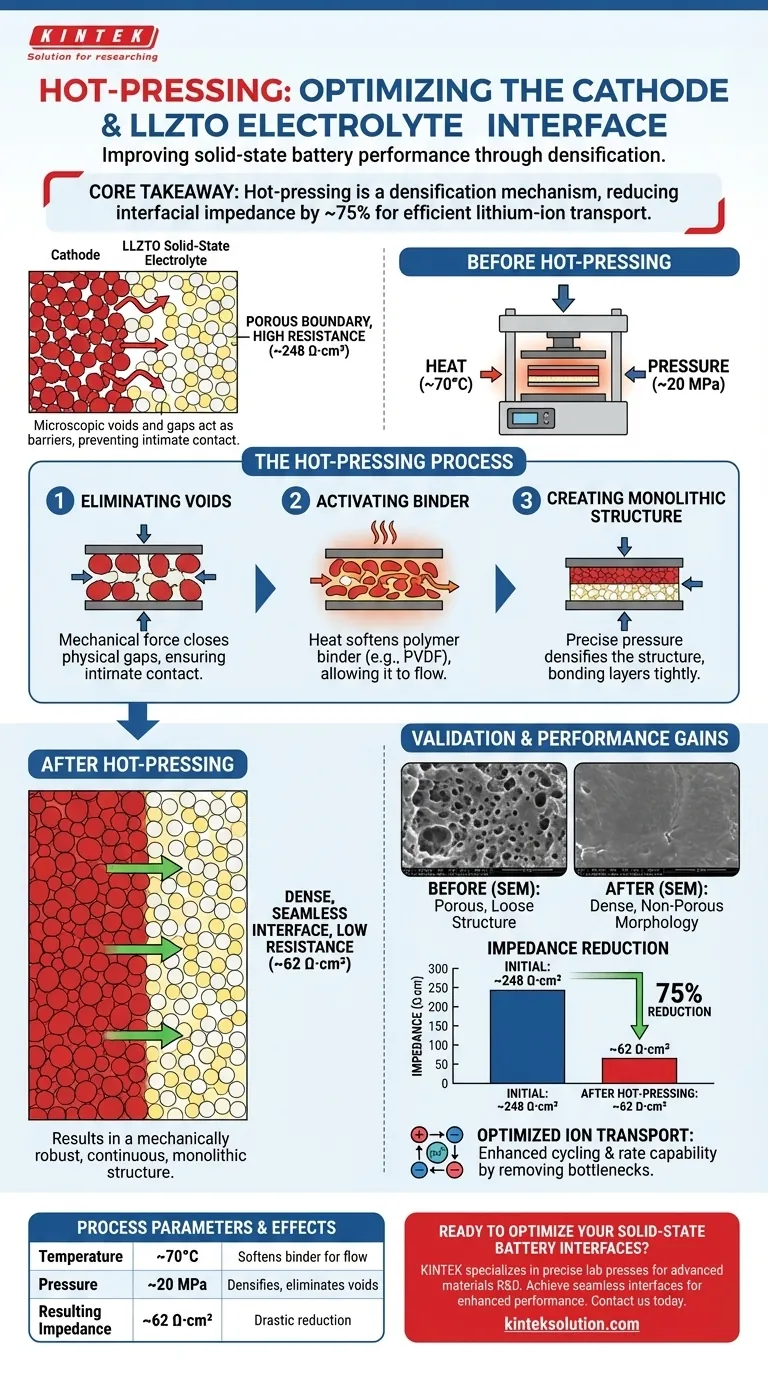
Core Takeaway: The effectiveness of solid-state batteries hinges on minimizing resistance at the junction between layers. Hot-pressing is not merely a bonding step; it is a densification mechanism that reduces interfacial impedance by approximately 75% (from ~248 Ω·cm² to ~62 Ω·cm²), enabling efficient lithium-ion transport.
The Mechanics of Interface Engineering
To understand why this process is essential, one must look at the physical state of the materials before treatment.
Eliminating Microscopic Voids
Initial fabrication steps, such as solvent evaporation, often leave large pores and gaps within the electrolyte membrane.
These physical voids act as barriers to ionic flow. Hot-pressing applies mechanical force to physically close these gaps, ensuring the cathode and electrolyte are in intimate contact rather than merely touching at high points.
Activating the Polymer Binder
Heat is the catalyst for structural rearrangement. By raising the temperature—typically to around 70°C—the process softens the polymer binder (such as PVDF) within the composite.
Once softened, the binder flows more freely. This induced flow allows the polymer to fill the interstices between the LLZTO ceramic fillers, creating a cohesive internal structure.
Creating a Monolithic Structure
Pressure acts as the densifier. Applying precise pressure, often around 20 MPa, forces the softened materials to consolidate.
This transforms the initially loose, porous coated structure into a dense, continuous whole. The result is a mechanically robust "monolithic" structure where the layers are tightly bonded, rather than separate components pressed together.
Quantifiable Performance Gains
The structural changes induced by hot-pressing translate directly into measurable battery performance metrics.
Drastic Impedance Reduction
The primary metric for success is the reduction of interfacial impedance.
References indicate that this process can lower impedance from approximately 248 Ω·cm² down to about 62 Ω·cm². This reduction is critical for minimizing energy loss during battery operation.
Optimized Ion Transport
A seamless interface facilitates the smooth transport of lithium ions.
By removing the physical bottlenecks (voids), the battery achieves enhanced cycling performance and rate capability. The ions can move across the interface without the resistance caused by poor contact points.
Validating the Transformation
Engineers verify the success of the hot-pressing process through direct visual evidence.
Scanning Electron Microscopy (SEM)
The standard for verification is observing the cross-sectional microstructure via SEM.
Comparisons clearly show the transition from a porous, loose structure before treatment to a dense, non-porous morphology afterward. This provides visual proof that voids have been eliminated and particle contact is optimized.
Critical Considerations and Constraints
While highly effective, the hot-pressing process relies on specific processing windows to function correctly.
The Necessity of Precision
The references emphasize the application of "precise" pressure and temperature.
The process is not a blunt instrument; the temperature must be sufficient to soften the specific binder used (e.g., PVDF) without degrading other components. Similarly, pressure must be high enough (e.g., 20 MPa) to densify the material but controlled to maintain structural integrity.
Material Dependencies
The mechanism described relies on the presence of a flowable component, such as a polymer binder.
In the context of LLZTO/PVDF composites, the process works because the binder can be induced to flow and bind the ceramic fillers. Pure ceramic interfaces without a malleable binder would require significantly different processing parameters.
Making the Right Choice for Your Goal
The hot-pressing process is a fundamental step for high-performance solid-state batteries.
- If your primary focus is Maximizing Power Output: Prioritize this process to reduce interfacial impedance (to ~62 Ω·cm²), which directly improves the battery's rate capability.
- If your primary focus is Mechanical Durability: Use this process to densify the composite structure, transforming loose layers into a unified, mechanically strong monolith.
Summary: By eliminating voids and fusing the cathode to the electrolyte, hot-pressing turns a porous potential failure point into a highly efficient, conductive pathway for lithium ions.
Summary Table:
| Process Parameter | Typical Value | Primary Effect |
|---|---|---|
| Temperature | ~70°C | Softens polymer binder (e.g., PVDF) for flow |
| Pressure | ~20 MPa | Densifies material, eliminates voids |
| Resulting Impedance | ~62 Ω·cm² | Drastic reduction from initial ~248 Ω·cm² |
Ready to Optimize Your Solid-State Battery Interfaces?
The hot-pressing process is critical for transforming porous, high-resistance layers into a dense, monolithic structure with drastically lower impedance. Achieving the precise temperature and pressure control required for this densification is key to your battery's performance and durability.
KINTEK specializes in lab press machines, including automatic and heated lab presses, designed to deliver the precise control needed for advanced materials R&D. Our equipment helps researchers like you create seamless solid-solid interfaces for enhanced ion transport and power output.
Contact us today to discuss how our lab press solutions can help you achieve superior interfacial contact and accelerate your solid-state battery development.
Visual Guide
Related Products
- Automatic High Temperature Heated Hydraulic Press Machine with Heated Plates for Lab
- Heated Hydraulic Press Machine with Heated Plates for Vacuum Box Laboratory Hot Press
- Heated Hydraulic Press Machine With Heated Plates For Vacuum Box Laboratory Hot Press
- Automatic Heated Hydraulic Press Machine with Hot Plates for Laboratory
- Laboratory Manual Heated Hydraulic Press Machine with Hot Plates
People Also Ask
- Function of a Laboratory Hydraulic Press with Heated Platens in SSE? Enhance Battery Density & Conductivity
- How does a laboratory heated hydraulic press facilitate PBN sample prep for WAXS? Achieve Precise X-Ray Scattering
- What are the requirements for electrode pressing with high-viscosity ionic liquids like EMIM TFSI? Optimize Performance
- What are the industrial applications of heated hydraulic presses? Master Heat & Force for Precision Manufacturing
- Why is a laboratory hydraulic press with heating plates required for PLA/TEC films? Achieve Precise Sample Integrity



















