
The application of high pressure by a laboratory hydraulic press enhances ionic conductivity primarily by mechanically eliminating voids and maximizing the contact area between particles. This process transforms loose electrolyte powder into a dense, cohesive pellet, creating a continuous physical medium required for efficient ion transport.
Core Takeaway: The press solves the problem of grain boundary resistance. By applying immense pressure (often 350–500 MPa), you force particles into intimate contact—sometimes inducing plastic deformation—which closes the gaps that otherwise act as roadblocks to lithium-ion movement.
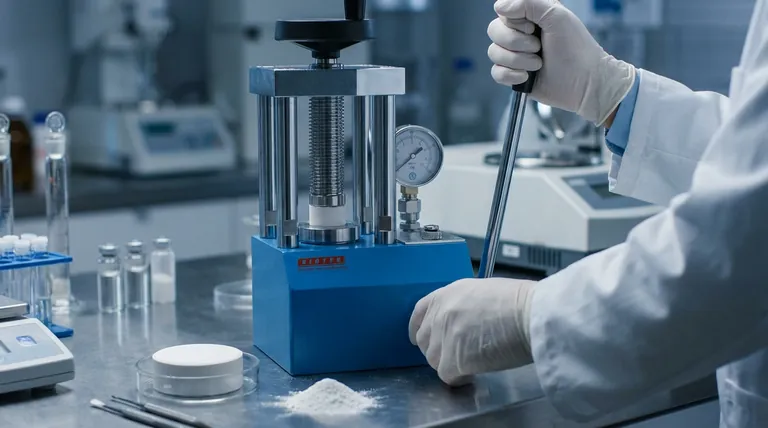
The Mechanism of Densification
Eliminating Voids and Porosity
The primary barrier to conductivity in powder-based electrolytes is the presence of air gaps, or voids, between particles. A hydraulic press significantly diminishes these voids by compacting the loose powder.
Reducing this internal porosity is essential because ions cannot travel through air; they require a solid medium. By increasing the density of the pellet, you ensure the physical volume is occupied by conductive material rather than insulating empty space.
Creating Continuous Ion Pathways
For a battery to function, lithium ions must travel from one side of the electrolyte to the other without interruption. The densification process creates continuous, efficient pathways for these ions to traverse.
Without sufficient compaction, the path is fragmented. High-pressure pressing builds the necessary "bridges" between particles, facilitating smoother transport across the solid-phase interfaces.
Overcoming Interface Resistance
Reducing Grain Boundary Resistance
The interface where two particles meet is known as a grain boundary. In loose powders, the resistance at these boundaries is high, severely throttling performance.
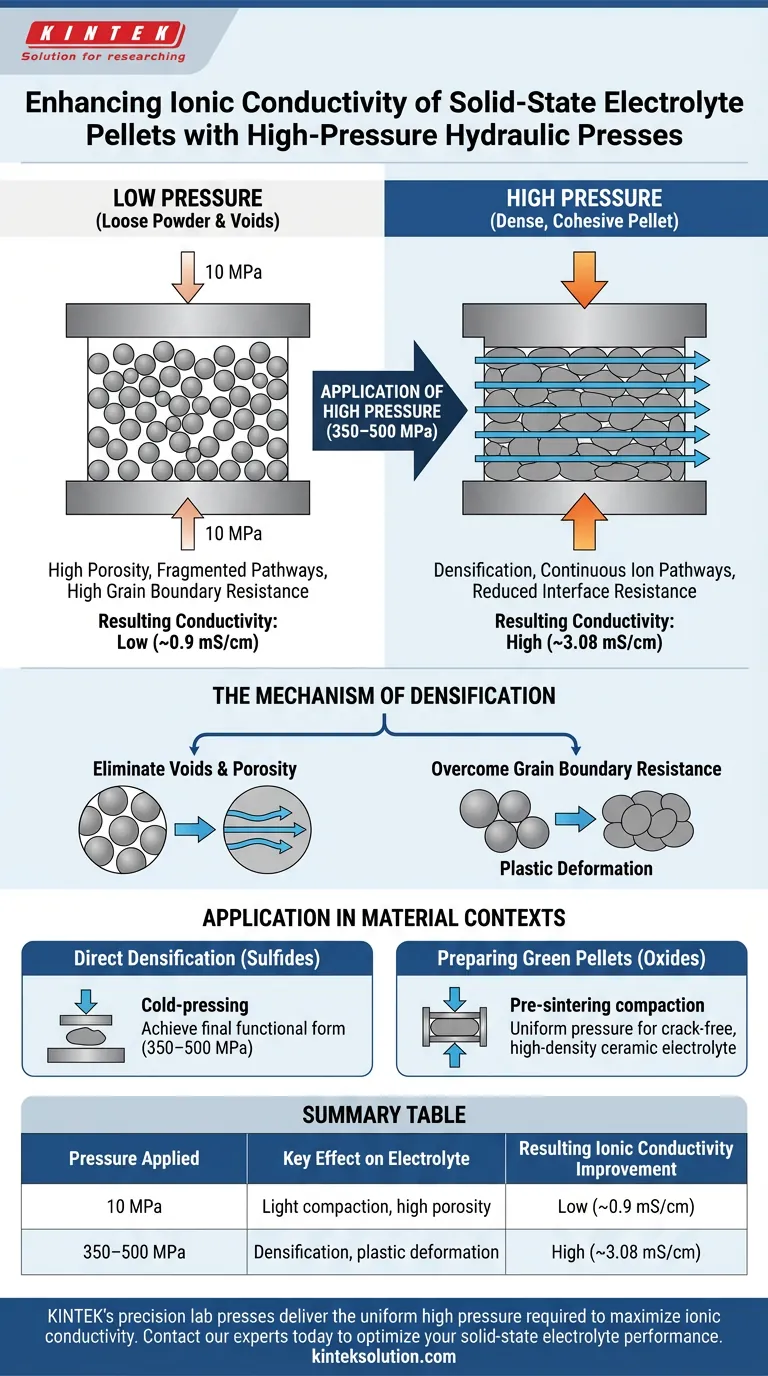
Data indicates that increasing pressure from 10 MPa to 350 MPa can raise total ionic conductivity from 0.9 mS/cm to 3.08 mS/cm. This improvement is directly linked to the reduction of grain boundary resistance as particles are forced closer together.
Inducing Plastic Deformation
In certain materials, such as sulfide-based solid electrolytes, the pressure does more than just push particles together; it physically alters the microstructure.
High pressure causes the particles to undergo plastic deformation, changing their shape to fill the surrounding gaps. This "molding" effect creates intimate contact that is far superior to simple touching, further lowering the resistance at the particle interfaces.
Application in Different Material Contexts
Direct Densification (Sulfides)
For materials like Li-argyrodite or LGPS, the press is used to cold-press the powder into its final functional form.
References suggest pressures up to 500 MPa are used to achieve the necessary density for these materials. This direct compaction is fundamental to achieving high-rate performance in all-solid-state batteries.
Preparing Green Pellets (Oxides)
For oxide-based electrolytes like LLZO, the hydraulic press serves a crucial preparatory role before high-temperature sintering.
The press compacts the synthesized powder into a "green pellet"—a compacted but unsintered form. Uniform pressure here is a prerequisite for creating a crack-free, high-density ceramic electrolyte after the final firing process.
Understanding the Trade-offs
The Requirement for High Magnitude Pressure
Achieving the necessary connectivity is not possible with light compaction; specific thresholds must be met to trigger the required microstructural changes.
References highlight that pressures often need to reach 350 MPa to 500 MPa to be effective. If the pressure is insufficient, the particles may physically touch, but they will lack the "intimate" contact and plastic deformation required to minimize grain boundary resistance, resulting in suboptimal conductivity.
Making the Right Choice for Your Goal
To maximize the effectiveness of your solid-state electrolyte fabrication, align your pressing strategy with your material properties:
- If your primary focus is Sulfide-Based Electrolytes: Apply high pressure (350–500 MPa) to induce plastic deformation, which is the key driver for minimizing grain boundary resistance and maximizing conductivity.
- If your primary focus is Oxide-Based Ceramics (LLZO): Focus on applying uniform, stable pressure to form a high-quality green pellet, which ensures a dense and crack-free structure after the subsequent sintering phase.
- If your primary focus is Optimization: Systematically increase pressure while measuring density; conductivity gains will plateau once internal voids are fully minimized and maximum density is reached.
Ultimately, the hydraulic press is not just a shaping tool, but a critical instrument for engineering the microstructure that defines battery performance.
Summary Table:
| Pressure Applied | Key Effect on Electrolyte | Resulting Ionic Conductivity Improvement |
|---|---|---|
| 10 MPa | Light compaction, high porosity | Low (~0.9 mS/cm) |
| 350–500 MPa | Densification, plastic deformation | High (~3.08 mS/cm) |
Ready to optimize your solid-state electrolyte performance? KINTEK's precision lab presses—including automatic, isostatic, and heated models—deliver the uniform high pressure (up to 500 MPa) required to eliminate grain boundary resistance and maximize ionic conductivity. Whether you're working with sulfide-based electrolytes or oxide ceramics like LLZO, our machines ensure dense, void-free pellets for superior battery research. Contact our experts today to discuss your lab's specific needs!
Visual Guide
Related Products
- Automatic Laboratory Hydraulic Press for XRF and KBR Pellet Pressing
- Laboratory Hydraulic Pellet Press for XRF KBR FTIR Lab Press
- Laboratory Hydraulic Split Electric Lab Pellet Press
- Manual Laboratory Hydraulic Pellet Press Lab Hydraulic Press
- Laboratory Hydraulic Press 2T Lab Pellet Press for KBR FTIR
People Also Ask
- Why is pressing powder into a pellet critical before sintering? Ensure Dense, Conductive Solid-State Electrolytes
- What is the role of a laboratory pressure machine and KBr in FTIR? Master Sample Preparation for Flame Retardants
- What are the advantages of using a laboratory automatic hydraulic press for HEA green compact forming?
- What are the advantages of using a lab automatic hydraulic press for HEA green body molding? Ensure Material Integrity
- How does an automatic laboratory hydraulic press improve KBr pellet preparation? Achieve Precision IR Spectroscopy



















