
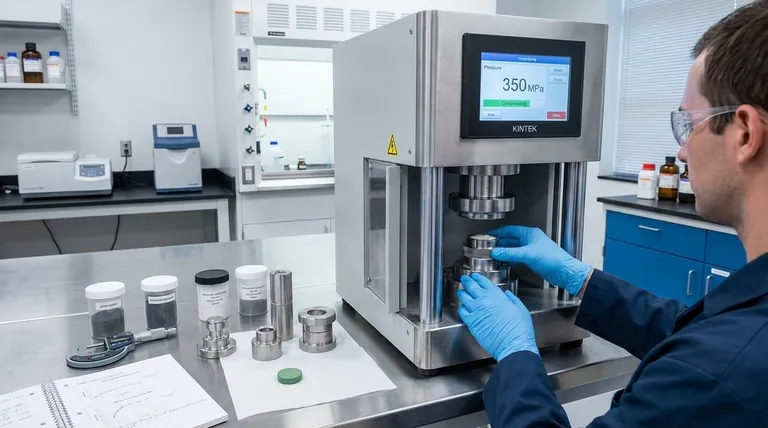
The laboratory hydraulic press is the fundamental tool for overcoming the inherent physical limitations of all-solid-state battery interfaces. By applying precise, high-magnitude pressure, it forces rigid solid components into intimate contact, eliminating microscopic voids and densifying electrode layers. This mechanical densification creates the necessary continuous pathways for ion and electron transport, directly resolving the high interfacial resistance that otherwise severely limits battery performance.
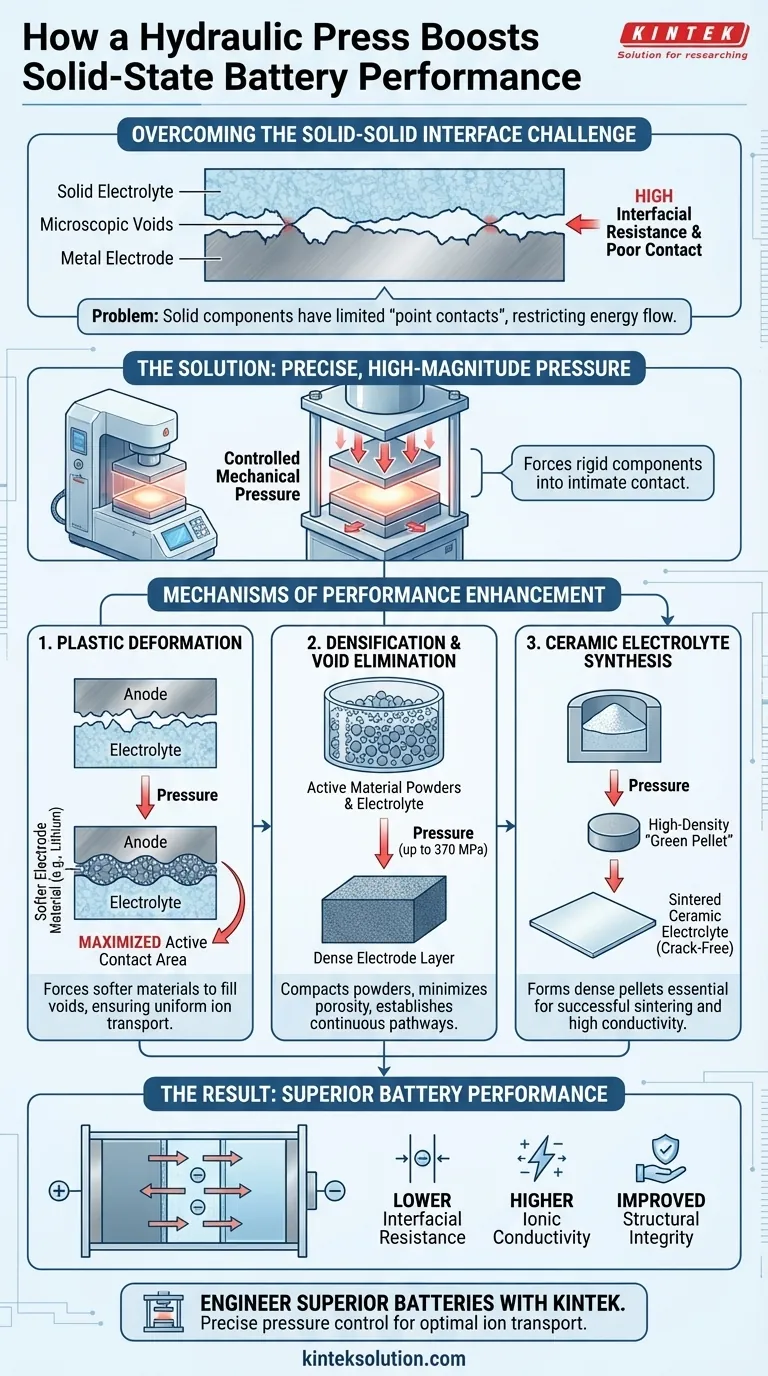
The core challenge in solid-state batteries is that, unlike liquid electrolytes, solid components do not naturally "wet" the electrode surface. A hydraulic press bridges this gap by using mechanical force to plastically deform materials and compact powders, maximizing the active contact area required for efficient electrochemical reaction.
Overcoming the Solid-Solid Interface Challenge
The Problem of Point Contacts
In all-solid-state battery assembly, components such as garnet solid electrolytes and metal electrodes are naturally rigid. Without intervention, placing these materials together results in mere "point contacts."
These limited contact points create extremely high interfacial resistance. This restricts the flow of energy and compromises the cell's ability to function.
Inducing Plastic Deformation
To resolve this, the hydraulic press applies controlled mechanical pressure to the assembly. This forces softer electrode materials, such as metallic lithium, to undergo plastic deformation.
By deforming the metal, the press forces the material to fill microscopic voids on the electrolyte's surface. This dramatically increases the effective contact area, ensuring uniform, low-resistance ion transport across the interface.
Mechanisms of Performance Enhancement
Densification and Void Elimination
A primary function of the press is the cold-pressing of active material powders, conductive additives, and solid electrolytes. High pressure brings these discrete particles into intimate contact.
This process eliminates the voids between particles. By minimizing internal porosity, the press ensures the electrode layer is dense and structurally sound.
Establishing Transport Pathways
Achieving a dense electrode structure is not merely about physical strength; it is critical for conductivity. The densification process establishes continuous pathways for both ions and electrons.
These uninterrupted pathways significantly reduce interfacial resistance. Consequently, this leads to higher ionic conductivity and superior overall battery performance.
Specific Pressure Requirements
To achieve these results, significant force is often required. For example, compacting electrolyte powder to form a dense separator often requires pressures around 300 MPa.
In some applications, such as cold-pressing electrolyte powder into pellets, pressures up to 370 MPa are utilized. This level of force is essential to maximize particle contact and minimize porosity.
The Role in Ceramic Electrolyte Synthesis
Forming the "Green Pellet"
Before high-temperature sintering, the hydraulic press is used to compact synthesized powders (such as LLZO or LATP) into a "green pellet."
This stage is a fundamental prerequisite for success. The press applies uniform pressure to tightly pack the particles within a mold, creating a dense shape with substantial mechanical strength.
Ensuring Sintering Success
The quality of the green pellet directly dictates the quality of the final product. A high-density green pellet is necessary to obtain a crack-free ceramic electrolyte after sintering.
By ensuring proper compaction early in the process, the press enables the creation of ceramic sheets that possess the high ionic conductivity required for advanced applications.
Operational Advantages and Precision
Control and Consistency
Using a laboratory hydraulic press allows for the application of large amounts of force with high precision. The ability to adjust pressure to specific requirements—such as the 370 MPa threshold—is vital for experimental repeatability.
Safety and Efficiency
Modern lab presses are designed with safety features to prevent overloading. They offer a cost-effective solution that exerts stable pressure with minimal maintenance, ensuring that the critical variables of force and time are controlled variables in your experiment.
Making the Right Choice for Your Goal
To maximize the utility of a hydraulic press in your assembly process, focus on the specific needs of your materials:
- If your primary focus is lowering interfacial resistance: Prioritize pressure settings that induce plastic deformation in your anode materials to eliminate point contacts.
- If your primary focus is ceramic electrolyte synthesis: Ensure you are achieving a high-density "green pellet" to prevent cracking and defects during the subsequent sintering phase.
- If your primary focus is ion transport stability: Use the press to compact electrolyte powders at high pressures (up to 370 MPa) to minimize porosity and create continuous ionic pathways.
The hydraulic press is not just an assembly tool; it is a mechanism for mechanically engineering the conductivity and structural integrity of your solid-state cell.
Summary Table:
| Key Function | Impact on Battery Performance | Typical Pressure Range |
|---|---|---|
| Densification & Void Elimination | Creates dense, structurally sound electrode layers | Up to 370 MPa |
| Plastic Deformation of Anodes | Increases contact area, reduces interfacial resistance | Application-specific |
| Forming 'Green Pellets' | Enables creation of crack-free ceramic electrolytes | High, uniform pressure |
| Establishing Transport Pathways | Enhances ionic and electronic conductivity | Critical for performance |
Ready to Engineer Superior All-Solid-State Batteries?
The precise pressure control of a KINTEK laboratory hydraulic press is fundamental to overcoming the core challenges of solid-state battery assembly. Our automatic lab presses, isostatic presses, and heated lab presses are engineered to deliver the consistent, high-magnitude force required to eliminate interfacial resistance and ensure optimal ion transport.
Let KINTEK's expertise empower your research and development. We specialize in providing reliable lab press solutions that deliver the mechanical integrity and performance your laboratory needs.
Contact our experts today to discuss how our presses can enhance your specific battery assembly process!
Visual Guide
Related Products
- Laboratory Hydraulic Press Lab Pellet Press Button Battery Press
- Laboratory Hydraulic Press 2T Lab Pellet Press for KBR FTIR
- Laboratory Hydraulic Press Lab Pellet Press Machine for Glove Box
- 24T 30T 60T Heated Hydraulic Lab Press Machine with Hot Plates for Laboratory
- Automatic Laboratory Hydraulic Press Lab Pellet Press Machine
People Also Ask
- How is a laboratory hydraulic press used for HAP composite gels? Master Mineral Substrate Standardization
- What role does a laboratory hydraulic press play in reaction pellets? Optimizing Lunar Soil and Metal Fuel Density
- What role does a laboratory hydraulic press play in the preparation of piezoelectric ceramic discs for DC-PG? | KINTEK
- Why is a laboratory hydraulic press required for PBAT and PLA sample preparation? Achieve Flawless Characterization
- What role does a laboratory hydraulic press play in the assembly of all-solid-state battery test cells? Expert Guide



















