
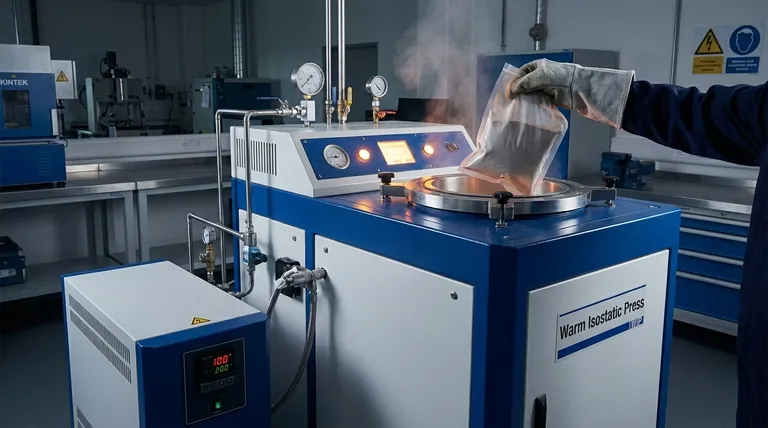
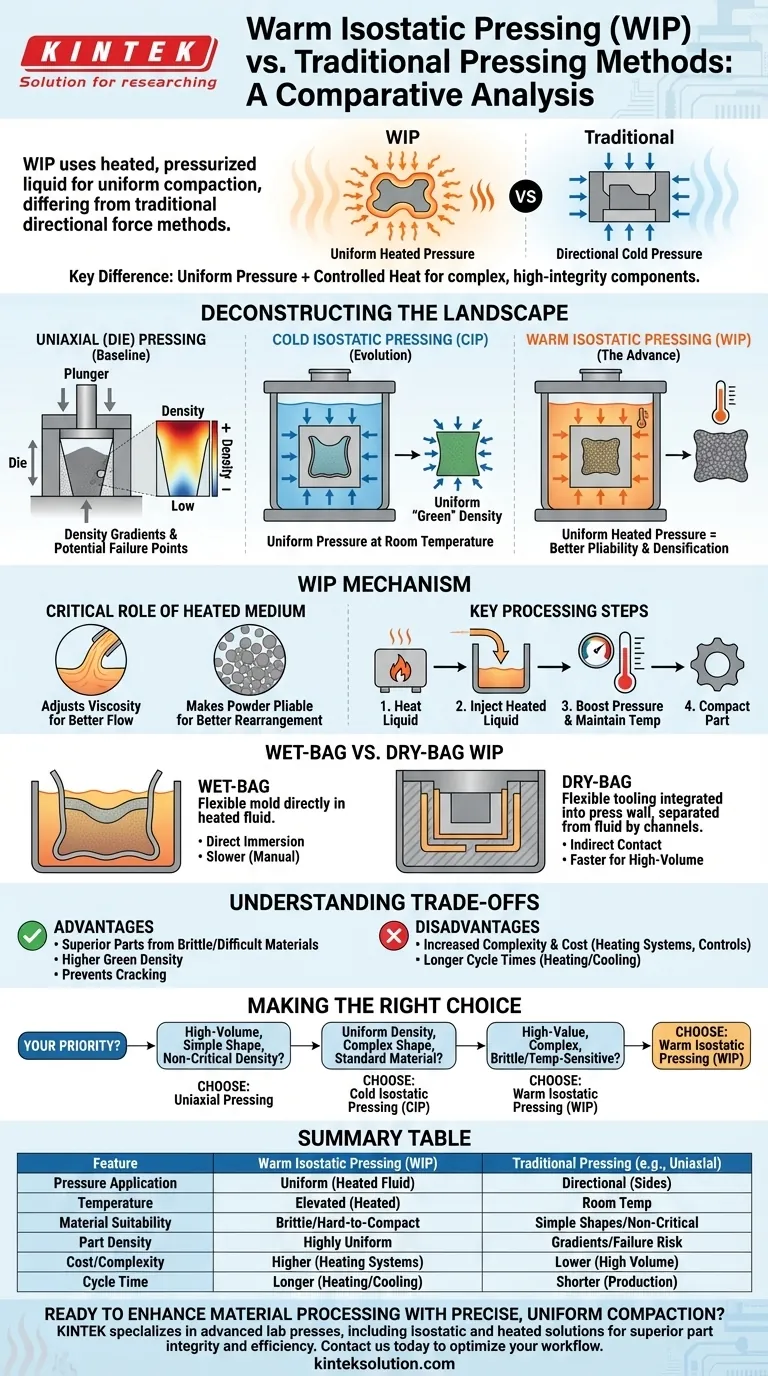
At its core, Warm Isostatic Pressing (WIP) differs from traditional methods by using a heated, pressurized liquid to uniformly compact a powder. Unlike conventional pressing that applies force from one or two directions, WIP surrounds the material, ensuring even density, while the elevated temperature allows for the processing of materials that would otherwise crack or fail to consolidate properly at room temperature.
The fundamental distinction is not just the use of pressure, but the strategic combination of uniform pressure and controlled heat. This unlocks the ability to form complex, high-integrity components from materials that are incompatible with cold or directional pressing techniques.
Deconstructing the Pressing Landscape
To understand the value of WIP, we must first distinguish it from the more common methods it was developed to improve upon. Each method applies force differently, with significant consequences for the final part.
The Baseline: Uniaxial (Die) Pressing
Uniaxial pressing is the most conventional method. Powder is placed in a rigid die and compressed from one or two directions by a plunger.
This directional force creates density gradients. The areas of the part closest to the plunger become denser than the areas farther away, which can be a critical point of failure.
The Evolution: Cold Isostatic Pressing (CIP)
Cold Isostatic Pressing (CIP) improves on uniaxial pressing by applying pressure uniformly from all directions. This is achieved by placing the powder in a flexible, sealed mold and submerging it in a high-pressure fluid at room temperature.
The result is a "green" part (an unsintered part) with highly uniform density. This eliminates the internal stresses and weak points created by directional pressing.
The Unique Mechanism of Warm Isostatic Pressing (WIP)
WIP takes the principles of CIP a step further by introducing controlled heat to the process. This seemingly simple addition has profound effects on the material being processed.
The Critical Role of the Heated Medium
In WIP, a liquid medium is heated to a specific temperature before being injected into the pressing chamber. This serves two key purposes.
First, heating the liquid adjusts its viscosity, ensuring it flows correctly to transmit pressure perfectly around the component. Second, and more importantly, the heat makes the material powder itself more pliable, enabling better particle rearrangement and densification at lower pressures than would be required in a cold state.
Key Processing Steps
The WIP process is precise and controlled. It begins by heating the liquid medium to the target temperature using a dedicated heat generator.
This heated liquid is then injected into a sealed cylinder containing the powder mold. A booster source raises the pressure, compacting the part. Maintaining precise temperature control throughout this cycle is paramount for consistent results.
Wet-Bag vs. Dry-Bag Isostatic Pressing
Isostatic pressing, both cold and warm, can be implemented in two ways. Wet-bag pressing involves directly immersing the sealed mold into the pressure fluid.
Dry-bag pressing integrates the pressure tooling into the press itself, creating internal channels where the fluid is pumped. This method shields the part from direct contact with the fluid and is generally faster for high-volume production.
Understanding the Trade-offs
Choosing WIP involves evaluating its significant advantages against its operational complexity. It is a specialized tool for specific challenges.
Advantage: Superior Parts from Difficult Materials
WIP is exceptionally beneficial for materials that are brittle or do not compact well at room temperature. The elevated temperature makes them more ductile, preventing cracking and achieving higher green density.
Disadvantage: Increased Complexity and Cost
The need for a heat generator, high-pressure fluid heaters, and precise temperature control systems makes WIP equipment more complex and expensive than both uniaxial and cold isostatic presses.
Disadvantage: Longer Cycle Times
Compared to simple die compaction, the WIP cycle is inherently slower. Heating the fluid, pressurizing the chamber, and potentially cooling the component all add time, making it less suitable for high-volume production of simple parts.
Making the Right Choice for Your Application
Selecting the correct pressing method depends entirely on your material, the complexity of your part, and your production goals.
- If your primary focus is high-volume production of simple shapes with non-critical density: Uniaxial pressing is the most cost-effective solution.
- If your primary focus is achieving uniform density in complex shapes with standard materials: Cold Isostatic Pressing (CIP) offers a significant upgrade over uniaxial pressing without the added thermal complexity.
- If your primary focus is forming high-value, complex components from brittle or temperature-sensitive powders: Warm Isostatic Pressing (WIP) is the definitive choice for ensuring part integrity and uniform densification.
Ultimately, mastering advanced materials processing requires selecting the technique that best aligns with the intrinsic properties of your material.
Summary Table:
| Feature | Warm Isostatic Pressing (WIP) | Traditional Pressing (e.g., Uniaxial) |
|---|---|---|
| Pressure Application | Uniform from all directions using heated fluid | Directional from one or two sides |
| Temperature | Elevated (heated medium) | Room temperature |
| Material Suitability | Ideal for brittle, hard-to-compact materials | Best for simple shapes, non-critical density |
| Part Density | Highly uniform, reduces weak points | Density gradients, potential for failure |
| Cost and Complexity | Higher due to heating systems | Lower, more cost-effective for high volume |
| Cycle Time | Longer due to heating and cooling | Shorter, faster for production |
Ready to enhance your material processing with precise, uniform compaction? KINTEK specializes in advanced lab press machines, including automatic lab presses, isostatic presses, and heated lab presses tailored for laboratory needs. Our solutions deliver superior part integrity, reduce defects, and improve efficiency for challenging materials. Contact us today to discuss how our equipment can optimize your workflow and achieve consistent, high-quality results!
Visual Guide
Related Products
- Warm Isostatic Press for Solid State Battery Research Warm Isostatic Press
- Electric Lab Cold Isostatic Press CIP Machine
- Automatic Lab Cold Isostatic Pressing CIP Machine
- Manual Cold Isostatic Pressing CIP Machine Pellet Press
- Electric Split Lab Cold Isostatic Pressing CIP Machine
People Also Ask
- Why must composite cathodes be sealed in vacuum lamination bags for WIP? Ensure Battery Stability and Density
- How do sacrificial volume materials (SVM) maintain microchannels in isostatic pressing? Ensure Structural Integrity
- What is the function of elastic molds in warm isostatic pressing? Achieve Uniform Density in Composite Particles
- What is the process involved in warm isostatic pressing? Mastering Uniform Density with WIP Technology
- What is the role of the flexible material in warm isostatic pressing? Key to Uniform Density & Precision



















