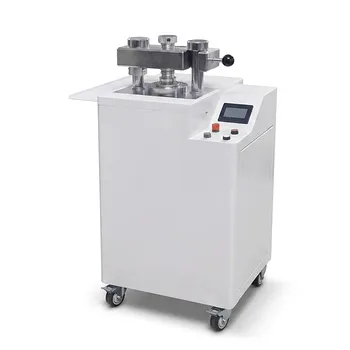
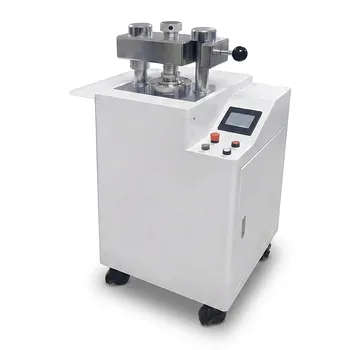
Preparation for FTIR analysis involves mixing your sample with a binder, typically potassium bromide (KBr) powder, and compressing it into a thin, transparent disc. A hydraulic press is used to apply significant force to a die containing this mixture, fusing the powder into a solid "pellet" that allows infrared light to pass through for accurate spectroscopic reading.
Core Takeaway: The goal of using a hydraulic press in FTIR is not just compaction, but optical clarity. By fusing the sample with an IR-transparent binder (KBr) under high pressure, you eliminate air pockets and light scattering, creating a homogeneous medium that yields stable baselines and sharp characteristic peaks.
The Principles of Sample Preparation
The Role of the Hydraulic Press
In spectroscopy, the physical state of the sample is as critical as its chemical composition. A hydraulic press is essential because it applies high pressure—often up to 15 tons or specific pressures like 100 Bar—to the sample material.
Creating a Solid Solution
The press does not simply crush the material; it fuses it. By compressing the powder mixture, the press forces the particles to flow together. This creates a uniform, dense pellet that acts as a solid solution, distinct from a loose powder.
Eliminating Optical Interference
Loose powders contain air gaps that scatter light and distort data. The hydraulic press removes these internal voids. This ensures the infrared beam interacts directly with your sample molecules rather than bouncing off particle boundaries.
The Step-by-Step Procedure
1. Dilution and Mixing
The sample must first be diluted in a binder material, most commonly Potassium Bromide (KBr). This binder is chosen because it is transparent to infrared light and does not interfere with the resulting spectrum.
2. Fine Grinding
Before pressing, the mixture is thoroughly ground to ensure consistency. The goal is to reduce particle size to the point where the mixture is completely homogenous. Large particles will cause light scattering even after pressing.
3. Loading the Die
The finely ground powder is placed into a durable pellet die. This is a specialized metal mold designed to withstand the immense force of the hydraulic press without deforming.
4. Applying Pressure
The die is placed into the hydraulic press. Pressure is applied steadily to compact the powder. This process transforms the opaque powder mixture into a translucent or transparent solid pellet.
Common Pitfalls and Trade-offs
The Risk of Moisture Absorption
KBr is hygroscopic, meaning it absorbs water from the air. If the pressing process is too slow or the environment is too humid, the resulting pellet may be cloudy. This introduces broad water peaks in your spectrum that can mask critical data.
Particle Size Issues
If the initial grinding is insufficient, the hydraulic press cannot compensate for it. A pellet made from coarse powder will remain opaque and scatter light, resulting in a noisy spectrum with a sloping baseline.
Pressure Management
While high pressure is necessary, it must be uniform. Inconsistent pressure can lead to pellets that are too fragile to handle or have varying density gradients, which affects the reproducibility of your results.
Making the Right Choice for Your Goal
How to Apply This to Your Project
- If your primary focus is routine identification: Ensure your sample is diluted sufficiently (typically 1% sample to 99% KBr) to prevent "bottoming out" the detector with a pellet that is too dark.
- If your primary focus is high-resolution quantitative analysis: Prioritize the grinding step and use a vacuum die if possible to remove all air, ensuring the highest level of transparency and baseline stability.
Mastering the hydraulic press technique transforms a variable powder into a consistent optical component, ensuring your FTIR data reflects the sample's chemistry rather than its preparation.
Summary Table:
| Stage | Action | Purpose in FTIR |
|---|---|---|
| Dilution | Mix sample with KBr (1:99 ratio) | Ensures IR transparency and prevents signal saturation |
| Grinding | Fine pulverization of mixture | Reduces light scattering by eliminating large particles |
| Loading | Place powder into a pellet die | Prepares the material for uniform force application |
| Pressing | Apply high pressure (up to 15 tons) | Fuses powder into a translucent solid pellet for clear spectra |
Elevate Your Spectroscopic Precision with Kintek
Maximize the accuracy of your FTIR analysis with KINTEK’s premium laboratory pressing solutions. Whether you are performing routine identification or high-resolution quantitative research, our comprehensive range of manual, automatic, and heated presses ensures perfectly fused, transparent pellets every time.
Specializing in advanced material preparation, KINTEK offers multifunctional and glovebox-compatible models, as well as cold and warm isostatic presses tailored for battery research and material science. Don't let poor sample preparation compromise your data—contact us today to find the ideal press for your laboratory!
Related Products
- Laboratory Hydraulic Press 2T Lab Pellet Press for KBR FTIR
- Automatic Laboratory Hydraulic Press for XRF and KBR Pellet Pressing
- Laboratory Hydraulic Pellet Press for XRF KBR FTIR Lab Press
- Automatic XRF Pellet Press for Laboratory Spectrometry Sample Preparation
- Automatic Fluorescence Sample Preparation Press 40 Ton Lab Pellet Press for XRF Analysis
People Also Ask
- What is the role of a laboratory pressure machine and KBr in FTIR? Master Sample Preparation for Flame Retardants
- What is the role of a laboratory hydraulic press in high-loading NCM811 cathode prep for solid-state batteries?
- What role does a laboratory hydraulic press play in reaction pellets? Optimizing Lunar Soil and Metal Fuel Density
- Why is a laboratory hydraulic press necessary for sample preparation? Precise Pelleting for Spiro Heterocyclic Analysis
- Why is a laboratory hydraulic press necessary for the assembly of trilayer bipolar stacking pouch cells?