
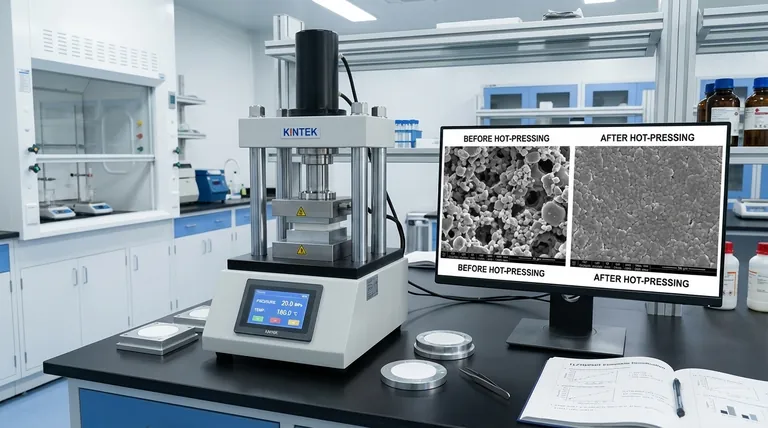
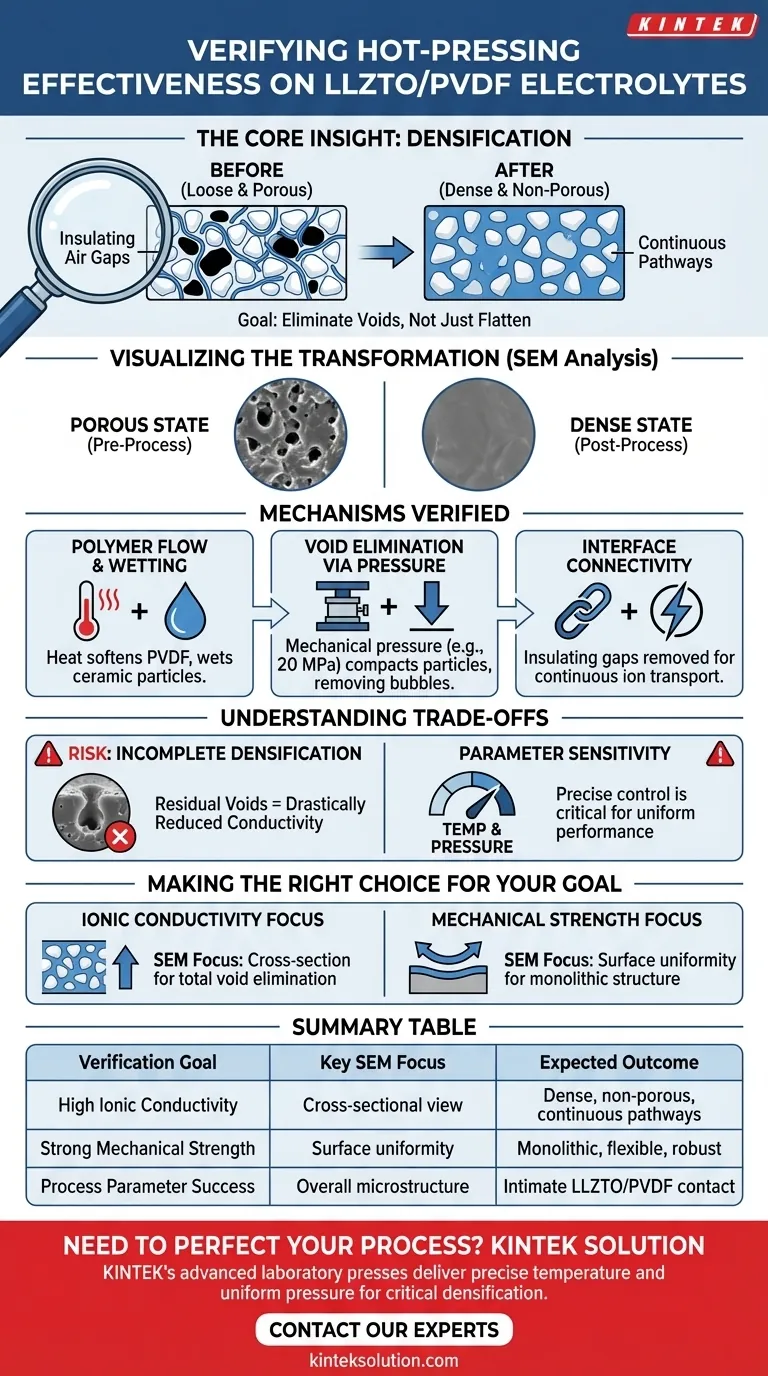
The effectiveness of the hot-pressing process is typically verified using Scanning Electron Microscopy (SEM). This imaging technique provides direct visual evidence of the electrolyte's physical transformation. By comparing the microstructure before and after processing, researchers look for a specific transition from a loose, porous state to a dense, non-porous, and monolithic structure.
The Core Insight Verifying the hot-pressing process is not merely about checking for flatness; it is about confirming densification. The success of an LLZTO/PVDF composite relies entirely on eliminating insulating air voids to establish continuous pathways for lithium-ion transport.
Visualizing the Transformation
The Role of Microstructural Analysis
SEM is the primary tool used because it reveals the cross-sectional and surface morphology of the membrane.
It allows researchers to see the physical interaction between the ceramic filler (LLZTO) and the polymer matrix (PVDF) at a microscopic level.
The "Before" State
Prior to hot pressing, the membrane typically exhibits a porous and loose structure.
Solvent evaporation during the initial casting leaves behind large voids and air gaps, which act as insulators and sever ion transport channels.
The "After" State
A successful hot-pressing process results in a dense, non-porous structure.
The SEM imagery should show that the polymer has flowed to fill the voids, creating a continuous, integrated sheet where particles are in intimate contact.
The Mechanisms Being Verified
Polymer Flow and Wetting
The verification process confirms that the applied heat successfully softened the PVDF polymer matrix.
By reducing the polymer's viscosity, the heat enables it to flow and "wet" the ceramic particles, binding them tightly together.
Void Elimination via Pressure
The SEM images verify that the applied mechanical pressure (e.g., 20 MPa) was sufficient to compact the particles.
This pressure eliminates internal bubbles and creates the physical density required for a mechanically robust membrane.
Interface Connectivity
The ultimate goal of this verification is to ensure interface engineering has occurred.
The images must confirm that the insulating gaps between the ceramic particles and the polymer have been removed, establishing the continuous pathways necessary for high ionic conductivity.
Understanding the Trade-offs
The Risk of Incomplete Densification
If SEM verification reveals remaining micro-pores, the process has failed to achieve the necessary percolation threshold.
Even small residual voids can reduce ionic conductivity by several orders of magnitude, rendering the electrolyte ineffective for practical application.
Parameter Sensitivity
The visual quality of the membrane is highly sensitive to the specific temperature and pressure combination.
If the temperature is too low, the polymer will not flow sufficiently to fill voids; if pressure is uneven, the membrane will lack the uniform distribution required for consistent performance.
Making the Right Choice for Your Goal
To ensure your composite electrolyte meets performance standards, target your verification based on these priorities:
- If your primary focus is Ionic Conductivity: Ensure SEM analysis focuses on the cross-section to verify the total elimination of internal voids, as these are the primary bottleneck for ion transport.
- If your primary focus is Mechanical Strength: Examine the surface uniformity to confirm a monolithic structure, which indicates the polymer has successfully bound the ceramic filler into a flexible, robust network.
The difference between a functional battery and a failure often lies in the microscopic elimination of air gaps verified through rigorous imaging.
Summary Table:
| Verification Goal | Key SEM Analysis Focus | Expected Outcome |
|---|---|---|
| High Ionic Conductivity | Cross-sectional view for internal voids | Dense, non-porous structure with continuous ion pathways |
| Strong Mechanical Strength | Surface uniformity and particle binding | Monolithic, flexible, and robust membrane |
| Process Parameter Success | Overall microstructure | Intimate contact between LLZTO filler and PVDF matrix |
Need to perfect your composite electrolyte fabrication process?
KINTEK's advanced laboratory presses, including our heated lab presses and isostatic presses, are engineered to deliver the precise temperature and uniform pressure control required for achieving the critical densification verified by SEM analysis. Whether your goal is maximizing ionic conductivity or ensuring mechanical robustness for your LLZTO/PVDF composites, our equipment provides the reliability and consistency your research demands.
Contact our experts today to discuss how our lab press solutions can help you eliminate insulating voids and build better batteries.
Visual Guide
Related Products
- Automatic Heated Hydraulic Press Machine with Hot Plates for Laboratory
- Automatic High Temperature Heated Hydraulic Press Machine with Heated Plates for Lab
- Warm Isostatic Press for Solid State Battery Research Warm Isostatic Press
- Lab Heat Press Special Mold
- Heated Hydraulic Press Machine with Heated Plates for Vacuum Box Laboratory Hot Press
People Also Ask
- Function of a Laboratory Hydraulic Press with Heated Platens in SSE? Enhance Battery Density & Conductivity
- Why is a laboratory hydraulic press with heating plates required for PLA/TEC films? Achieve Precise Sample Integrity
- What are the requirements for electrode pressing with high-viscosity ionic liquids like EMIM TFSI? Optimize Performance
- How does a laboratory heated hydraulic press facilitate PBN sample prep for WAXS? Achieve Precise X-Ray Scattering
- What are the industrial applications of heated hydraulic presses? Master Heat & Force for Precision Manufacturing














