
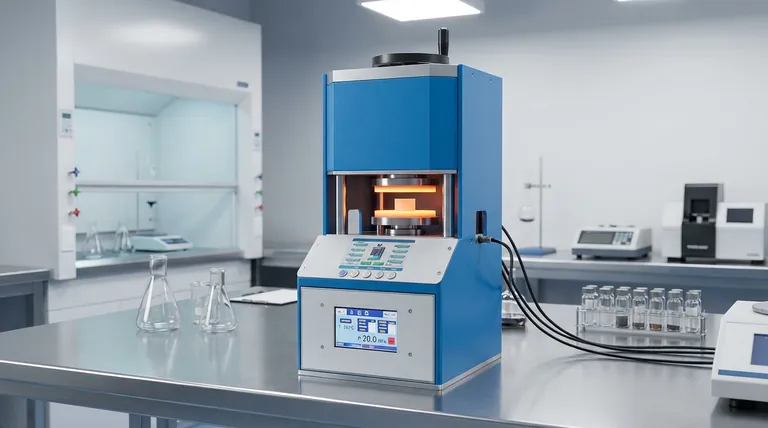
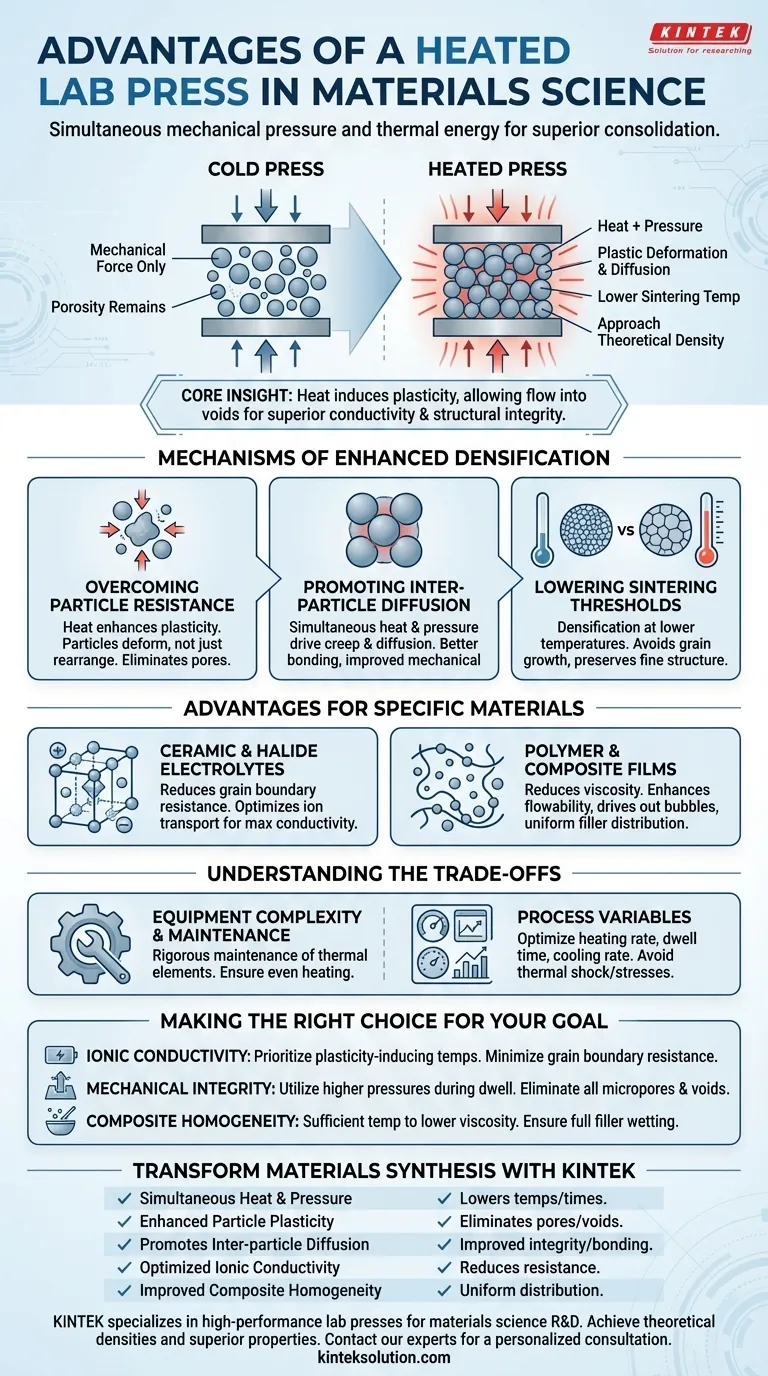
A heated lab press fundamentally transforms material consolidation by applying simultaneous mechanical pressure and thermal energy. This synergistic approach significantly lowers the required sintering temperatures and durations compared to separate compaction and heating steps, enabling the fabrication of components that approach their theoretical maximum density.
The Core Insight While cold pressing relies solely on mechanical force to pack particles, adding heat induces plastic deformation and diffusion at the particle boundaries. This "softening" effect allows the material to flow into voids that pressure alone cannot close, resulting in superior ionic conductivity and mechanical structural integrity.
The Mechanisms of Enhanced Densification
Overcoming Particle Resistance
In scenarios like fabricating solid electrolytes (e.g., Li6PS5Cl-based composites), heat enhances plasticity.
By warming the material, you soften the particle surfaces. This allows the applied pressure to deform the particles plastically rather than just rearranging them, effectively eliminating the pores found in cold-pressed compacts.
Promoting Inter-particle Diffusion
Simultaneous heat and pressure drive creep and diffusion between particles.
This facilitates better bonding at the microscopic level. The particles do not just sit next to each other; they fuse, leading to a substantial improvement in the overall mechanical integrity of the component.
Lowering Sintering Thresholds
A heated press allows for densification at significantly lower temperatures than pressure-less sintering.
Because the material is densified more efficiently, you avoid the excessive grain growth often caused by high-temperature sintering. This preserves finer grain structures, which is critical for maintaining optimal material properties.
Advantages for Specific Material Types
For Ceramic and Halide Electrolytes
The primary advantage here is the reduction of grain boundary resistance.
Hot pressing is highly effective at eliminating residual porosity. By maximizing contact between grains, the pathway for ion transport is optimized, leading to the highest possible ionic conductivity performance.
For Polymer and Composite Films
In polymer matrices, heat functions by reducing viscosity.
This enhances the flowability of the polymer, ensuring it properly "wets" any inorganic filler particles. The pressure then drives out internal bubbles, resulting in a dense, homogeneous membrane with uniform filler distribution.
Understanding the Trade-offs
Equipment Complexity and Maintenance
Unlike simple cold presses, a heated press requires rigorous maintenance of thermal elements.
Ensuring even heating distribution is critical; a failure in a heating element can lead to temperature gradients that warp the sample or cause uneven densification.
Process Variables
The introduction of temperature adds a layer of complexity to your experimental design.
You must optimize the heating rate, dwell time, and cooling rate alongside pressure parameters. Incorrect thermal cycling can induce thermal shock or residual stresses in the final puck or film.
Making the Right Choice for Your Goal
To maximize the utility of a heated lab press, align your process parameters with your specific material outcomes.
- If your primary focus is Ionic Conductivity: Prioritize temperatures that induce plasticity without degrading the material to minimize grain boundary resistance.
- If your primary focus is Mechanical Integrity: Utilize higher pressures during the heated dwell time to eliminate all micropores and voids.
- If your primary focus is Composite Homogeneity: Ensure the temperature is sufficient to lower the matrix viscosity for full wetting of filler particles before applying peak pressure.
The heated lab press is not just a compaction tool; it is a synthesis instrument that bridges the gap between loose powder and a fully integrated, high-performance solid.
Summary Table:
| Advantage | Key Benefit |
|---|---|
| Simultaneous Heat & Pressure | Lowers sintering temperatures and times vs. separate steps. |
| Enhanced Particle Plasticity | Softens materials to eliminate pores and voids for maximum density. |
| Promotes Inter-particle Diffusion | Fuses particles for improved mechanical integrity and bonding. |
| Optimized Ionic Conductivity | Reduces grain boundary resistance in solid electrolytes. |
| Improved Composite Homogeneity | Ensures uniform filler distribution in polymer matrices. |
Ready to transform your materials synthesis with precise control?
KINTEK specializes in high-performance lab press machines, including automatic, isostatic, and heated lab presses designed for the exacting demands of materials science R&D. Our heated lab presses deliver the simultaneous heat and pressure you need to achieve theoretical densities and superior ionic conductivity in your ceramic electrolytes, polymers, and composites.
Let's discuss how a KINTEK solution can optimize your process. Contact our experts today for a personalized consultation.
Visual Guide
Related Products
- 24T 30T 60T Heated Hydraulic Lab Press Machine with Hot Plates for Laboratory
- Manual Heated Hydraulic Lab Press with Integrated Hot Plates Hydraulic Press Machine
- Automatic High Temperature Heated Hydraulic Press Machine with Heated Plates for Lab
- Automatic Heated Hydraulic Press Machine with Hot Plates for Laboratory
- Heated Hydraulic Press Machine with Heated Plates for Vacuum Box Laboratory Hot Press
People Also Ask
- Function of a Laboratory Hydraulic Press with Heated Platens in SSE? Enhance Battery Density & Conductivity
- Why is a laboratory hydraulic press with heating plates required for PLA/TEC films? Achieve Precise Sample Integrity
- What role does a laboratory heated hydraulic press play in LTCC? Essential for High-Density Ceramic Lamination
- What is the primary function of a laboratory heated hydraulic press? Mastering Thermoplastic Carbon Fiber Composites
- What is the critical role of a laboratory heated hydraulic press? Mastering PVC Sample Prep for Testing



















