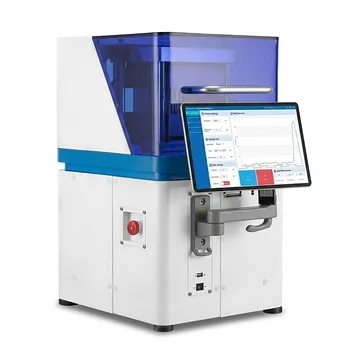
Hydraulic presses provide a unique combination of high-force output and delicate precision required for rigorous scientific analysis. In a laboratory environment, their primary advantages lie in their ability to apply adjustable, exact pressure to a diverse range of materials—from metals to biological samples—while maintaining a compact footprint and low operational costs.
The core value of a laboratory hydraulic press is its ability to deliver industrial-grade force with microscopic control, ensuring the creation of uniform, high-quality samples for spectroscopy and material testing.
Unmatched Precision and Control
Fine-Tuned Force Application
The defining feature of a lab-grade hydraulic press is the ability to maintain adjustable pressure settings. This allows researchers to apply the exact amount of force required for a specific protocol, ensuring repeatability across experiments.
Minimizing Sample Damage
By offering precise control over speed and position, these presses protect sample integrity. The operator can ramp up pressure gradually, which minimizes the risk of fracturing or deforming delicate specimens during preparation.
Essential for Analytical Consistency
This level of precision is critical for preparing samples for analytical techniques like X-ray fluorescence (XRF) and infrared spectroscopy (FTIR). Creating uniform pellets with smooth, homogeneous surfaces is necessary to collect accurate spectral data.
Versatility and Efficiency
Handling Diverse Materials
Hydraulic presses are not limited to hard industrial materials. They are highly versatile, capable of processing a wide spectrum of substances including metals, ceramics, polymers, and even biological samples.
High Output, Small Footprint
Despite their ability to generate significant force, laboratory hydraulic presses are designed to be efficient and space-saving. They deliver high tonnage without dominating valuable bench space, making them ideal for crowded lab environments.
Cost-Effectiveness and Durability
These machines are built for longevity. They are durable, withstand heavy use, and require minimal maintenance, making them a cost-effective long-term investment for research facilities.
Understanding the Trade-offs
Manual vs. Automated Operation
While manual hydraulic presses are cost-effective and portable, they require physical effort and may be less consistent than automated versions. If your lab requires high-throughput sample processing, the physical demand of a manual press can become a bottleneck.
Safety Considerations
Working with high pressure always carries inherent risks. While modern presses include safety features like pressure relief valves and overload protection, operators must remain vigilant to prevent accidents caused by material failure under compression.
Making the Right Choice for Your Goal
To maximize the utility of a hydraulic press in your laboratory, consider your specific operational constraints:
- If your primary focus is Budget and Portability: Opt for a manual hydraulic press, which offers a lightweight design and lower cost while still including essential features like pressure gauges.
- If your primary focus is Sample Quality for Spectroscopy: Prioritize a press with precision control valves to ensure the creation of perfectly homogeneous pellets for FTIR or XRF analysis.
- If your primary focus is Material Testing: Ensure the press is rated for the maximum force output required to push your specific materials (metals or ceramics) to their failure points.
Ultimately, the right hydraulic press serves as a reliable, low-maintenance engine that transforms raw materials into actionable scientific data.
Summary Table:
| Feature | Laboratory Advantage | Research Application |
|---|---|---|
| Adjustable Force | Ensures repeatability and minimizes sample damage | XRF & FTIR Pellet Preparation |
| Versatility | Processes metals, ceramics, polymers, and biologicals | Material Science & Bio-research |
| Compact Design | High tonnage output with a small benchtop footprint | Space-constrained Lab Settings |
| Durability | Long-lasting performance with minimal maintenance | High-throughput Testing Facilities |
Elevate Your Research with KINTEK Precision Pressing Solutions
At KINTEK, we understand that scientific accuracy begins with perfect sample preparation. Whether you are conducting advanced battery research or spectroscopic analysis, our comprehensive range of laboratory pressing solutions—including manual, automatic, heated, and glovebox-compatible models—is engineered to meet your exact specifications. From specialized cold and warm isostatic presses to multifunctional industrial-grade systems, we provide the durability and precision your lab demands.
Ready to transform your material testing? Contact KINTEK today to find the ideal hydraulic press for your specific application and experience the value of expert-engineered laboratory equipment.
Related Products
- Laboratory Hydraulic Press Lab Pellet Press Machine for Glove Box
- Laboratory Hydraulic Press 2T Lab Pellet Press for KBR FTIR
- 24T 30T 60T Heated Hydraulic Lab Press Machine with Hot Plates for Laboratory
- Laboratory Hydraulic Press Lab Pellet Press Button Battery Press
- Laboratory Hydraulic Pellet Press for XRF KBR FTIR Lab Press
People Also Ask
- How does a laboratory hydraulic press contribute to the preparation of Li3-3xScxSb samples? Optimize Ionic Conductivity
- What is the function of a laboratory hydraulic press in FT-IR of curcumin-coated MWCNTs? Achieve Optical Clarity.
- Why is a laboratory hydraulic press required for compression molding boron-siloxane? Solve High-Loading Density Challenges
- What role does a laboratory hydraulic press play in the preparation of piezoelectric ceramic discs for DC-PG? | KINTEK
- What role does a laboratory hydraulic press play in reaction pellets? Optimizing Lunar Soil and Metal Fuel Density