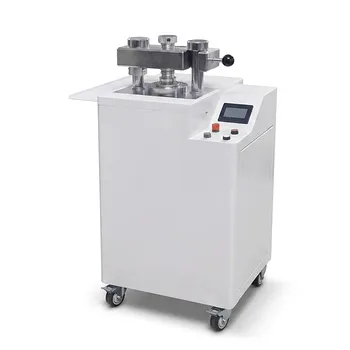
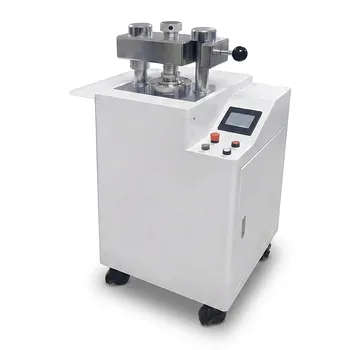
Compressed pellets produced by a laboratory press serve critical roles in research, analysis, and prototyping across multiple industries. These pellets are primarily utilized to form tablets in pharmaceutical development, prepare homogeneous samples for spectroscopy, and create detailed shapes and patterns in ceramics and materials engineering.
The core value of a compressed pellet lies in standardization: it transforms variable raw powders into solid, uniform test subjects, allowing for accurate data collection and scalable process simulation.
Key Applications in Analysis and Development
Spectroscopic Analysis
In analytical chemistry, the most frequent application is the preparation of samples for spectroscopy, particularly Infrared (IR) and X-ray methods.
Compacting a sample into a pellet ensures a consistent path length for light or radiation to pass through.
For example, presses are often used to create KBr (Potassium Bromide) pellets, which are standard for infrared spectral analysis.
Pharmaceutical Formulation
In the pharmaceutical sector, laboratory presses are essential for drug development.
Researchers use them to compress active ingredients and excipients into trial tablets to study their physical properties.
This allows for the evaluation of drug delivery mechanisms and stability before moving to mass production.
Ceramics and Materials Science
Engineers use compressed pellets to prototype complex materials, including ceramics, polymers, and composites.
The press allows for the creation of detailed shapes and patterns that mimic final product specifications.
This includes forming samples for catalysts in chemistry, electrode materials in the energy sector, and rock or ore samples for geological mining analysis.
Bridging Research and Industrial Scale
Formula Screening
A laboratory press acts as a vital simulation tool for industrial-scale manufacturing.
It allows researchers to screen formulas and optimize the ratios of different biomass or chemical materials in small batches.
By testing on a microscopic scale, scientists can predict how materials will behave during large-scale extrusion or molding.
Process Optimization
Beyond simple shaping, these pellets help determine the ideal processing conditions.
Researchers can study the specific effects of pressure, temperature, and dwell time on material properties like fiber bonding strength.
This provides the precise control data needed to support and de-risk the transition to industrial production lines.
Understanding the Trade-offs
The Requirement for Consistency
The utility of a compressed pellet is entirely dependent on its uniformity.
For an application to be successful, the resulting pellets must maintain a rigorous consistency in size and shape.
If the hydraulic force is not applied evenly, or if the die is not perfectly aligned, the sample may yield unreliable analytical results.
Scale vs. Speed
While laboratory presses offer high adjustability and precision, they are designed for batch production, not high-speed manufacturing.
They are excellent for R&D, testing, and short production runs, but they cannot match the throughput of industrial rotary presses.
Users must recognize that data gathered from a lab press represents a controlled ideal, which may require adjustment when scaling to mass production environments.
Making the Right Choice for Your Goal
To maximize the utility of your laboratory press, match your technique to your specific objective:
- If your primary focus is Spectroscopic Analysis: Prioritize the creation of defect-free, optically clear pellets (like KBr) to ensure signal accuracy in IR or X-ray readings.
- If your primary focus is Pharmaceutical R&D: Focus on simulating the exact density and shape of intended commercial tablets to validate dissolution and stability profiles.
- If your primary focus is Industrial Scale-up: Use the press to rigorously test variable pressures and temperatures to define the processing limits of your material before commissioning large runs.
Precision in sample preparation is the prerequisite for precision in experimental data.
Summary Table:
| Application Category | Primary Use Cases | Key Analytical Benefits |
|---|---|---|
| Spectroscopy | KBr pellets, X-ray diffraction | Uniform path length, consistent signal accuracy |
| Pharmaceuticals | Tablet formulation, drug delivery | Validates dissolution, stability, and density |
| Materials Science | Ceramics, polymers, catalysts | Mimics final product geometry for prototyping |
| Energy & Mining | Battery electrode pellets, ore analysis | Enables screening of formulas and process limits |
| Process Simulation | Industrial scale-up, formula screening | De-risks transition to mass production lines |
Optimize Your Research with KINTEK’s Precision Pressing Solutions
Maximize your laboratory efficiency with KINTEK, your expert partner in comprehensive pressing technology. Whether you are conducting cutting-edge battery research or detailed spectroscopic analysis, our range of manual, automatic, heated, and multifunctional presses—including specialized cold and warm isostatic models—are designed to meet your most rigorous standards.
Our Value to You:
- Precision Engineering: Ensure absolute uniformity in size and shape for reliable analytical data.
- Versatile Configurations: Choose from glovebox-compatible designs or specialized models for unique material properties.
- Scalable Insights: Bridge the gap from R&D to industrial production with high-accuracy simulation tools.
Contact KINTEK today to find your perfect laboratory press!
Related Products
- Automatic Laboratory Hydraulic Press for XRF and KBR Pellet Pressing
- XRF KBR Plastic Ring Lab Powder Pellet Pressing Mold for FTIR
- Lab XRF Boric Acid Powder Pellet Pressing Mold for Laboratory Use
- Manual Cold Isostatic Pressing CIP Machine Pellet Press
- XRF KBR Steel Ring Lab Powder Pellet Pressing Mold for FTIR
People Also Ask
- Why is pressing powder into a pellet critical before sintering? Ensure Dense, Conductive Solid-State Electrolytes
- What is the role of a laboratory pressure machine and KBr in FTIR? Master Sample Preparation for Flame Retardants
- What are the advantages of using a laboratory automatic hydraulic press for HEA green compact forming?
- What are the advantages of using a lab automatic hydraulic press for HEA green body molding? Ensure Material Integrity
- What are the advantages of using an automatic laboratory hydraulic press? Enhance Precision in Sample Preparation