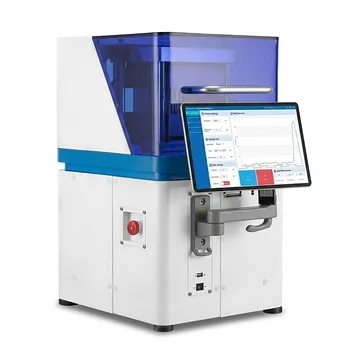
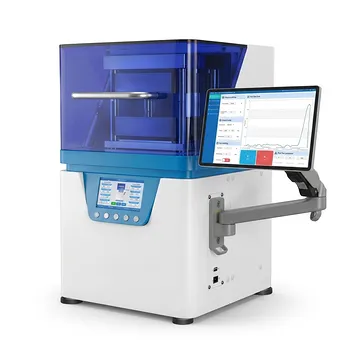
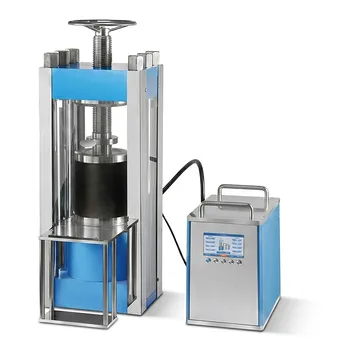
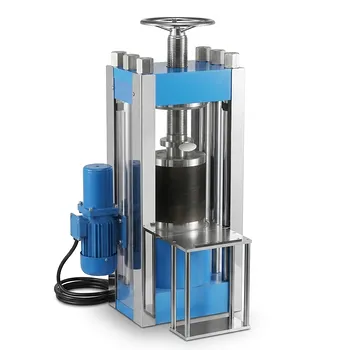
Heated lab presses are precision instruments that combine hydraulic force with controlled thermal energy to shape, mold, and test materials with high accuracy. Their primary advantages lie in enhanced heating efficiency and improved workpiece quality, making them the standard solution for critical processes ranging from polymer film production to pharmaceutical pill making.
Core Insight: The value of a heated lab press lies in its ability to decouple variable environmental factors from your results; by ensuring uniform temperature distribution and consistent pressure, these systems transform volatile raw materials into samples with strictly reproducible characteristics.
The Core Advantages of Heated Systems
Enhanced Heating Efficiency
Heated lab presses utilize flat heating elements designed to ensure uniform temperature distribution across the entire platen surface.
This design optimizes processing times by bringing materials to the required state faster and more evenly than non-specialized heating methods.
Superior Workpiece Quality
The combination of uniform heat and hydraulic pressure leads to consistent material thickness and structural integrity.
This repeatability is critical for quality control, ensuring that every sample produced exhibits the exact same characteristics as the last.
Operational Safety and Sustainability
Modern units are designed to minimize heat generation outside the active zone, which reduces overall energy consumption.
Many systems also feature closed moulding areas to contain fumes and protection doors with safety locks, creating a safer environment when working with hazardous substances or high temperatures up to 500 °C.
Critical Applications in Industry and Research
Material Characterization and Testing
These presses are indispensable in the polymer, composite, and ceramic industries for investigating material properties.
They allow researchers to create specific shapes or test specimens to analyze how materials behave under heat and stress.
Spectroscopy Sample Preparation
In analytical chemistry, precision is non-negotiable. Heated presses are widely used to prepare samples for Infrared (IR) and XRF spectroscopy.
They compress powders into solid, stable pellets or films, providing a clear medium for accurate spectral analysis.
Prototyping and Short-Run Manufacturing
Beyond pure research, these presses facilitate rapid prototyping and limited production runs.
They are ideal for laminating multiple material layers into composite structures or performing rubber and plastic molding for specialized components.
Understanding the Trade-offs
Volume vs. Precision
While excellent for R&D and short runs, heated lab presses are generally not designed for high-volume mass production.
Their focus is on the integrity of individual samples rather than throughput speed; attempting to use them for industrial-scale manufacturing can create bottlenecks.
Thermal Management Requirements
Operating at temperatures up to 500 °C requires strict adherence to safety protocols.
While closed systems contain fumes, the high thermal output demands that the laboratory environment be equipped with adequate ventilation and heat management infrastructure.
Making the Right Choice for Your Goal
When integrating a heated lab press into your workflow, consider your primary objective:
- If your primary focus is Research and Development: Prioritize a unit with the widest temperature range (up to 500 °C) and precise pressure controls to maximize material testing versatility.
- If your primary focus is Quality Control/Spectroscopy: Focus on units with proven platen flatness and heating uniformity to ensure every test pellet yields identical spectral data.
- If your primary focus is Safety/Hazardous Materials: Select a press featuring a fully closed moulding area and integrated fume containment systems to protect operators from emissions.
The right heated press does not just squash material; it acts as a controlled environment that eliminates variables to yield absolute truth in your data.
Summary Table:
| Feature | Key Benefit | Typical Application |
|---|---|---|
| Uniform Heating | Consistent material thickness & structural integrity | Polymer & composite research |
| High-Pressure Precision | Accurate, reproducible sample characteristics | Spectroscopy (IR/XRF) pellet prep |
| Thermal Control | High-temp stability up to 500 °C | Rubber & plastic molding |
| Safety Enclosures | Fume containment & operator protection | Hazardous material processing |
Elevate Your Material Research with KINTEK Precision
Maximize your laboratory's potential with KINTEK’s industry-leading pressing solutions. Whether you are conducting cutting-edge battery research or precise spectroscopy analysis, our range of manual, automatic, heated, and multifunctional models delivers the thermal uniformity and hydraulic force your work demands. From glovebox-compatible units to advanced isostatic presses, we provide the tools to eliminate variables and ensure reproducible results.
Ready to optimize your workflow? Contact KINTEK today to find the perfect press for your specialized application.
Related Products
- 24T 30T 60T Heated Hydraulic Lab Press Machine with Hot Plates for Laboratory
- Automatic Heated Hydraulic Lab Press 120x120mm Plate Fully Automated Material Research Press
- Automatic Heated Hydraulic Lab Press with Programmable Touch Screen Controls and Precision Temperature Regulation
- Automatic Heated Hydraulic Lab Press Machine 200x200 Plate Size for Battery Research and Materials Science
- Manual Heated Hydraulic Lab Press with Integrated Hot Plates Hydraulic Press Machine
People Also Ask
- Function of a Laboratory Hydraulic Press with Heated Platens in SSE? Enhance Battery Density & Conductivity
- Why is a laboratory hydraulic press with heating plates required for PLA/TEC films? Achieve Precise Sample Integrity
- What role does a laboratory heated hydraulic press play in LTCC? Essential for High-Density Ceramic Lamination
- Why reduce load when applying composite strengthening tabs? Protect Specimen Integrity and Data Accuracy
- Why is a laboratory heated hydraulic press required? Ensure Precise Vulcanization for NBR/EPDM Nanocomposites