
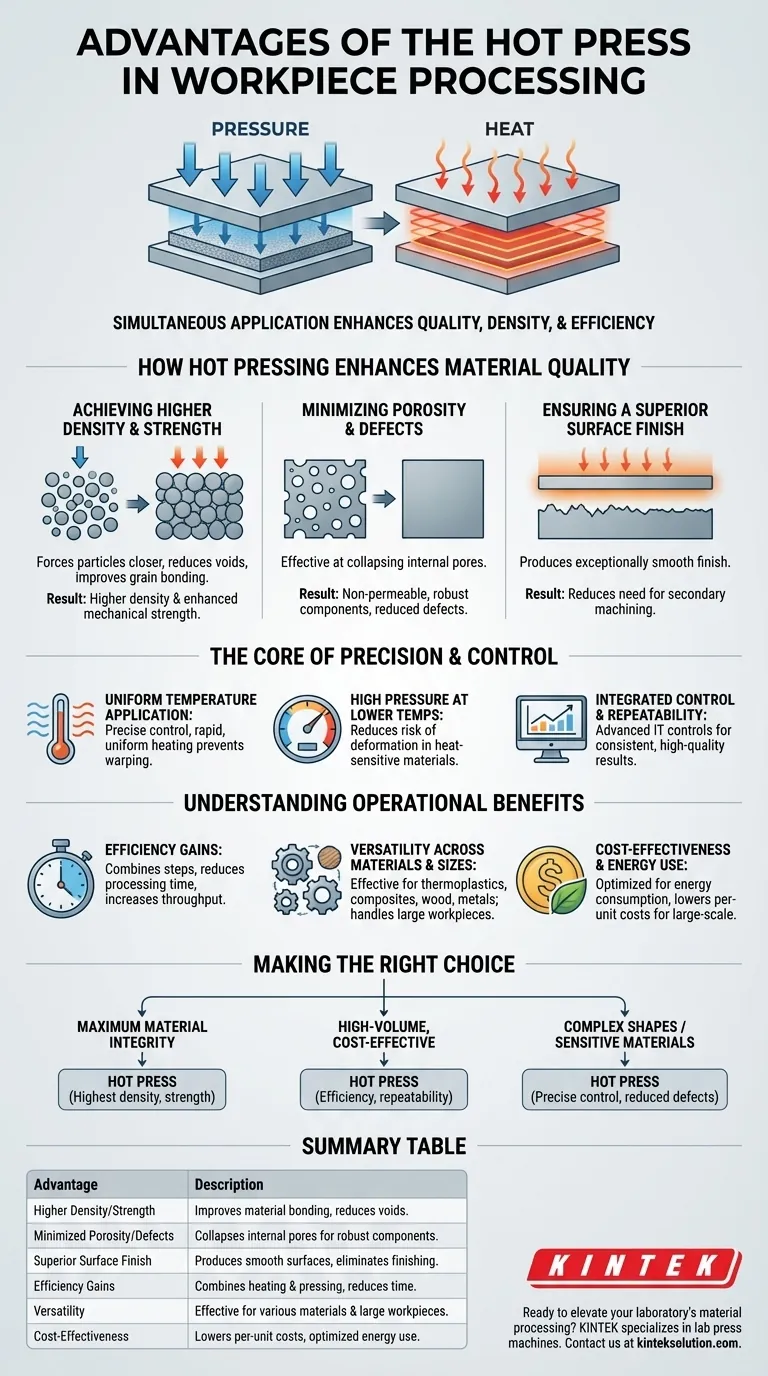
At its core, a hot press enhances workpiece quality by applying significant pressure and controlled heat simultaneously. This single, unified process improves material density, reduces processing time, and minimizes defects, resulting in superior mechanical properties and a better surface finish compared to methods that separate these forces.
The fundamental advantage of hot pressing is not just combining heat and pressure, but using their interaction to precisely control a material's final microstructure. This leads to end products that are stronger, denser, and more consistent than what can often be achieved through other means.
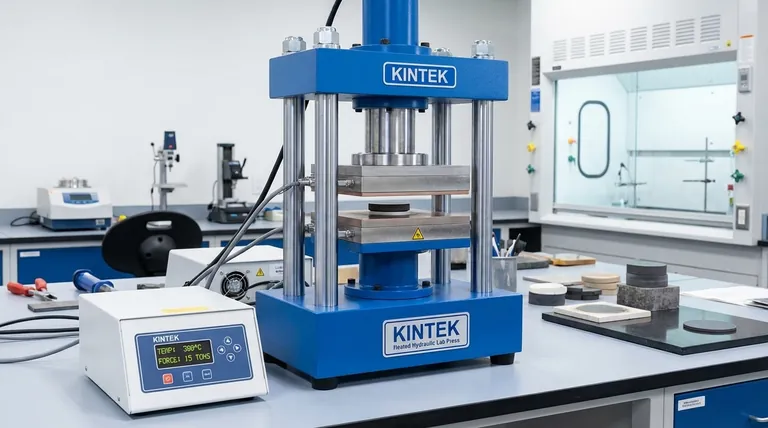
How Hot Pressing Enhances Material Quality
The primary function of a hot press is to fundamentally alter and improve a material's internal structure and external finish. This translates directly to higher-performing components.
Achieving Higher Density and Strength
By applying immense pressure at an elevated temperature, the hot press forces material particles closer together. This process significantly reduces internal voids and improves the bonding between grains.
The direct result is a workpiece with higher density and vastly enhanced mechanical strength.
Minimizing Porosity and Defects
The applied pressure is highly effective at collapsing internal pores and other irregularities within the material. This reduction in porosity is critical for creating non-permeable, robust components.
This process minimizes common defects, leading to a more reliable and structurally sound final product.
Ensuring a Superior Surface Finish
The combination of heat and a smooth press plate produces a workpiece with an exceptionally smooth surface finish.
This often reduces or eliminates the need for secondary machining or finishing processes, saving both time and cost.
The Core of Hot Pressing: Precision and Control
The quality improvements from hot pressing are not accidental; they are the result of a highly controllable and repeatable process.
Uniform Temperature Application
Modern hydraulic hot presses provide precise temperature control and rapid, uniform heating across the entire surface of the workpiece.
This consistency prevents warping and ensures that every part of the material undergoes the same transformation, eliminating weak spots caused by uneven heat.
The Role of High Pressure
A hot press can apply larger amounts of pressure at lower temperatures compared to some alternative methods, like negative pressure systems.
This high-pressure, lower-temperature combination reduces the risk of workpiece deformation or degradation, which is especially important for heat-sensitive materials.
Integrated Control and Repeatability
Many hot press systems integrate advanced IT controls. This allows for precise management of pressure, temperature, and time cycles.
This digital control ensures that the process is highly repeatable, guaranteeing consistent, high-quality results from one batch to the next.
Understanding the Operational Benefits
Beyond part quality, the hot press offers significant advantages in efficiency, versatility, and cost, though these factors must be weighed for any specific application.
Efficiency Gains in Production
Combining heating and pressing into a single operation reduces overall processing time and increases production throughput. Shorter cycle times lead directly to higher efficiency.
Versatility Across Materials and Sizes
The technology is not limited to one type of material. Hot presses are highly effective for a wide range of materials, including thermoplastics, composites, wood, and metals.
Furthermore, they can be designed to handle very large-diameter or large-surface-area workpieces, offering flexibility in scale.
Cost-Effectiveness and Energy Use
For large-scale production, hot pressing can be very cost-effective. The initial equipment investment is often reasonable, and the process's efficiency leads to lower per-unit costs.
The process is also designed for superior temperature uniformity, which minimizes wasted heat and reduces energy consumption compared to less-optimized heating methods.
Making the Right Choice for Your Application
Selecting a hot press depends entirely on your primary production goals.
- If your primary focus is maximum material integrity: A hot press is ideal for achieving the highest possible density, strength, and internal consistency in the final part.
- If your primary focus is high-volume, cost-effective production: The efficiency, reduced finishing needs, and repeatability of hot pressing make it a strong candidate for large-scale manufacturing.
- If your primary focus is processing complex shapes or sensitive materials: The precise control over lower temperatures and high pressure allows you to form parts with minimal risk of defects or material degradation.
Ultimately, a hot press empowers you to produce higher-quality components more efficiently by giving you direct control over the material's fundamental properties.
Summary Table:
| Advantage | Description |
|---|---|
| Higher Density and Strength | Improves material bonding and reduces voids for enhanced mechanical properties. |
| Minimized Porosity and Defects | Collapses internal pores to create robust, reliable components. |
| Superior Surface Finish | Produces smooth surfaces, often eliminating the need for secondary finishing. |
| Efficiency Gains | Combines heating and pressing into one step, reducing overall processing time. |
| Versatility | Effective for thermoplastics, composites, wood, and metals, including large workpieces. |
| Cost-Effectiveness | Lowers per-unit costs and energy consumption through optimized processes. |
Ready to elevate your laboratory's material processing with precision and efficiency? KINTEK specializes in lab press machines, including automatic lab presses, isostatic presses, and heated lab presses, designed to deliver superior density, strength, and consistency for your workpieces. Our solutions reduce defects, save time, and cut costs—perfect for laboratories focused on high-quality results. Contact us today to discuss how our hot press technology can transform your workflow!
Visual Guide
Related Products
- Automatic High Temperature Heated Hydraulic Press Machine with Heated Plates for Lab
- Heated Hydraulic Press Machine with Heated Plates for Vacuum Box Laboratory Hot Press
- Heated Hydraulic Press Machine With Heated Plates For Vacuum Box Laboratory Hot Press
- Automatic Heated Hydraulic Press Machine with Hot Plates for Laboratory
- Laboratory Manual Heated Hydraulic Press Machine with Hot Plates
People Also Ask
- Function of a Laboratory Hydraulic Press with Heated Platens in SSE? Enhance Battery Density & Conductivity
- What are the requirements for electrode pressing with high-viscosity ionic liquids like EMIM TFSI? Optimize Performance
- How does a laboratory heated hydraulic press facilitate PBN sample prep for WAXS? Achieve Precise X-Ray Scattering
- What are the industrial applications of heated hydraulic presses? Master Heat & Force for Precision Manufacturing
- Why is a laboratory hydraulic press with heating plates required for PLA/TEC films? Achieve Precise Sample Integrity



















