
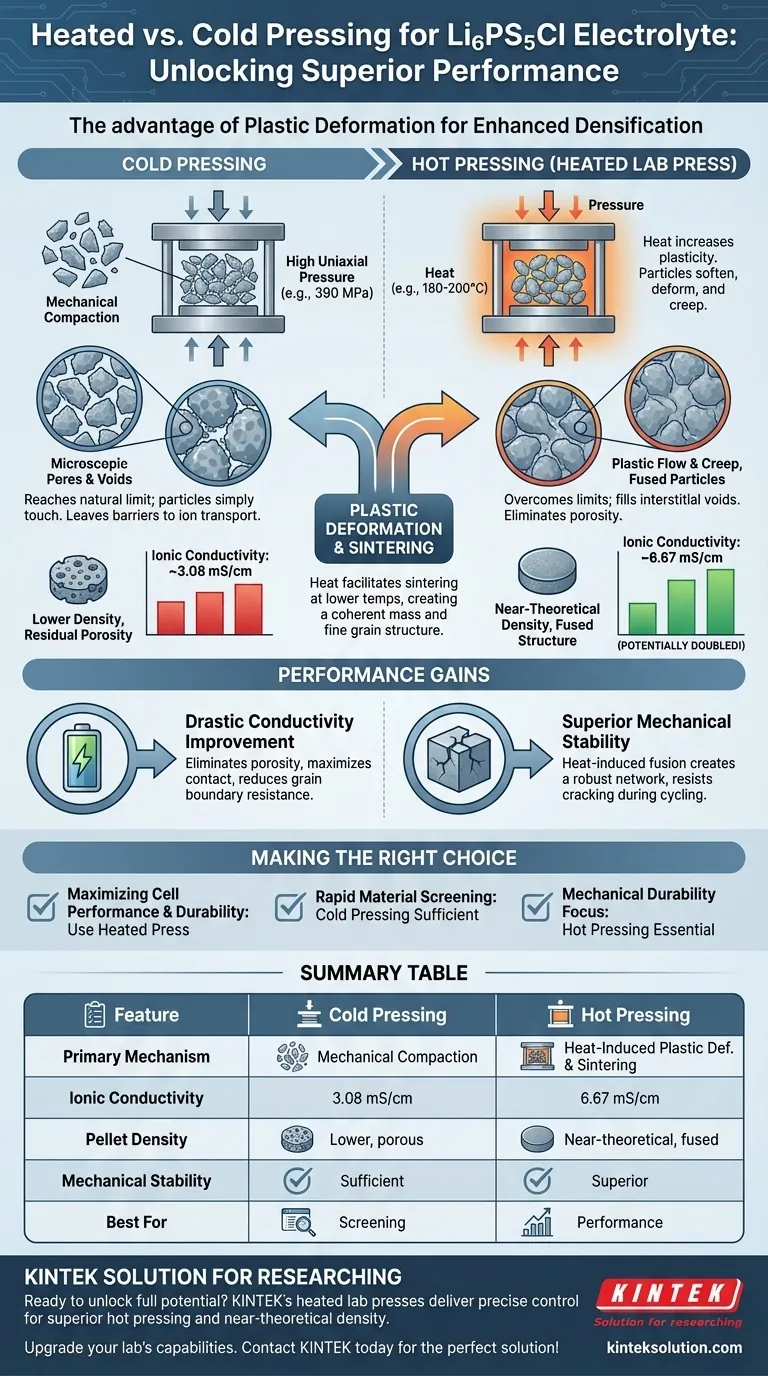
The primary advantage of using a heated lab press for Li6PS5Cl electrolyte powder is the ability to achieve superior densification through plastic deformation. While cold pressing relies solely on mechanical force to compact particles, the addition of heat softens the particle surfaces, allowing them to flow into voids and fuse together, resulting in a significantly more conductive and stable solid electrolyte.
Core Takeaway Cold pressing reaches a natural limit where particles simply touch; hot pressing overcomes this by inducing plastic flow and creep. This synergy of heat and pressure eliminates porosity and reduces grain boundary resistance, potentially doubling ionic conductivity compared to room-temperature processing.
The Mechanisms of Densification
Overcoming the Limits of Cold Pressing
Cold pressing effectively creates a solid separator by applying high uniaxial pressure (e.g., 390 MPa). However, this method relies primarily on mechanical compaction.
Even at high pressures, cold pressing often leaves microscopic pores and voids between particles. These voids act as barriers to ion transport and weaken the pellet's structural integrity.
The Role of Plastic Deformation
When you apply heat (e.g., 180°C to 200°C) simultaneously with pressure, the Li6PS5Cl particles undergo a fundamental change. The heat increases the plasticity of the material.
Instead of just being pushed together, the softened particles deform and "creep." This allows the material to fill interstitial voids that cold pressing simply cannot remove, pushing the pellet closer to its theoretical density.
Enhanced Sintering at Lower Temperatures
A heated press facilitates sintering—the process where particles fuse into a coherent mass—without requiring a separate, high-temperature furnace step.
By integrating pressure, you can achieve fine grain structures and high density at lower temperatures and shorter durations than traditional pressure-less sintering requires.
Performance Gains in Solid Electrolytes
Drastic Improvement in Ionic Conductivity
The most tangible benefit of hot pressing is the boost in electrical performance. By eliminating porosity, you maximize the contact area between particles.
This creates a more intimate solid-solid interface, significantly reducing grain boundary resistance.
Data indicates that this process can increase ionic conductivity from approximately 3.08 mS/cm (cold pressed) to 6.67 mS/cm (hot pressed).
Superior Mechanical Stability
Pellets formed via hot pressing exhibit greater mechanical strength. The heat-induced fusion creates a robust network rather than a loosely compacted aggregate.
This structural integrity is vital for battery assembly and long-term cycling, as it helps the electrolyte withstand the physical stresses of operation without cracking or delaminating.
Understanding the Trade-offs
The "Good Enough" Threshold
While hot pressing is superior for performance, cold pressing (at pressures like 390 MPa) can still produce a mechanically strong separator with "sufficient" integrity for many standard tests.
If your experimental goal does not require maximizing conductivity to the absolute theoretical limit, the complexity of heating may yield diminishing returns.
Process Parameters Matter
Hot pressing is not a "set it and forget it" solution; it requires precise control.
Successful fabrication relies on specific parameters (e.g., 200°C at 240 MPa or 180°C at 350 MPa). Deviating from these can result in incomplete densification or potential material degradation if temperatures climb too high.
Making the Right Choice for Your Goal
To decide between cold and hot pressing for your Li6PS5Cl fabrication, consider your specific performance targets:
- If your primary focus is maximizing cell performance: Use a heated press to double your ionic conductivity (up to ~6.67 mS/cm) and minimize internal resistance.
- If your primary focus is rapid material screening: Cold pressing is sufficient to check basic compatibility and stability, provided you account for the lower baseline conductivity.
- If your primary focus is mechanical durability: Hot pressing is essential to create a fused, dense pellet that resists void formation during cycling.
Ultimately, hot pressing transitions your electrolyte from a compacted powder into a fused ceramic-like layer, unlocking the material's true potential.
Summary Table:
| Feature | Cold Pressing | Hot Pressing (Heated Lab Press) |
|---|---|---|
| Primary Mechanism | Mechanical Compaction | Heat-Induced Plastic Deformation & Sintering |
| Typical Ionic Conductivity (Li6PS5Cl) | ~3.08 mS/cm | ~6.67 mS/cm |
| Pellet Density | Lower, with residual porosity | Near-theoretical density |
| Mechanical Stability | Sufficient for basic tests | Superior, fused ceramic-like structure |
| Best For | Rapid material screening | Maximizing cell performance & durability |
Ready to unlock the full potential of your solid electrolyte materials?
KINTEK's heated lab presses are engineered to deliver the precise temperature and pressure control required for superior hot pressing. By enabling plastic deformation and sintering at lower temperatures, our presses help you achieve near-theoretical density and drastically higher ionic conductivity in materials like Li6PS5Cl.
Upgrade your lab's capabilities and accelerate your battery research.
Contact KINTEK today to find the perfect lab press solution for your specific application!
Visual Guide
Related Products
- Cylindrical Lab Electric Heating Press Mold for Laboratory Use
- Lab Heat Press Special Mold
- Automatic High Temperature Heated Hydraulic Press Machine with Heated Plates for Lab
- Automatic Heated Hydraulic Press Machine with Hot Plates for Laboratory
- 24T 30T 60T Heated Hydraulic Lab Press Machine with Hot Plates for Laboratory
People Also Ask
- How does a laboratory electric heated press ensure sample quality? Optimize SiR-EPDM vulcanization and molding.
- What role does a laboratory electric heated press play in polymer composite fabrication? Key for Standardized Specimens
- What role does a laboratory electric heating press play in NBR molding? Master Vulcanization & Material Density
- Why is a laboratory electric heating press required for PP/EPDM molding? Achieve Superior Specimen Integrity
- What is the purpose of incorporating cartridge heaters into a lab press mold for MLCC block compression? Optimize Results



















