
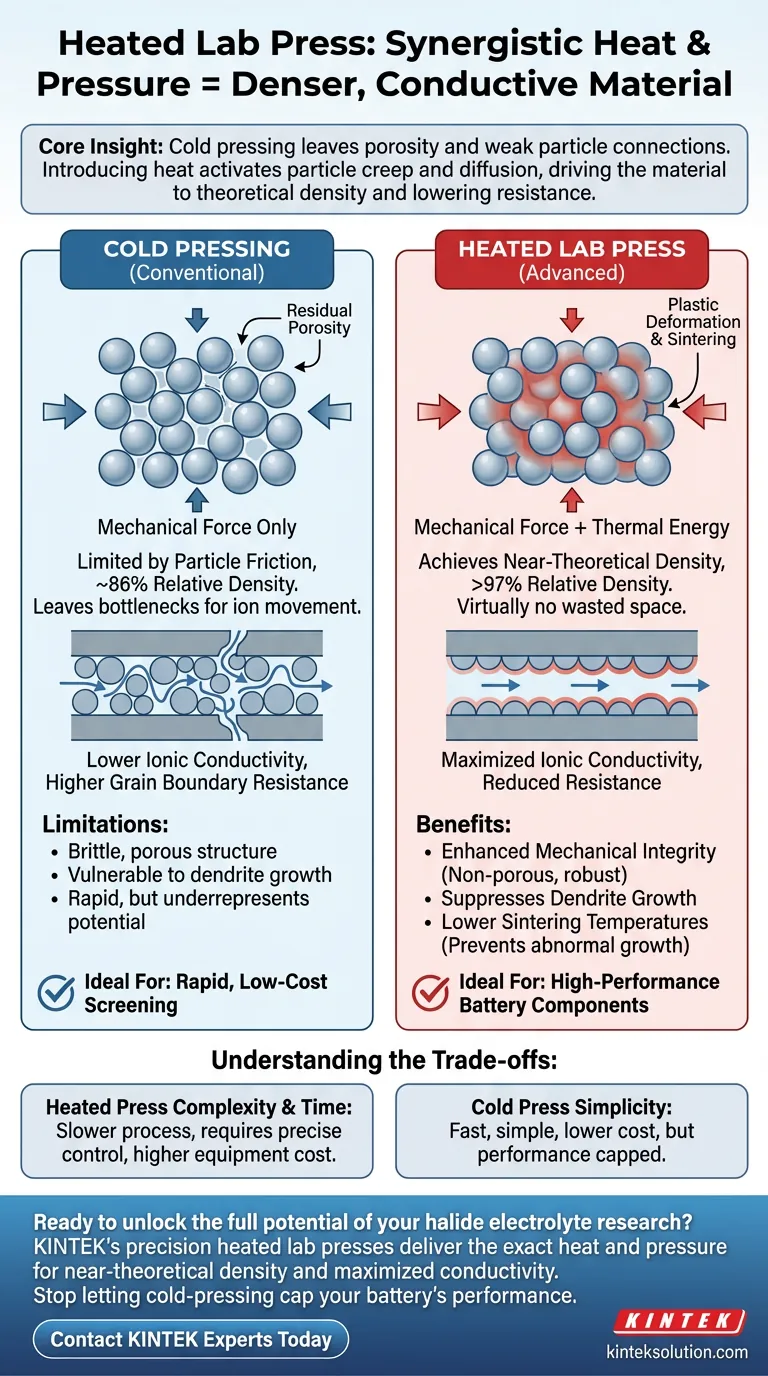
The primary advantage of using a heated lab press is the synergistic application of thermal energy and mechanical force, which creates a denser, more conductive material than cold pressing can achieve. While cold pressing relies solely on mechanical compaction to pack powder particles, a heated press softens the material, promoting plastic deformation and sintering to eliminate microscopic voids.
Core Insight Cold pressing often leaves residual porosity and weak connections between particles, which act as bottlenecks for ion movement. By introducing heat during compression, you activate mechanisms like particle creep and diffusion, driving the electrolyte separator toward its theoretical density and significantly lowering the resistance that impedes battery performance.
The Mechanics of Densification
Overcoming the Limits of Cold Pressing
Conventional cold pressing is limited by the friction between particles. Even under high pressure, particles can only pack so tightly before they lock in place, leaving gaps (pores) between them.
The Role of Plastic Deformation
When you apply heat, the surface of the halide electrolyte particles softens. This increases plasticity, allowing the particles to deform and flow into the empty spaces that cold pressing cannot reach.
Achieving Theoretical Density
This process allows the material to approach its theoretical density—the state where virtually no wasted space remains. References indicate that hot pressing can increase relative density from roughly 86% (common in conventional sintering) to over 97%.
Impact on Electrochemical Performance
Reducing Grain Boundary Resistance
The interface where two particles meet is often the point of highest resistance in a solid electrolyte. By fusing particles together via heat and pressure, you tighten these grain boundaries.
Maximizing Ionic Conductivity
Because the grain boundaries are tighter and porosity is eliminated, ions have a clearer, less obstructed path. This results in a substantial increase in ionic conductivity, which is the critical metric for battery efficiency.
Suppressing Dendrite Growth
A denser, non-porous microstructure is physically robust. This density is crucial for suppressing the penetration of lithium dendrites, which can cause short circuits in less dense, cold-pressed separators.
Operational and Structural Benefits
Lower Sintering Temperatures
Simultaneously applying pressure reduces the thermal energy required to bond particles. This allows you to sinter materials at lower temperatures or for shorter durations, preventing abnormal grain growth that can degrade performance.
Enhanced Mechanical Integrity
Pellets produced via hot pressing exhibit superior mechanical stability. They are less brittle and have better bonding between particles, which improves their ability to withstand the physical stress of repeated charging and discharging cycles.
Understanding the Trade-offs
While the performance benefits are clear, utilizing a heated lab press involves specific considerations regarding process complexity.
Process Complexity and Time
Hot pressing is generally a slower process than cold pressing. It requires time for the equipment to heat up, stabilize, and cool down, which can reduce throughput compared to the rapid stamping of cold press methods.
Equipment Cost and Precision
Heated presses are more sophisticated pieces of equipment requiring precise control over temperature and pressure ramps. This increases the initial capital investment and requires more careful calibration to ensure consistent results.
Making the Right Choice for Your Goal
To determine if the transition to a heated press is necessary for your specific application, consider your primary performance metrics.
- If your primary focus is maximum ionic conductivity: You must use a heated press to minimize grain boundary resistance and achieve the high density required for efficient ion transport.
- If your primary focus is mechanical durability: A heated press is essential to create a robust, non-porous pellet that can survive long-term cycling without structural failure.
- If your primary focus is rapid, low-cost screening: Cold pressing may suffice for initial material checks, but the data will likely underrepresent the material's true potential.
For high-performance halide electrolytes, heat is not just an additive factor; it is the catalyst that transforms a packed powder into a functional, conductive ceramic component.
Summary Table:
| Feature | Cold Pressing | Heated Lab Press |
|---|---|---|
| Relative Density | ~86% | >97% |
| Ionic Conductivity | Lower (porosity limits) | Significantly Higher |
| Mechanical Integrity | Brittle, porous | Dense, robust, suppresses dendrites |
| Process Simplicity | Fast, simple | Slower, requires precise control |
| Ideal For | Rapid, low-cost screening | High-performance battery components |
Ready to unlock the full potential of your halide electrolyte research?
KINTEK's precision heated lab presses (including automatic and isostatic models) are engineered to deliver the exact combination of heat and pressure required to achieve near-theoretical density and maximize ionic conductivity in your separators. Stop letting cold-pressing limitations cap your battery's performance.
Contact our lab equipment experts today to discuss how a KINTEK heated press can accelerate your development of safer, more efficient solid-state batteries.
Visual Guide
Related Products
- 24T 30T 60T Heated Hydraulic Lab Press Machine with Hot Plates for Laboratory
- Automatic Heated Hydraulic Press Machine with Hot Plates for Laboratory
- Automatic High Temperature Heated Hydraulic Press Machine with Heated Plates for Lab
- Cylindrical Lab Electric Heating Press Mold for Laboratory Use
- Manual Heated Hydraulic Lab Press with Integrated Hot Plates Hydraulic Press Machine
People Also Ask
- Function of a Laboratory Hydraulic Press with Heated Platens in SSE? Enhance Battery Density & Conductivity
- Why is a laboratory hydraulic press with heating plates required for PLA/TEC films? Achieve Precise Sample Integrity
- What role does a laboratory heated hydraulic press play in LTCC? Essential for High-Density Ceramic Lamination
- Why reduce load when applying composite strengthening tabs? Protect Specimen Integrity and Data Accuracy
- Why is a laboratory heated hydraulic press required? Ensure Precise Vulcanization for NBR/EPDM Nanocomposites



















