
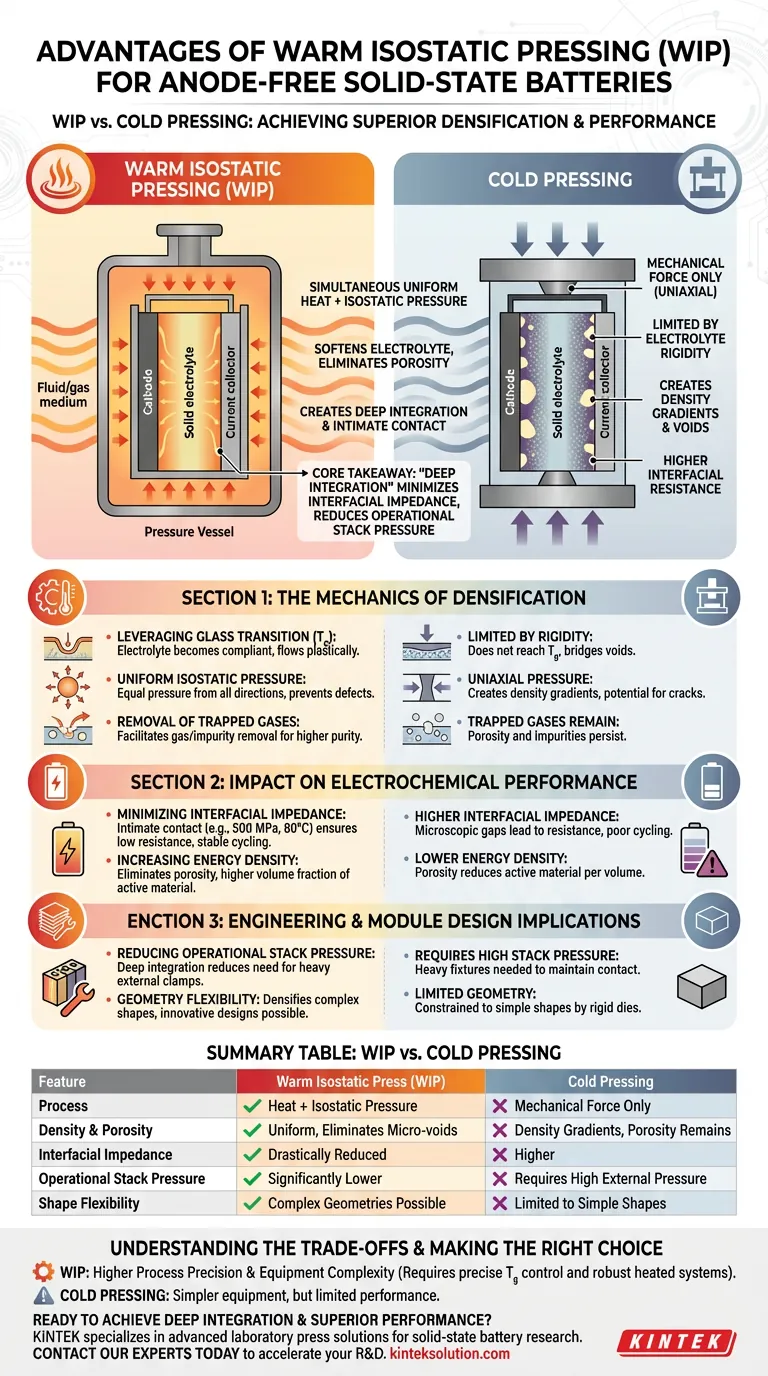
Warm Isostatic Pressing (WIP) creates superior anode-free solid-state batteries by simultaneously applying uniform isostatic pressure and moderate heat, typically near the solid electrolyte's glass transition temperature. Unlike cold-pressing methods that rely solely on mechanical force, WIP softens the electrolyte material to eliminate internal porosity and forge a seamless, chemically intimate interface between layers.
Core Takeaway: The definitive advantage of WIP is the ability to achieve "deep integration" at the microscopic level. By processing the battery near the electrolyte's glass transition point ($T_g$), you drastically reduce interfacial impedance and remove the need for excessive external stack pressure during the battery's operational life.
The Mechanics of Densification
Leveraging the Glass Transition Temperature
Cold pressing is limited by the inherent rigidity of the solid electrolyte. WIP overcomes this by heating the material to its glass transition temperature ($T_g$).
At this specific thermal point, the electrolyte becomes compliant. This allows it to flow plastically under pressure, filling microscopic voids that cold pressing would bridge over and leave empty.
Uniform Isostatic Pressure
Cold pressing, particularly uniaxial pressing, often creates density gradients where the center is less dense than the edges.
WIP applies pressure equally from all directions using a warm medium (fluid or gas). This ensures the entire battery stack achieves uniform density, preventing the formation of compact defects or stress risers common in cold-pressed parts.
Removal of Trapped Gases
A major failure point in solid-state batteries is gas trapped within the powder compact.
The combination of a warm medium and isostatic pressure actively facilitates the removal of trapped gases and impurities. This results in a higher purity product with improved structural integrity compared to cold-processed alternatives.
Impact on Electrochemical Performance
Minimizing Interfacial Impedance
The primary bottleneck in solid-state batteries is the resistance at the solid-solid interface.
WIP typically operates at parameters such as 500 MPa and 80°C to force the cathode, electrolyte, and current collector into intimate contact. This eliminates microscopic gaps, ensuring low resistance and enabling stable, long-term cycling performance.
Increasing Energy Density
By eliminating porosity more effectively, WIP increases the volume fraction of active material.
This densification allows for a higher overall energy density. The battery contains more energy-storing material per unit of volume compared to a less dense, cold-pressed counterpart.
Engineering and Module Design Implications
Reducing Operational Stack Pressure
Solid-state batteries often require heavy external clamps (stack pressure) to maintain contact during operation.
Because WIP achieves deep integration during manufacturing, the finished cell requires significantly lower stack pressure to function. This allows engineers to simplify mechanical fixtures, reducing the weight and complexity of the final battery module.
Geometry and Shape Flexibility
Cold pressing is often constrained to simple shapes due to the limitations of rigid dies.
Isostatic compaction allows for the densification of complex shapes and geometries. This removes design constraints, allowing for more efficient material utilization and innovative cell form factors.
Understanding the Trade-offs
Process Precision and Control
While WIP offers superior results, it introduces a higher level of process complexity than cold pressing.
Success relies heavily on precise temperature control relative to the electrolyte's $T_g$. Applying pressure at the wrong temperature fails to achieve the "softening" effect, negating the benefits of the warm process.
Equipment Complexity
WIP requires equipment capable of handling high pressure and heat simultaneously.
This is inherently more complex than standard cold hydraulic presses. The system must manage a heated fluid or gas medium safely, requiring robust seals and thermal management systems not needed for cold pressing.
Making the Right Choice for Your Goal
To maximize the potential of your anode-free solid-state battery project, consider your primary engineering constraints.
- If your primary focus is Electrochemical Performance: Prioritize WIP to minimize interfacial impedance and ensure stable long-term cycling through superior contact.
- If your primary focus is Module Weight and Efficiency: Use WIP to achieve deep integration, which allows you to reduce the heavy mechanical fixtures required for stack pressure.
WIP is not just a densification method; it is a critical enabling technology for viable, high-performance solid-state batteries.
Summary Table:
| Feature | Warm Isostatic Press (WIP) | Cold Pressing |
|---|---|---|
| Process | Heat + Isostatic Pressure | Mechanical Force Only |
| Density & Porosity | Uniform, Eliminates Micro-voids | Density Gradients, Porosity Remains |
| Interfacial Impedance | Drastically Reduced | Higher |
| Operational Stack Pressure | Significantly Lower | Requires High External Pressure |
| Shape Flexibility | Complex Geometries Possible | Limited to Simple Shapes |
Ready to achieve deep integration and superior performance for your solid-state battery research?
KINTEK specializes in advanced laboratory press solutions, including Warm Isostatic Presses (WIP) designed for the precise temperature and pressure control required to densify anode-free solid-state batteries. Our expertise can help you:
- Minimize interfacial impedance for stable, long-term cycling.
- Increase energy density by eliminating porosity.
- Simplify module design by reducing operational stack pressure requirements.
Contact our experts today to discuss how a KINTEK lab press can accelerate your R&D. Get in Touch Now
Visual Guide
Related Products
- Warm Isostatic Press for Solid State Battery Research Warm Isostatic Press
- Electric Lab Cold Isostatic Press CIP Machine
- Automatic Lab Cold Isostatic Pressing CIP Machine
- Manual Cold Isostatic Pressing CIP Machine Pellet Press
- Electric Split Lab Cold Isostatic Pressing CIP Machine
People Also Ask
- Why must composite cathodes be sealed in vacuum lamination bags for WIP? Ensure Battery Stability and Density
- How do sacrificial volume materials (SVM) maintain microchannels in isostatic pressing? Ensure Structural Integrity
- What is the function of elastic molds in warm isostatic pressing? Achieve Uniform Density in Composite Particles
- What is the role of the flexible material in warm isostatic pressing? Key to Uniform Density & Precision
- What is the function of hydraulic pressure in warm isostatic pressing? Achieve Uniform Material Density



















