
In short, pellet pressing is a critical technique used to transform powdered materials into solid, uniform discs for a vast range of applications. Its use spans industrial manufacturing in pharmaceuticals and nuclear energy to fundamental research in materials science and environmental analysis, where sample consistency is paramount.
The core value of pellet pressing lies in its ability to create standardized, dense, and homogenous samples. This eliminates variables, ensuring that results from analysis or manufacturing are repeatable, reliable, and directly comparable.
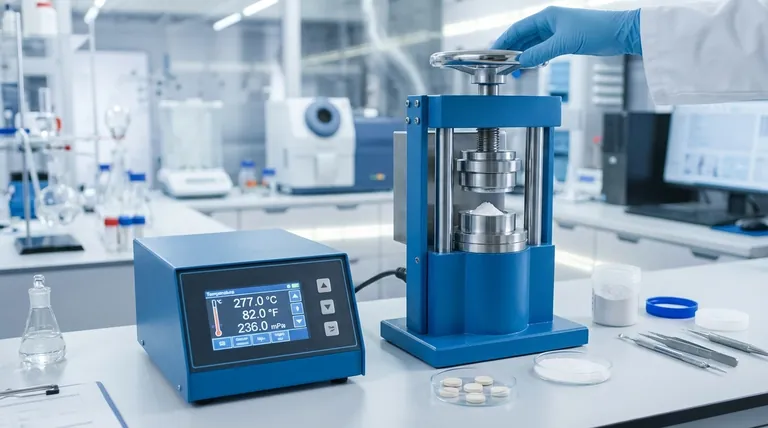
The Core Principle: Why Uniformity is Essential
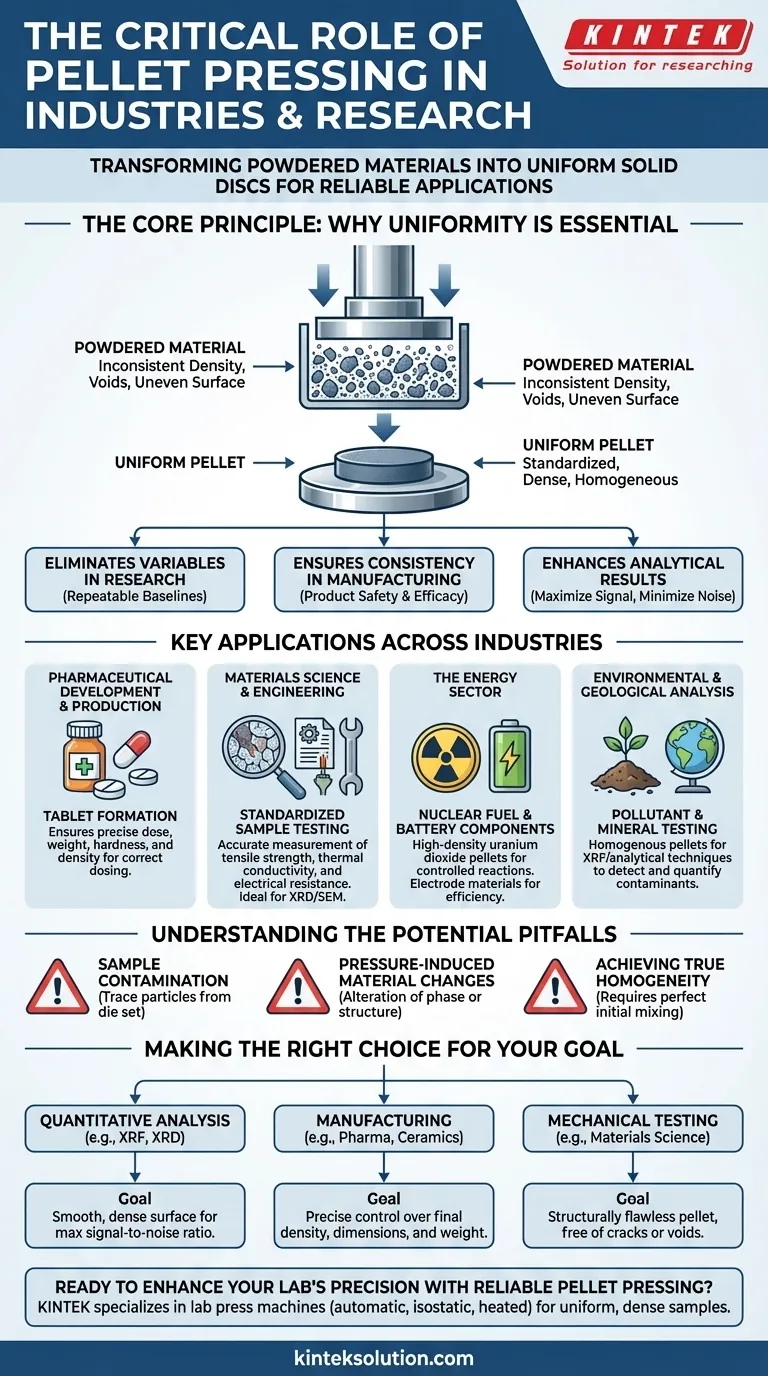
The simple act of pressing a powder into a solid pellet solves a fundamental challenge in both science and industry: variability. An unpressed powder has inconsistencies in density and surface texture that can dramatically skew results.
Eliminating Variables in Research
In any scientific experiment, the goal is to isolate a single variable. A non-uniform sample introduces unwanted variables like inconsistent density, voids, and an uneven surface, which can corrupt analytical data.
By creating a homogenous pellet, researchers establish a reliable baseline. This ensures that any observed changes are due to the experimental conditions, not random variations in the sample itself.
Ensuring Consistency in Manufacturing
In industrial settings, consistency is directly tied to product safety and efficacy. For a pharmaceutical tablet, uniform density ensures a precise dose and predictable dissolution rate in the body.
Similarly, in nuclear energy, the density and homogeneity of a uranium fuel pellet directly dictate its performance and safety within a reactor. Pellet pressing is the manufacturing step that guarantees these critical properties.
Enhancing Analytical Results
Many analytical techniques, such as X-ray diffraction (XRD) or scanning electron microscopy (SEM), work by bouncing energy off a sample's surface.
A dense, smooth pellet provides a flat, uniform surface that minimizes background noise and maximizes the analytical signal. This leads to clearer, more accurate, and more easily interpretable data.
Key Applications Across Industries
The need for uniform samples makes pellet pressing a go-to technique in nearly every field that deals with solid materials.
Pharmaceutical Development and Production
Pellet presses are essential for forming tablets. They ensure that the active pharmaceutical ingredients (APIs) and inactive excipients are compressed into a tablet with a precise weight, hardness, and density for correct dosing.
Materials Science and Engineering
This field relies heavily on pellet pressing to create standardized samples for testing. Researchers craft uniform pellets of metals, ceramics, and polymers to accurately measure properties like tensile strength, thermal conductivity, and electrical resistance.
These pellets are also ideal for characterization techniques like XRD and SEM, which require a prepared, flat surface for analysis.
The Energy Sector
The nuclear industry uses pellet pressing to produce high-density uranium dioxide fuel pellets. The uniformity of these pellets is critical for controlling the nuclear reaction and ensuring efficient heat transfer.
In renewable energy, the technique is used to prepare materials for battery electrodes and solid-oxide fuel cells, where density and surface contact are vital for performance.
Environmental and Geological Analysis
When analyzing pollutants in soil or sediment, scientists press the material into a pellet to create a homogenous sample for techniques like X-ray fluorescence (XRF). This allows for accurate detection and quantification of contaminants.
Geologists use the same method to prepare rock and ore samples for mineralogical and elemental analysis.
Understanding the Potential Pitfalls
While incredibly useful, the process is not without its considerations. An expert must be aware of the potential trade-offs to ensure data integrity.
Risk of Sample Contamination
The die set used for pressing can, over time, shed microscopic particles. This can introduce trace contaminants into the sample, which may be a concern for high-purity applications or trace element analysis.
Pressure-Induced Material Changes
The immense pressure applied during pressing can sometimes alter the physical state of the material. It may induce phase changes in the crystalline structure or trigger chemical reactions in sensitive compounds, subtly changing the sample from its original state.
Achieving True Homogeneity
Pellet pressing compacts the material, but it cannot fix a poorly mixed initial powder. If the starting material is not perfectly homogenous, the resulting pellet will contain gradients in composition, undermining the goal of uniformity.
Making the Right Choice for Your Goal
The way you approach pellet pressing should be dictated by your ultimate objective.
- If your primary focus is quantitative analysis (e.g., XRF, XRD): Your goal is to create a pellet with a perfectly smooth, flat, and dense surface to maximize signal-to-noise ratio and ensure repeatable measurements.
- If your primary focus is manufacturing (e.g., Pharmaceuticals, Ceramics): Your objective is to achieve precise and repeatable control over the pellet's final density, dimensions, and weight for consistent product performance and safety.
- If your primary focus is mechanical testing (e.g., Materials Science): You must create a structurally flawless pellet, free of internal cracks or voids, to obtain an accurate measurement of the material's intrinsic physical properties.
Ultimately, pellet pressing is a foundational technique that turns unreliable powders into the consistent, predictable solids that modern science and industry depend on.
Summary Table:
| Application Area | Key Use Cases | Benefits |
|---|---|---|
| Pharmaceutical Development | Tablet formation, drug dosing | Precise weight, hardness, and density for safety and efficacy |
| Materials Science | Sample testing, XRD/SEM analysis | Accurate property measurements and uniform surfaces |
| Energy Sector | Nuclear fuel, battery electrodes | Controlled density and performance for efficiency |
| Environmental Analysis | Soil/contaminant testing via XRF | Homogeneous samples for reliable data |
Ready to enhance your lab's precision with reliable pellet pressing? KINTEK specializes in lab press machines, including automatic, isostatic, and heated lab presses, designed to meet the needs of laboratories in pharmaceuticals, materials science, energy, and environmental research. Our equipment ensures uniform, dense samples for accurate analysis and consistent manufacturing. Contact us today to discuss how our solutions can benefit your specific applications!
Visual Guide
Related Products
- Laboratory Hydraulic Split Electric Lab Pellet Press
- Manual Laboratory Hydraulic Pellet Press Lab Hydraulic Press
- Laboratory Hydraulic Pellet Press for XRF KBR FTIR Lab Press
- Automatic Laboratory Hydraulic Press Lab Pellet Press Machine
- Automatic Laboratory Hydraulic Press for XRF and KBR Pellet Pressing
People Also Ask
- What are the emerging trends in the design and materials of lab pellet presses? Modernize Your Lab Efficiency
- How do lab pellet presses support customization and flexibility? Optimize Your Sample Prep for Any Material
- What are common lab pellet press issues? Expert Troubleshooting Guide for Reliable Material Research
- What are the common operational types of lab pellet presses? Choosing the Right Manual, Automatic, or Hydraulic System
- Why use a laboratory pellet press for solid-state battery evaluation? Ensure Accuracy in Interface Stability Testing



















