
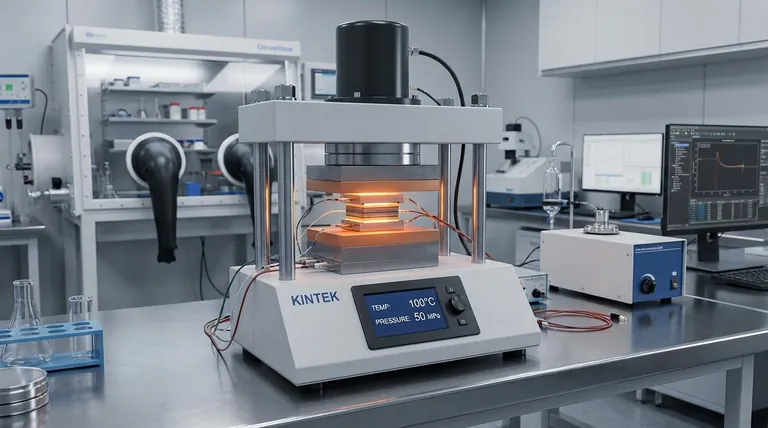
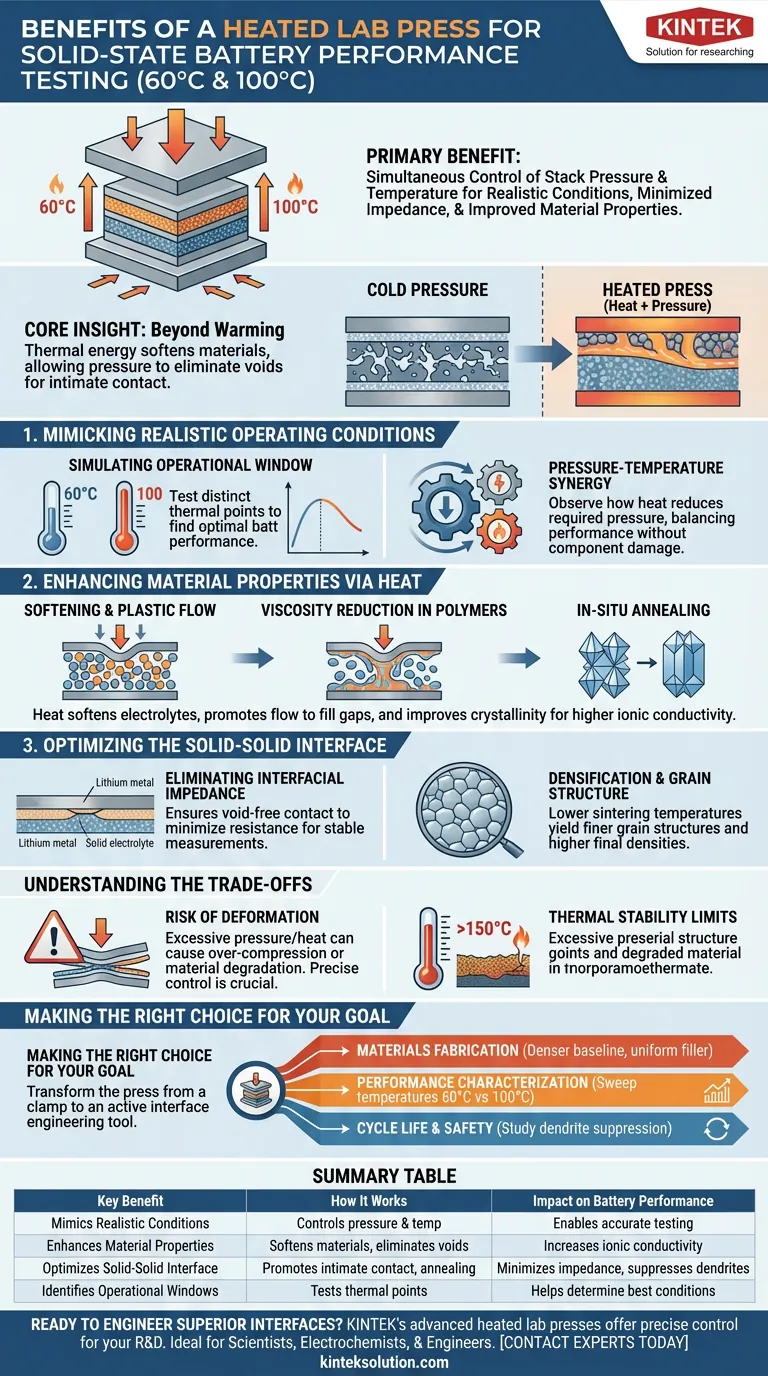
The primary benefit of using a heated lab press for solid-state battery testing is the ability to simultaneously control stack pressure and temperature. This dual control allows you to replicate realistic operating conditions (such as 60°C to 100°C) to minimize interfacial impedance, while improving material density and ionic conductivity through in-situ annealing and softening effects.
Core Insight: In solid-state batteries, performance is dictated by the quality of physical contact between solid layers. A heated press does not merely warm the sample; it uses thermal energy to soften materials, allowing the applied pressure to eliminate microscopic voids and create a seamless, high-performance interface that cold pressure alone cannot achieve.
Mimicking Realistic Operating Conditions
Simulating the Operational Window
Solid-state batteries often require elevated temperatures to achieve optimal ionic conductivity. A heated press allows you to test distinct thermal points, such as 60°C and 100°C, to determine the specific operational window where the battery performs best.
Assessing Pressure-Temperature Synergy
Pressure and temperature are not isolated variables; they interact dynamically. By controlling both, researchers can observe how increased heat reduces the mechanical pressure required to achieve adequate contact. This helps in identifying the ideal balance that maximizes performance without physically damaging the cell components.
Enhancing Material Properties via Heat
Softening and Plastic Flow
For composite cathodes and polymer electrolytes, applying gentle heat (e.g., below 150°C) lowers the bulk modulus of the material. This softens the electrolyte particles, promoting plastic flow. Under pressure, these softened materials fill gaps more effectively, creating a denser, void-free interface with active materials.
Viscosity Reduction in Polymers
When working with composite polymer electrolytes, heat significantly reduces the viscosity of the polymer matrix. This enhances the material's flowability and ability to "wet" filler particles. The result is a more uniform distribution of inorganic fillers and the elimination of internal bubbles that could hinder ion transport.
In-Situ Annealing
The heating process acts as an annealing treatment during the compression phase. This can improve the crystallinity of the electrolyte, which directly correlates to enhanced ionic conductivity within the composite electrode.
Optimizing the Solid-Solid Interface
Eliminating Interfacial Impedance
The greatest challenge in solid-state batteries is the resistance at the point where layers meet. A heated press ensures intimate, void-free physical contact between the lithium metal electrode and the solid electrolyte. This physical continuity is fundamental for minimizing interfacial impedance and enabling stable electrochemical measurements.
Densification and Grain Structure
For ceramic components, the combination of heat and pressure can lower the required sintering temperature and duration. This process yields finer grain structures and higher final densities. Denser materials generally exhibit superior mechanical properties and ionic conductivity compared to those processed at lower temperatures or without pressure.
Understanding the Trade-offs
The Risk of Deformation
While heat facilitates better contact, it also makes materials more compliant. Excessive pressure at elevated temperatures (e.g., approaching 100°C for certain polymers) can lead to over-compression or deformation of the separator layer, potentially causing short circuits.
Thermal Stability Limits
The "gentle heat" mentioned (often below 150°C) is a critical boundary. Exceeding the thermal stability limit of specific organic components in a composite electrolyte can degrade the material rather than anneal it. Precise temperature regulation is required to stay within the beneficial window of flow and annealing without crossing into decomposition.
Making the Right Choice for Your Goal
If your primary focus is Materials Fabrication:
- Use the heated press to lower sintering temperatures and ensure uniform filler distribution in composite films, creating a denser baseline material.
If your primary focus is Performance Characterization:
- Use the heated press to sweep through temperatures (60°C vs. 100°C) while maintaining constant pressure to identify the precise thermal environment required for peak ionic conductivity.
If your primary focus is Cycle Life & Safety:
- Leverage the uniform pressure capability to study the suppression of lithium dendrite growth under realistic thermal operating conditions.
By integrating heat with pressure, you transform the press from a simple clamp into an active tool for interface engineering and material optimization.
Summary Table:
| Key Benefit | How It Works | Impact on Battery Performance |
|---|---|---|
| Mimics Realistic Conditions | Simultaneously controls pressure and temperature (e.g., 60°C, 100°C) | Enables accurate performance testing under actual operating environments |
| Enhances Material Properties | Heat softens materials, allowing pressure to eliminate voids and improve density | Increases ionic conductivity and creates seamless, high-performance interfaces |
| Optimizes Solid-Solid Interface | Promotes intimate contact between layers via in-situ annealing and plastic flow | Minimizes interfacial impedance and suppresses lithium dendrite growth for improved safety and cycle life |
| Identifies Operational Windows | Tests specific thermal points to find the ideal pressure-temperature synergy | Helps determine the best conditions for peak performance without damaging components |
Ready to Engineer Superior Solid-State Battery Interfaces?
Accurately replicating real-world conditions is key to developing high-performance, safe solid-state batteries. KINTEK's advanced heated lab presses provide the precise control over pressure and temperature (from 60°C to 100°C and beyond) you need to optimize material interfaces, enhance ionic conductivity, and accelerate your R&D.
Our heated lab presses are ideal for:
- Materials Scientists fabricating denser composite electrodes and electrolytes
- Electrochemists characterizing performance under realistic thermal and pressure conditions
- Battery Engineers studying cycle life and dendrite suppression strategies
Discover how KINTEK's specialized lab equipment can transform your solid-state battery research. Contact our experts today for a personalized consultation!
Visual Guide
Related Products
- Warm Isostatic Press for Solid State Battery Research Warm Isostatic Press
- Cylindrical Lab Electric Heating Press Mold for Laboratory Use
- Laboratory Hydraulic Press Lab Pellet Press Button Battery Press
- Automatic High Temperature Heated Hydraulic Press Machine with Heated Plates for Lab
- 24T 30T 60T Heated Hydraulic Lab Press Machine with Hot Plates for Laboratory
People Also Ask
- Why must composite cathodes be sealed in vacuum lamination bags for WIP? Ensure Battery Stability and Density
- How do sacrificial volume materials (SVM) maintain microchannels in isostatic pressing? Ensure Structural Integrity
- What is the function of elastic molds in warm isostatic pressing? Achieve Uniform Density in Composite Particles
- What is the significance of temperature control in Warm Isostatic Pressing? Unlock Uniform Densification and Process Stability
- What is the function of hydraulic pressure in warm isostatic pressing? Achieve Uniform Material Density



















