
An H-frame hydraulic press is a robust machine characterized by a vertical steel frame constructed with two columns, resembling the letter "H," which houses a press cylinder, pump, and adjustable bolster. These presses range from small, portable benchtop units to massive industrial floor models, all utilizing hydraulic fluid to generate substantial compressive force for shaping, assembling, or testing materials.
The distinctive "H" shape provides superior structural rigidity, allowing the press to handle high-tonnage applications while maintaining the alignment necessary for precise operations in repair shops, assembly lines, and laboratories.
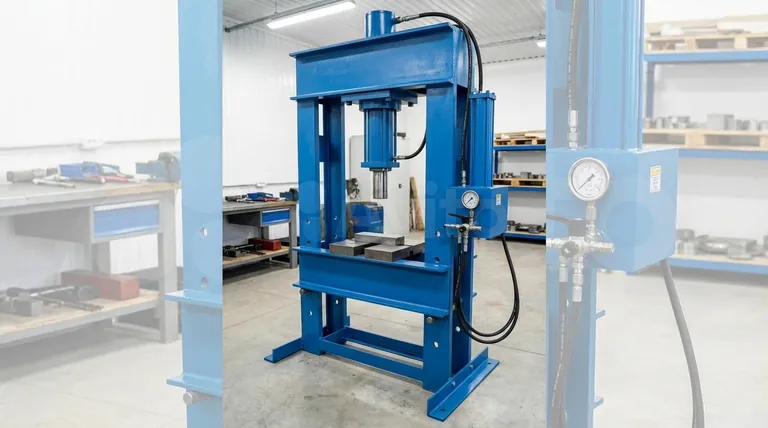
The Structural Anatomy
The defining feature of this press is its frame, but its functionality relies on the integration of several critical components.
The "H" Frame and Bolster
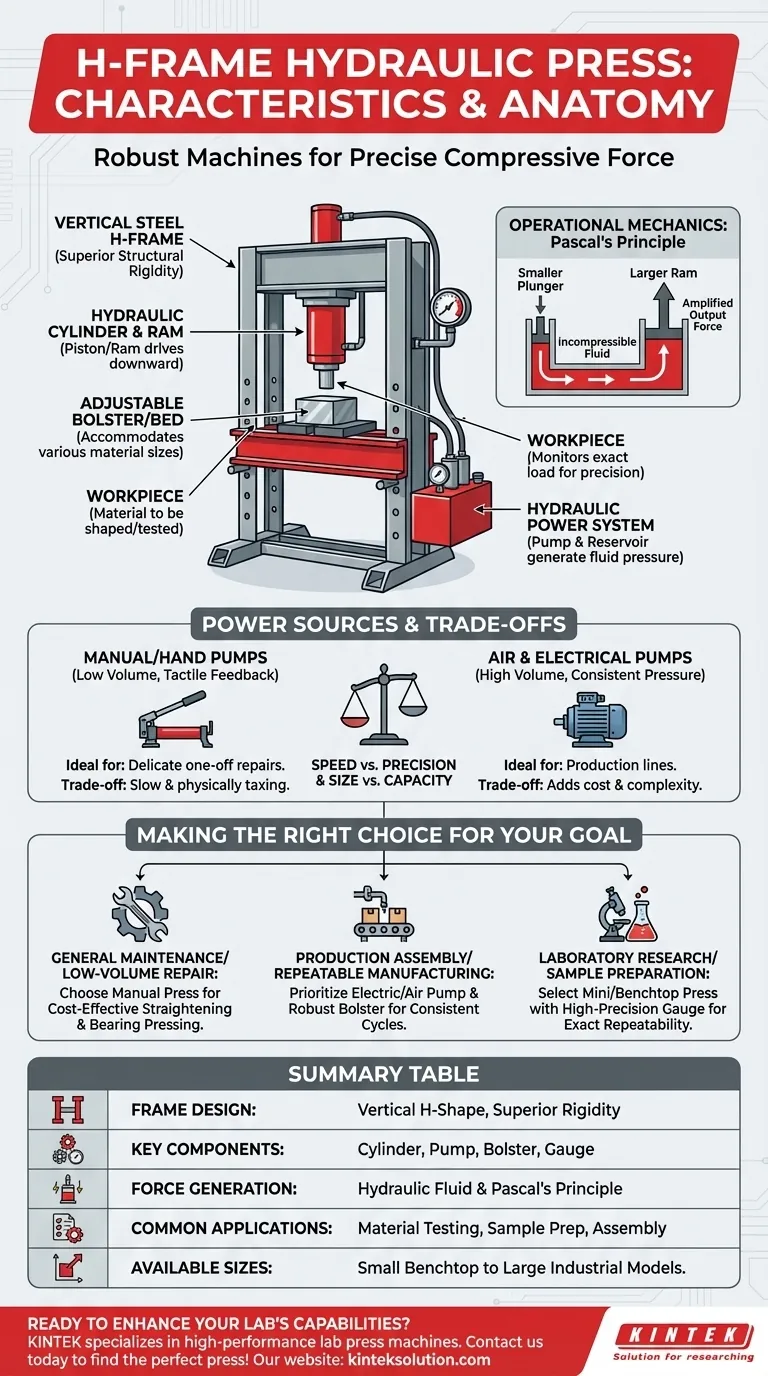
The mainframe is the skeleton of the machine, consisting of two vertical uprights connected by top and bottom cross-members. This design creates a stable, open span for the workpiece.
Between the columns sits the bolster, or bed. This is an adjustable platform that can be raised or lowered to accommodate materials of varying sizes, holding the die or workpiece securely during operation.
The Hydraulic Power System
At the heart of the machine is the hydraulic cylinder (containing a piston or ram), a fluid reservoir, and a pump. The pump pressurizes the hydraulic fluid, which is then forced into the cylinder.
This pressure acts upon the piston, driving it downward with immense force. The total force capability of the press is directly determined by the size and capacity of this cylinder.
Control Instruments
To manage this power, the press utilizes a system of control valves and gauges. Valves regulate the flow and direction of the fluid, giving the operator precise control over the piston's movement.
A pressure gauge is a critical component, particularly in laboratory or precision settings. It allows the operator to monitor the exact load being applied, ensuring repeatability and preventing damage to the workpiece.
Operational Mechanics
Understanding how the H-frame generates force helps in selecting the right model for your needs.
Hydraulic Force Generation
The mechanism relies on Pascal's principle. The system forces hydraulic fluid from a smaller plunger cylinder into a larger ram cylinder.
Because liquids are incompressible, the pressure is transmitted equally. As the larger piston moves, it amplifies the input force, allowing a relatively small motor or hand pump to generate tons of mechanical pressure on the anvil.
Power Source Variations
H-frame presses are versatile in how they are powered, depending on the required volume and consistency.
- Manual/Hand Pumps: Used for low-volume tasks. They are simple but require physical effort.
- Air and Electrical Pumps: Used for consistent, high-volume operation. These reduce operator fatigue and provide a steady flow of pressure.
Understanding the Trade-offs
While H-frame presses are versatile, the configuration you choose involves specific compromises.
Speed vs. Precision
Manual hand pumps allow for tactile feedback and high precision, making them ideal for delicate one-off repairs. However, they are slow and physically taxing.
Conversely, electric or air-powered pumps offer speed and consistency for production lines but add cost and complexity to the system.
Size vs. Capacity
The force capacity is tied to the cylinder size. Achieving high tonnage requires a larger cylinder and a heavier frame to withstand the stress.
While "mini presses" (weighing around 4 kilos) are available for labs, industrial applications requiring high force will necessitate significant floor space and a heavier physical footprint.
Making the Right Choice for Your Goal
The correct H-frame press depends entirely on your operational environment and the frequency of use.
- If your primary focus is general maintenance or low-volume repair: Look for a manually operated H-frame press; it offers the most cost-effective solution for straightening bent parts or pressing bearings where speed is not critical.
- If your primary focus is production assembly or repeatable manufacturing: Prioritize a press with an electric or air pump and a robust bolster system to ensure consistent cycle times and reduce operator fatigue.
- If your primary focus is laboratory research or sample preparation: Select a "mini" or benchtop H-frame press equipped with a high-precision pressure gauge to ensure exact repeatability for pellet pressing or material testing.
The H-frame press is a foundational tool because it scales simple hydraulic principles into a rigid, reliable platform suitable for almost any compressive task.
Summary Table:
| Characteristic | Description |
|---|---|
| Frame Design | Vertical steel frame with two columns (H-shape) for superior rigidity and alignment. |
| Key Components | Hydraulic cylinder, pump, adjustable bolster, and control instruments (e.g., pressure gauge). |
| Force Generation | Utilizes hydraulic fluid and Pascal's principle to generate high compressive force. |
| Common Applications | Material testing, sample preparation (pellet pressing), assembly, and repair tasks. |
| Available Sizes | Ranges from small benchtop 'mini presses' to large industrial floor models. |
Ready to enhance your lab's capabilities with a reliable hydraulic press?
KINTEK specializes in high-performance lab press machines, including automatic lab presses, isostatic presses, and heated lab presses. Our H-frame hydraulic presses are engineered for precision, durability, and repeatability, making them ideal for laboratory research, sample preparation, and material testing.
Contact us today to find the perfect press for your specific needs and discover how KINTEK can support your laboratory's success!
Visual Guide
Related Products
- Automatic High Temperature Heated Hydraulic Press Machine with Heated Plates for Lab
- Automatic Heated Hydraulic Press Machine with Heated Plates for Laboratory
- 24T 30T 60T Heated Hydraulic Lab Press Machine with Hot Plates for Laboratory
- Split Automatic Heated Hydraulic Press Machine with Heated Plates
- Heated Hydraulic Press Machine with Heated Plates for Vacuum Box Laboratory Hot Press
People Also Ask
- Function of a Laboratory Hydraulic Press with Heated Platens in SSE? Enhance Battery Density & Conductivity
- What are the requirements for electrode pressing with high-viscosity ionic liquids like EMIM TFSI? Optimize Performance
- How does a laboratory heated hydraulic press facilitate PBN sample prep for WAXS? Achieve Precise X-Ray Scattering
- What are the industrial applications of heated hydraulic presses? Master Heat & Force for Precision Manufacturing
- Why is a laboratory hydraulic press with heating plates required for PLA/TEC films? Achieve Precise Sample Integrity



















