
The primary advantage of using a hot press sintering furnace for LiTa2PO8 (LTPO) is the simultaneous application of high temperature and mechanical pressure, which drives material density far beyond what is possible with conventional methods.
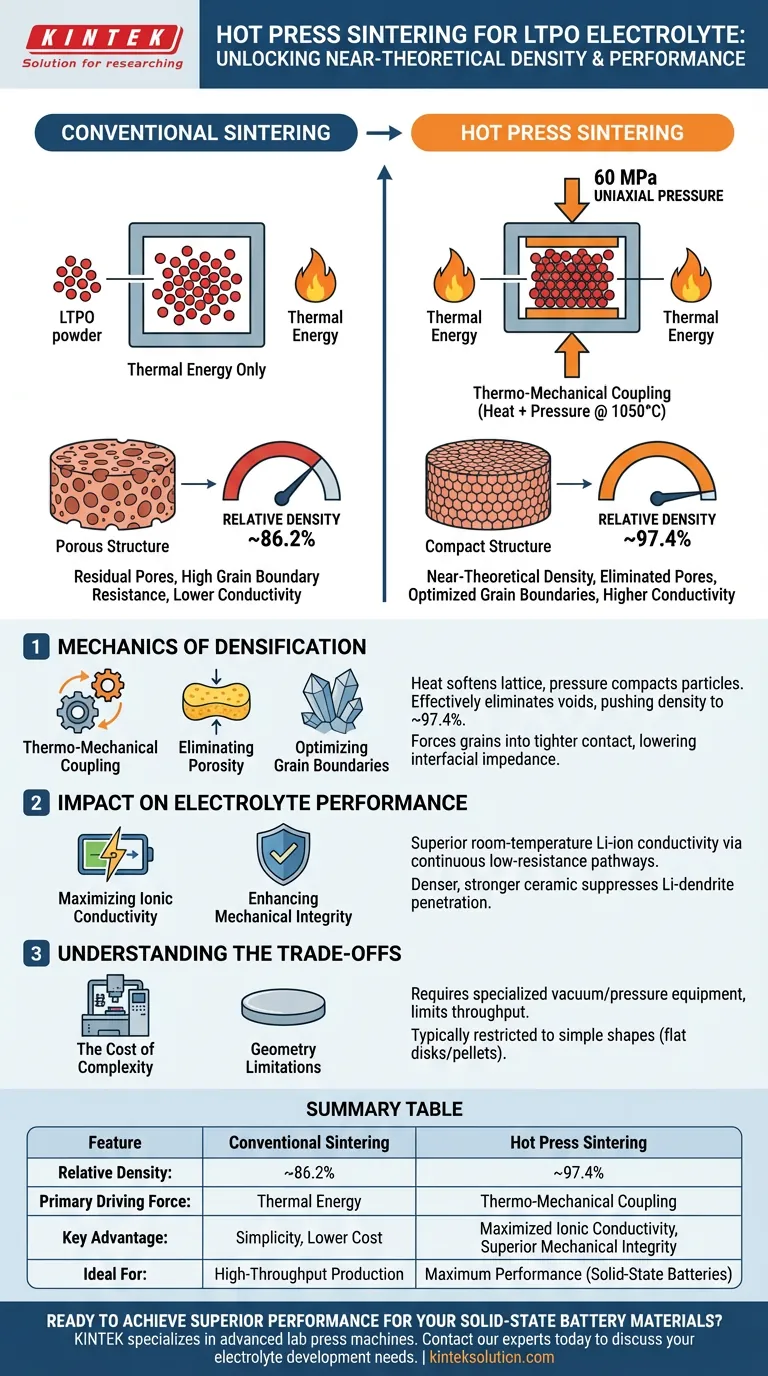
While conventional sintering relies solely on thermal energy to bond particles, hot press sintering introduces a thermo-mechanical coupling effect. For LTPO specifically, applying 60 MPa of uniaxial pressure at 1050°C increases the relative density from 86.2% (typical of conventional sintering) to 97.4%. This near-theoretical density drastically reduces internal porosity and grain boundary resistance, directly unlocking higher lithium-ion conductivity.
Core Takeaway Conventional pressureless sintering often leaves ceramic electrolytes with residual pores that impede ion flow. Hot pressing mechanically forces these pores to close while the material is malleable, creating a compact, highly conductive structure that serves as a superior pathway for lithium ions.
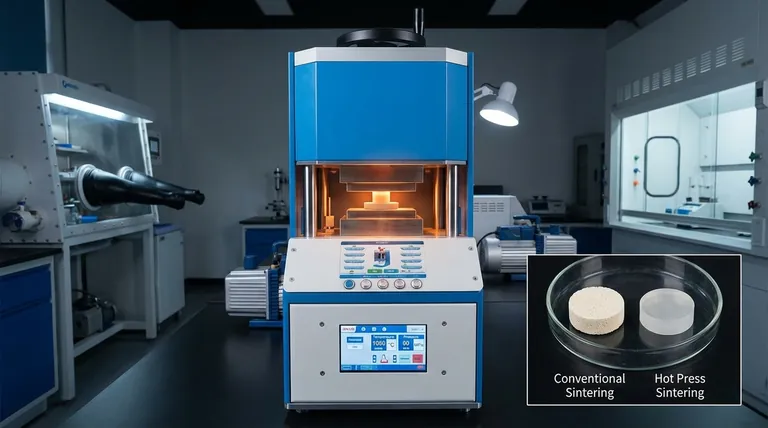
The Mechanics of Densification
Thermo-Mechanical Coupling
The hot press process utilizes a synergistic approach by applying heat and pressure at the same time.
This combination acts as a massive driving force for densification. The heat softens the lattice structure, while the uniaxial pressure physically compacts the powder particles, promoting sintering mechanisms that thermal energy alone cannot activate.
Eliminating Porosity
In solid-state electrolytes, empty space is a barrier to performance.
Conventional sintering typically achieves a relative density of only ~86% for LTPO, leaving significant gaps (pores) between grains. Hot pressing effectively eliminates these voids, pushing the relative density to 97.4%.
Optimizing Grain Boundaries
The interface between crystal grains is often the point of highest resistance in a ceramic.
Hot pressing forces these grains into tighter contact, merging the boundaries. This tight integration significantly lowers interfacial impedance, allowing lithium ions to move freely between grains rather than getting "stuck" at the edges.
Impact on Electrolyte Performance
Maximizing Ionic Conductivity
The direct result of higher density and tighter grain boundaries is superior electrical performance.
By removing the physical bottlenecks (pores) and electrical bottlenecks (grain boundary resistance), the electrolyte achieves much higher room-temperature lithium-ion conductivity. The ions have a continuous, low-resistance highway to travel through.
Enhancing Mechanical Integrity
A denser ceramic is inherently stronger.
The elimination of porosity and the suppression of abnormal grain growth result in improved mechanical properties. This structural robustness is critical for solid-state batteries, as it helps suppress the penetration of lithium dendrites that can cause short circuits.
Understanding the Trade-offs
The Cost of Complexity
While the performance gains are clear, hot pressing is a more complex operation than conventional sintering.
It requires specialized equipment capable of maintaining high vacuum, precise force control, and high temperatures simultaneously. This generally limits the throughput compared to batch sintering in a standard box furnace.
Geometry Limitations
Conventional sintering can handle complex shapes easily.
Hot pressing typically utilizes uniaxial pressure, which restricts sample geometries largely to simple shapes like flat disks or pellets. If your battery design requires complex 3D electrolyte structures, this method may present manufacturing challenges.
Making the Right Choice for Your Goal
To decide if hot pressing is the correct manufacturing route for your LTPO electrolyte, consider your primary performance metrics.
- If your primary focus is Maximum Conductivity: Hot pressing is essential, as the increase in density from 86% to 97% is the only way to minimize grain boundary resistance effectively.
- If your primary focus is Mechanical Durability: The hot press method creates a robust, pore-free barrier that offers the best defense against lithium dendrite penetration.
- If your primary focus is High Throughput/Low Cost: Conventional sintering may be preferable, provided you can accept lower ionic conductivity and lower density.
By leveraging the thermo-mechanical power of hot pressing, you transform LTPO from a porous ceramic into a high-performance, dense electrolyte capable of meeting the rigorous demands of solid-state batteries.
Summary Table:
| Feature | Conventional Sintering | Hot Press Sintering |
|---|---|---|
| Relative Density | ~86.2% | ~97.4% |
| Primary Driving Force | Thermal Energy | Thermo-Mechanical Coupling (Heat + Pressure) |
| Key Advantage | Simplicity, Lower Cost | Maximized Ionic Conductivity, Superior Mechanical Integrity |
| Ideal For | High-Throughput Production | Maximum Performance (e.g., Solid-State Batteries) |
Ready to achieve near-theoretical density and superior performance for your solid-state battery materials like LTPO? KINTEK specializes in advanced lab press machines, including automatic and heated lab presses, designed to deliver the precise thermo-mechanical control your research demands. Contact our experts today to discuss how our solutions can enhance your electrolyte development.
Visual Guide
Related Products
- Automatic High Temperature Heated Hydraulic Press Machine with Heated Plates for Lab
- Automatic Heated Hydraulic Press Machine with Hot Plates for Laboratory
- Laboratory Manual Heated Hydraulic Press Machine with Hot Plates
- 24T 30T 60T Heated Hydraulic Lab Press Machine with Hot Plates for Laboratory
- Manual Heated Hydraulic Lab Press with Integrated Hot Plates Hydraulic Press Machine
People Also Ask
- Function of a Laboratory Hydraulic Press with Heated Platens in SSE? Enhance Battery Density & Conductivity
- How does a laboratory heated hydraulic press facilitate PBN sample prep for WAXS? Achieve Precise X-Ray Scattering
- What are the requirements for electrode pressing with high-viscosity ionic liquids like EMIM TFSI? Optimize Performance
- What are the industrial applications of heated hydraulic presses? Master Heat & Force for Precision Manufacturing
- Why is a laboratory hydraulic press with heating plates required for PLA/TEC films? Achieve Precise Sample Integrity









