
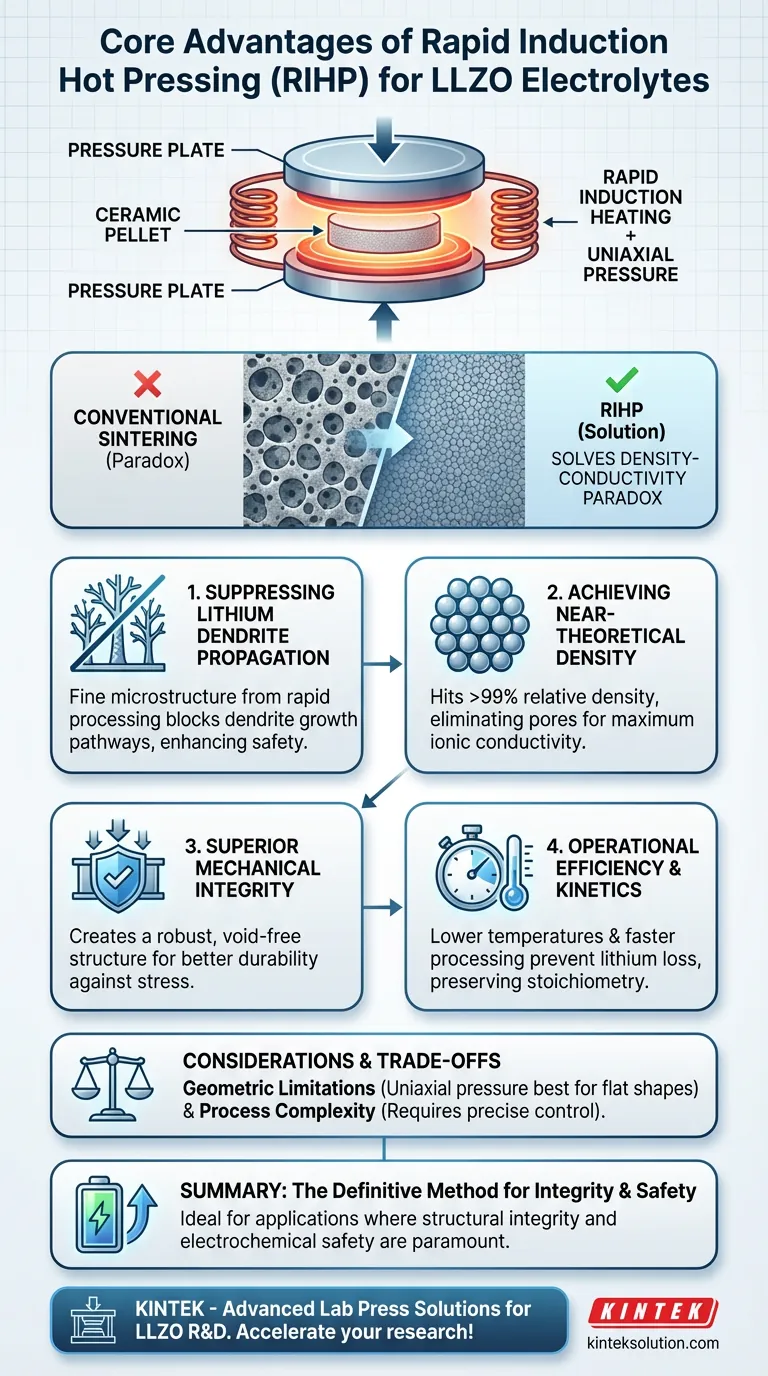
Rapid induction hot pressing (RIHP) technology effectively solves the density-conductivity paradox inherent in processing ceramic electrolytes like Li7La3Zr2O12 (LLZO). By combining rapid induction heating with uniaxial pressure, this technique achieves relative densities exceeding 99% of the theoretical value in a fraction of the time required by conventional sintering. This simultaneous application of heat and force creates a robust, highly conductive electrolyte structure critical for solid-state battery performance.
The Core Insight While traditional sintering often sacrifices fine grain structure to achieve density, rapid induction hot pressing achieves both simultaneously. It delivers a near-perfectly dense material while suppressing grain growth, directly addressing the two biggest failure modes in solid-state batteries: low ionic conductivity and dendrite penetration.
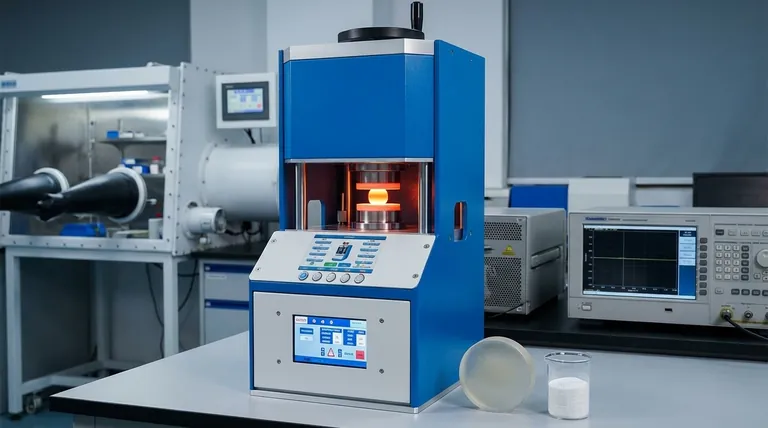
Mechanisms of Enhanced Performance
Suppressing Lithium Dendrite Propagation
The most critical advantage of RIHP is its ability to improve safety by modifying the microstructure of the ceramic. Grain boundaries—the interfaces between microscopic crystals—are the primary pathways where lithium dendrites grow and eventually cause short circuits.
Because the RIHP process occurs over a very short timeframe, it effectively suppresses the growth of these grains. This results in a finer microstructure with a reduced proportional area of grain boundaries, significantly enhancing the electrolyte's resistance to internal short circuits.
Achieving Near-Theoretical Density
Porosity is the enemy of ionic conductivity. RIHP utilizes a pressure gradient to accelerate mass migration and particle diffusion, forcing the LLZO powder to rearrange and densify rapidly.
This process routinely achieves densities over 99%, eliminating the internal pores that block ion flow. High density is the foundational requirement for achieving high lithium-ion conductivity and ensuring the battery operates efficiently.
Superior Mechanical Integrity
Beyond electrochemical performance, the physical durability of the electrolyte is paramount. The simultaneous high temperature and pressure create a compact, void-free structure.
This results in superior mechanical strength compared to pressureless sintering. A mechanically robust electrolyte is better equipped to withstand the physical stresses of battery assembly and the volume changes that occur during cycling.
Operational Efficiency and Kinetics
Lower Temperatures and Faster Processing
Conventional sintering requires long dwell times at high temperatures to fuse ceramic particles. RIHP leverages mechanical pressure to lower the activation energy required for densification.
This enables the fabrication of high-performance ceramic sheets at lower temperatures and in significantly shorter times. This efficiency prevents the lithium loss (volatilization) often seen in prolonged, high-heat processes, preserving the stoichiometry of the LLZO material.
Understanding the Trade-offs
Geometric Limitations
The references highlight the use of uniaxial pressure (force applied in one direction). While excellent for flat pellets or sheets, this method is inherently limited in the geometries it can produce. It is not suitable for complex, 3D shapes that require isostatic (uniform from all sides) pressure.
Process Complexity
Achieving the precise balance of induction heating and mechanical pressure requires specialized equipment. Unlike simple oven sintering, RIHP demands careful control to ensure the heating is uniform across the sample to prevent warping or cracking due to thermal gradients under pressure.
Making the Right Choice for Your Goal
If you are developing solid-state batteries using LLZO, consider how RIHP aligns with your specific engineering targets:
- If your primary focus is Safety and Durability: RIHP is the superior choice for mitigating dendrite growth by maintaining a fine-grain microstructure.
- If your primary focus is Conductivity: The ability to consistently hit >99% density makes this method ideal for maximizing ionic transport.
- If your primary focus is Processing Speed: Use this technology to reduce cycle times and lower the thermal budget compared to traditional sintering.
Summary: Rapid induction hot pressing is the definitive processing method for applications where the structural integrity and electrochemical safety of the LLZO electrolyte cannot be compromised.
Summary Table:
| Advantage | Key Benefit |
|---|---|
| Near-Theoretical Density | Achieves >99% relative density, eliminating pores for high ionic conductivity. |
| Dendrite Suppression | Fine-grained microstructure from rapid processing resists lithium dendrite growth. |
| Superior Mechanical Strength | Creates a robust, void-free structure for enhanced durability. |
| Lower Temperature & Faster Processing | Reduces thermal budget and processing time, preventing lithium loss. |
Ready to enhance your solid-state battery development with reliable, high-performance materials? KINTEK specializes in advanced lab press solutions, including heated presses ideal for R&D in ceramic electrolytes like LLZO. Our equipment can help you achieve the critical density and microstructure control needed for safer, more efficient batteries. Contact our experts today to discuss how our technology can accelerate your research and development!
Visual Guide
Related Products
- Automatic Heated Hydraulic Press Machine with Hot Plates for Laboratory
- Heated Hydraulic Press Machine with Heated Plates for Vacuum Box Laboratory Hot Press
- Laboratory Manual Heated Hydraulic Press Machine with Hot Plates
- Automatic High Temperature Heated Hydraulic Press Machine with Heated Plates for Lab
- Warm Isostatic Press for Solid State Battery Research Warm Isostatic Press
People Also Ask
- Function of a Laboratory Hydraulic Press with Heated Platens in SSE? Enhance Battery Density & Conductivity
- Why is a laboratory hydraulic press with heating plates required for PLA/TEC films? Achieve Precise Sample Integrity
- What are the requirements for electrode pressing with high-viscosity ionic liquids like EMIM TFSI? Optimize Performance
- How does a laboratory heated hydraulic press facilitate PBN sample prep for WAXS? Achieve Precise X-Ray Scattering
- What are the industrial applications of heated hydraulic presses? Master Heat & Force for Precision Manufacturing

















