
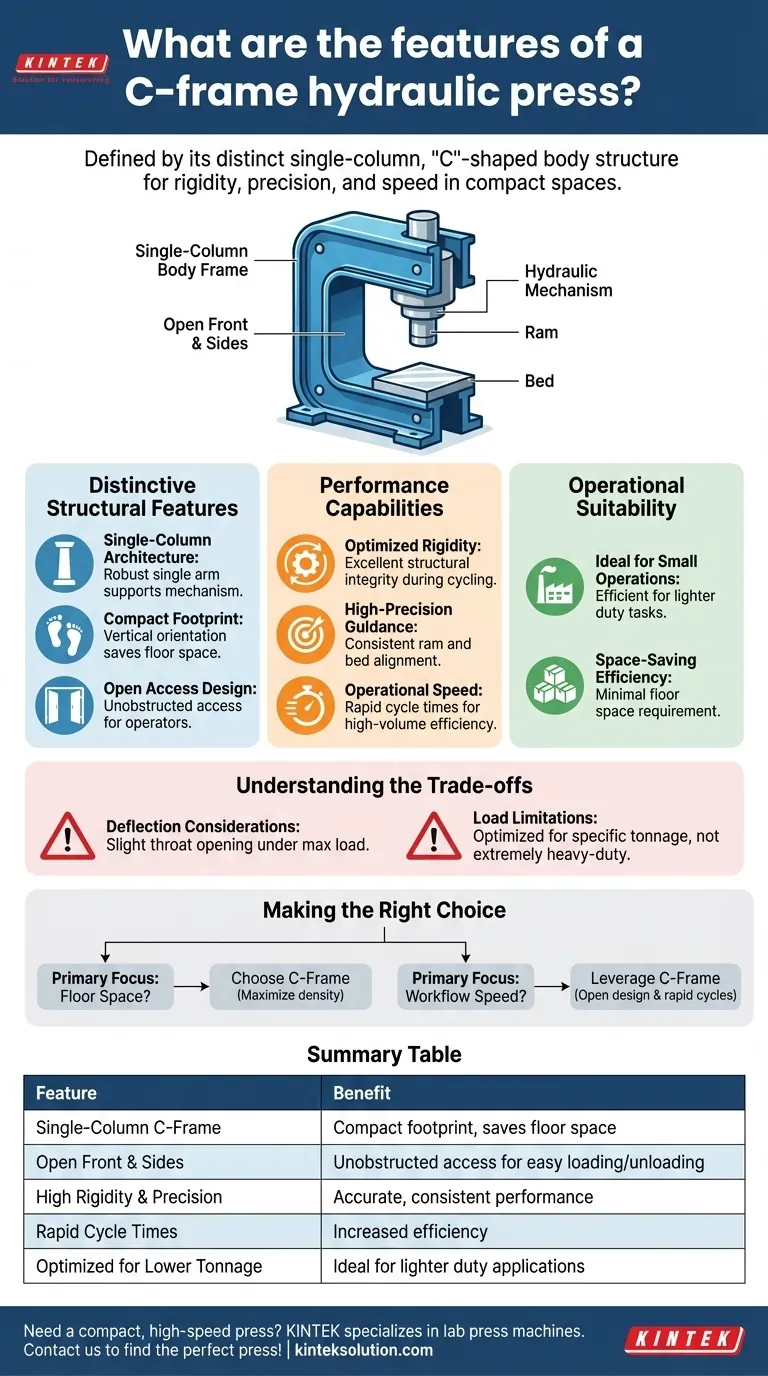
A C-frame hydraulic press is defined by its distinct single-column, "C"-shaped body structure. This unit is engineered to deliver excellent rigidity, guide performance, and high precision. It is specifically designed for environments where speed is critical and floor space is limited, making it the preferred choice for smaller manufacturing operations.
The C-frame press utilizes a single-arm design to deliver operational speed and accuracy in a compact footprint. Its open-front structure prioritizes accessibility and space efficiency without sacrificing the rigidity required for precise small-scale tasks.

Distinctive Structural Features
The Single-Column Architecture
The most visible feature of this press is the single-column body frame. Unlike 4-post presses, the "C" shape relies on a robust single arm to support the hydraulic mechanism.
Compact Footprint
The vertical, single-column orientation significantly reduces the machine's physical footprint. This allows facilities to install multiple units in a smaller area compared to portal or 4-column presses.
Open Access Design
The "C" shape inherently creates an open front and sides. This structure removes physical barriers, providing operators with unobstructed access to the die space for loading and unloading materials.
Performance Capabilities
Optimized Rigidity
Despite lacking four corners of support, the frame is engineered for excellent rigidity. This ensures the machine maintains structural integrity even during repetitive cycling.
High-Precision Guidance
The guide performance of the C-frame is designed to be exacting. This allows for high-tolerance work where the alignment of the ram and the bed must remain consistent.
Operational Speed
These presses are characterized by their speed. They are capable of rapid cycle times, which drives efficiency in high-volume, small-part production.
Operational Suitability
Ideal for Small Operations
The combination of size and speed makes this press well-suited for small operations. It handles lighter duty tasks efficiently without the energy consumption or space requirements of massive industrial presses.
Space-Saving Efficiency
For shops where square footage is a premium asset, the C-frame is the logical solution. It requires minimal floor space while still delivering the hydraulic force needed for forming or assembly.
Understanding the Trade-offs
Deflection Considerations
While the reference notes excellent rigidity, the C-frame design is physically different from a closed-box frame. Under maximum load, the open "C" shape can be subject to slight deflection (opening of the throat), unlike a fully enclosed 4-post frame.
Load Limitations
Because the force is supported by a single arm structure, these presses are typically optimized for specific tonnage ranges. They are generally not the primary choice for extremely heavy-duty, high-tonnage applications that require absolute zero deflection.
Making the Right Choice for Your Goal
Selecting a C-frame hydraulic press is a decision to prioritize efficiency and access over raw, heavy-duty tonnage.
- If your primary focus is Floor Space: Choose the C-frame to maximize your production density in a facility with limited square footage.
- If your primary focus is Workflow Speed: Leverage the C-frame's open design and rapid cycle times for efficient small-part operations.
The C-frame press remains the standard for facilities demanding precision and speed within a compact, accessible footprint.
Summary Table:
| Feature | Benefit |
|---|---|
| Single-Column C-Frame | Compact footprint, saves floor space |
| Open Front & Sides | Unobstructed access for easy loading/unloading |
| High Rigidity & Precision | Accurate, consistent performance for small-part tasks |
| Rapid Cycle Times | Increased efficiency in high-volume operations |
| Optimized for Lower Tonnage | Ideal for lighter duty applications |
Need a compact, high-speed press for your lab or small operation? KINTEK specializes in lab press machines, including automatic lab presses, isostatic presses, and heated lab presses. Our C-frame hydraulic presses are designed to deliver the precision, accessibility, and space-saving efficiency your laboratory needs. Contact us today to find the perfect press for your application!
Visual Guide
Related Products
- Laboratory Hydraulic Press 2T Lab Pellet Press for KBR FTIR
- Laboratory Hydraulic Press Lab Pellet Press Machine for Glove Box
- Automatic Laboratory Hydraulic Press Lab Pellet Press Machine
- Automatic Heated Hydraulic Press Machine with Heated Plates for Laboratory
- Automatic Laboratory Hydraulic Press for XRF and KBR Pellet Pressing
People Also Ask
- What is the role of a laboratory pressure machine and KBr in FTIR? Master Sample Preparation for Flame Retardants
- What is the role of a laboratory hydraulic press in high-loading NCM811 cathode prep for solid-state batteries?
- Why is a laboratory hydraulic press necessary for sample preparation? Precise Pelleting for Spiro Heterocyclic Analysis
- What role does a laboratory hydraulic press play in reaction pellets? Optimizing Lunar Soil and Metal Fuel Density
- In which fields are laboratory hydraulic presses widely used? Expert Guide to Sample Prep & Research Applications



















