
The financial and operational reality of owning a lab press extends far beyond the initial purchase price. To ensure a positive return on investment, you must evaluate the long-term availability and cost of spare parts and consumables alongside the machine’s ease of maintenance. A unit that is inexpensive to acquire but difficult to service will inevitably lead to costly downtime and increased operational errors.
True value in a lab press is defined by its Total Cost of Ownership (TCO), which balances the upfront capital expenditure against the ongoing expense of hydraulic fluid replacement, seal maintenance, and the operational cost of downtime.
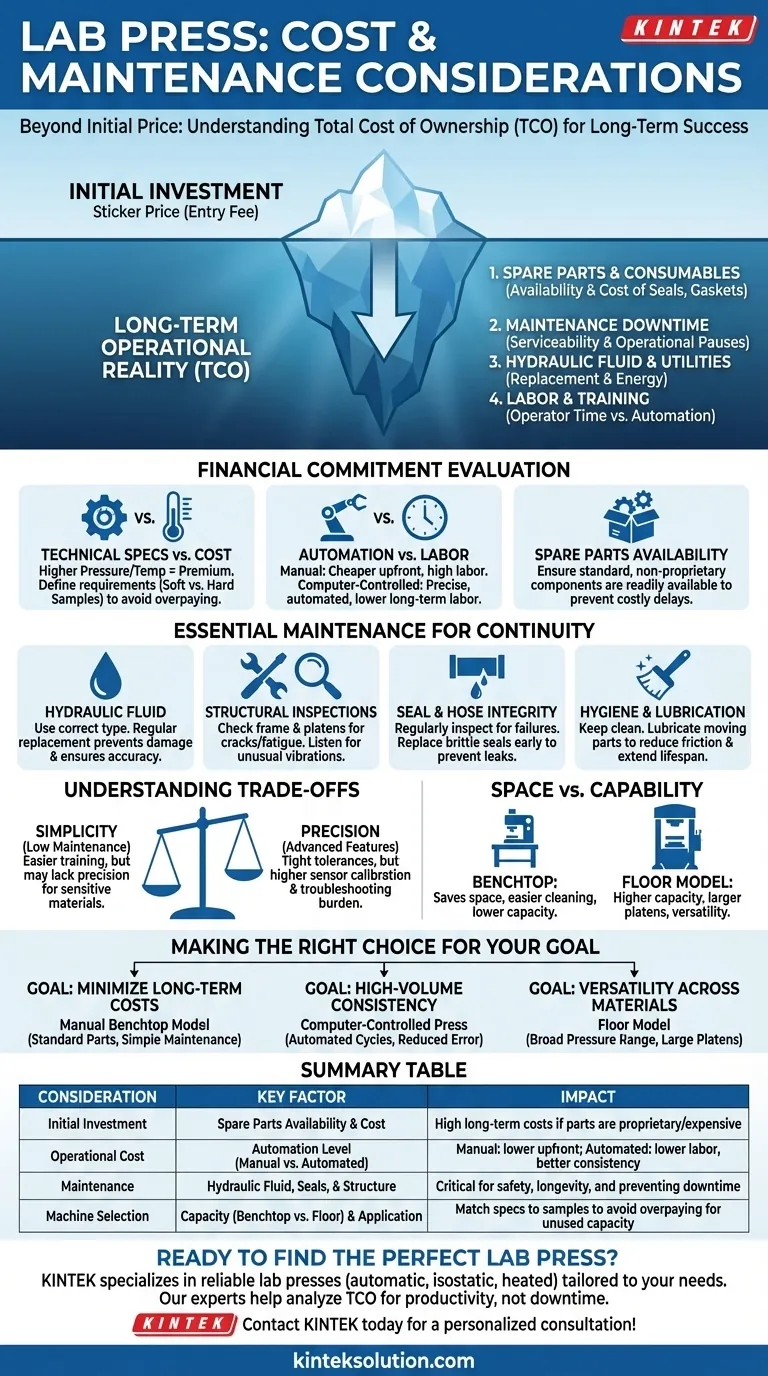
Evaluating the Total Financial Commitment
Initial Investment vs. Long-Term Support
The sticker price is only the entry fee. You must investigate the availability and pricing of spare parts and consumables before committing to a purchase.
A press that relies on proprietary, expensive, or hard-to-find components will drain your budget over time. Ensure that standard consumables, such as seals and gaskets, are readily available to prevent extended operational pauses.
The Cost of Technical Specifications
Your specific application requirements—pressure capacity, temperature range, and platen size—directly dictate the machine's cost.
Presses capable of generating over 100 tons or reaching temperatures up to 1200°F command a significant premium. To optimize cost, clearly define whether you are processing soft samples (requiring lower pressure) or hard samples, and avoid paying for capacity you will never utilize.
Automation and Labor Costs
Consider the financial implication of operator time. Manual presses are cheaper upfront but require constant operator attention to maintain pressure or temperature.
Computer-controlled options, while more expensive initially, offer precise programming and data logging. These features can reduce long-term labor costs by allowing for automated operation and ensuring consistent repeatability without constant supervision.
Essential Maintenance for Operational Continuity
Hydraulic Fluid Management
The lifeblood of a hydraulic press is its fluid. Over time, hydraulic fluids degrade and must be replaced to maintain pressure accuracy and machine safety.
It is critical to use the correct type of hydraulic oil specified by the manufacturer. Using incompatible fluids can damage internal components and void warranties.
Routine Structural Inspections
Regular visual inspections are non-negotiable for safety and longevity. You must frequently check the press frame, platens, and structural components for cracks or signs of fatigue.
Listen for unusual vibrations or noises during operation. These are often early warning signs of loose components or critical misalignment that requires immediate attention.
Seal and Hose Integrity
Leak prevention is the most common maintenance task. Regularly inspect all hoses, seals, and fittings for signs of failure.
Seals and gaskets are wear items; look for cracks or brittleness. catching a deteriorating seal early prevents catastrophic fluid leaks that can damage the workspace and the sample.
Hygiene and Lubrication
A clean machine is a reliable machine. Working parts must be kept free of dirt, debris, and leaked fluids to prevent scoring on the piston or platens.
Ensure proper lubrication of moving parts. This simple step reduces friction and wear, significantly extending the time between major repairs.
Understanding the Trade-offs
Simplicity vs. Precision
A user-friendly, low-maintenance press often lacks advanced features. While this saves time on training and repairs, it may sacrifice the temperature control precision needed for sensitive materials.
If your application has tight temperature tolerances, you may need a more complex system. Be aware that this complexity often increases the maintenance burden regarding sensor calibration and electronic troubleshooting.
Space vs. Capability
Choosing between a benchtop and a floor press involves a trade-off between facility costs (floor space) and performance.
Benchtop models save valuable lab real estate and are generally easier to clean and inspect. However, they typically offer lower force capacities and smaller platen sizes compared to floor models, potentially limiting future project scope.
Making the Right Choice for Your Goal
To select the right press, you must align the machine's capabilities with your specific operational priorities.
- If your primary focus is minimizing long-term operational costs: Prioritize a manual benchtop model with standard, non-proprietary seals and fittings to keep maintenance simple and cheap.
- If your primary focus is high-volume consistency and data integrity: Invest in a computer-controlled press with automated cycles, accepting higher upfront and maintenance costs in exchange for reduced operator error.
- If your primary focus is versatility across different materials: Select a floor model with a broad pressure range and large platens, ensuring you can handle both soft and hard samples without needing multiple machines.
By rigorously matching your maintenance capabilities and budget to your technical requirements, you ensure your lab press remains an asset rather than a liability.
Summary Table:
| Consideration | Key Factor | Impact |
|---|---|---|
| Initial Investment | Spare Parts Availability & Cost | High long-term costs if parts are proprietary/expensive |
| Operational Cost | Automation Level (Manual vs. Computer-Controlled) | Manual: lower upfront cost; Automated: lower labor cost, better consistency |
| Maintenance | Hydraulic Fluid, Seals, & Structural Inspections | Critical for safety, longevity, and preventing costly downtime |
| Machine Selection | Capacity (Benchtop vs. Floor Model) & Application Needs | Match specs to your samples (soft/hard) to avoid overpaying for unused capacity |
Ready to find a lab press that perfectly balances cost, performance, and ease of maintenance for your laboratory?
At KINTEK, we specialize in providing reliable lab press machines (including automatic lab presses, isostatic presses, and heated lab presses) tailored to your specific needs. Our experts will help you analyze your Total Cost of Ownership to ensure you get an asset that enhances your productivity, not a liability that causes downtime.
Contact KINTEL today for a personalized consultation and discover the right press for your budget and application!
Visual Guide
Related Products
- Laboratory Hydraulic Press 2T Lab Pellet Press for KBR FTIR
- 24T 30T 60T Heated Hydraulic Lab Press Machine with Hot Plates for Laboratory
- Manual Heated Hydraulic Lab Press with Integrated Hot Plates Hydraulic Press Machine
- Laboratory Hydraulic Press Lab Pellet Press Button Battery Press
- Laboratory Hydraulic Pellet Press for XRF KBR FTIR Lab Press
People Also Ask
- What is the role of a laboratory pressure machine and KBr in FTIR? Master Sample Preparation for Flame Retardants
- What is the role of a laboratory hydraulic press in high-loading NCM811 cathode prep for solid-state batteries?
- Why is a laboratory hydraulic press necessary for sample preparation? Precise Pelleting for Spiro Heterocyclic Analysis
- What role does a laboratory hydraulic press play in reaction pellets? Optimizing Lunar Soil and Metal Fuel Density
- Why is a laboratory hydraulic press used to compact monazite samples before the roasting treatment? Optimize Reactions



















