
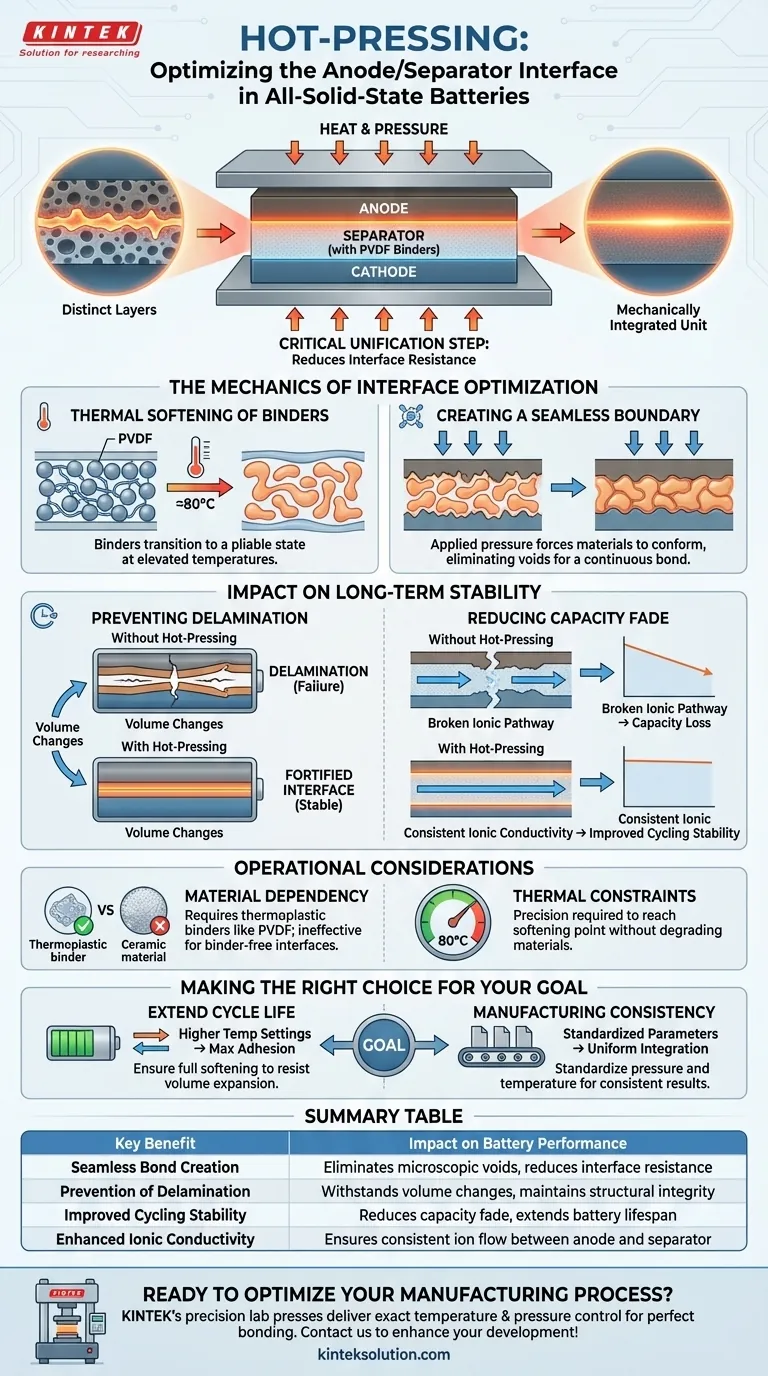
Hot-pressing functions as a critical unification step for solid-state battery components. By applying heat and pressure simultaneously, you transform the anode and separator from two distinct layers into a mechanically integrated unit, directly addressing the challenge of interface resistance.
In all-solid-state batteries, the lack of liquid electrolytes makes physical contact the primary determinant of performance. Hot-pressing softens polymer binders to create a seamless bond, preventing the structural failure that typically causes capacity loss.
The Mechanics of Interface Optimization
To understand the value of hot-pressing, you must look at how solid materials interact at the microscopic level.
Thermal Softening of Binders
The process relies on the presence of polymer binders, such as PVDF, within the anode and separator.
When exposed to elevated temperatures—typically around 80°C—these binders transition into a softer, more pliable state.
Creating a Seamless Boundary
As the binders soften, the applied pressure forces the materials to conform to one another.
This eliminates microscopic voids between the layers, creating a continuous, intimate physical bond that simple stacking cannot achieve.
Impact on Long-Term Stability
The primary deep need for solid-state batteries is durability. Hot-pressing directly combats the mechanical stresses that shorten battery life.
Preventing Delamination
During charging and discharging, electrode materials naturally expand and contract (volume changes).
Without a fortified interface, these volume changes cause the anode and separator to pull apart, a failure mode known as delamination.
Hot-pressing creates an adhesion strong enough to withstand these mechanical shifts, keeping the layers connected throughout the battery's life.
Reducing Capacity Fade
Delamination breaks the ionic pathway; when ions cannot flow, the battery loses capacity.
By maintaining structural integrity, hot-pressing ensures consistent ionic conductivity, resulting in significantly improved cycling stability and reduced capacity fade over time.
Operational Considerations
While effective, hot-pressing is not a universal fix and requires specific parameters to work correctly.
Material Dependency
This process is strictly dependent on the chemistry of your components.
It requires the presence of thermoplastic binders like PVDF; it is less effective for purely ceramic or binder-free interfaces that do not soften at these temperatures.
Thermal Constraints
Precision is required regarding temperature application.
The goal is to reach the softening point (e.g., 80°C) without degrading the active materials or the separator structure itself.
Making the Right Choice for Your Goal
To maximize the benefits of hot-pressing, align your process parameters with your specific performance targets.
- If your primary focus is extending Cycle Life: Ensure your temperature settings are high enough to fully soften the binder, creating maximum adhesion to resist volume expansion.
- If your primary focus is Manufacturing Consistency: Standardize the pressure and temperature variables to ensure every cell achieves the same level of interface integration.
By effectively fusing the anode and separator, you convert a physical vulnerability into a structural asset.
Summary Table:
| Key Benefit | Impact on Battery Performance |
|---|---|
| Seamless Bond Creation | Eliminates microscopic voids, reduces interface resistance |
| Prevention of Delamination | Withstands volume changes during cycling, maintains structural integrity |
| Improved Cycling Stability | Reduces capacity fade, extends battery lifespan |
| Enhanced Ionic Conductivity | Ensures consistent ion flow between anode and separator |
Ready to optimize your solid-state battery manufacturing process? KINTEK's precision lab press machines (including automatic lab presses, isostatic presses, and heated lab presses) are specifically designed to deliver the exact temperature and pressure control required for perfect anode/separator interface bonding. Our equipment helps battery researchers and manufacturers achieve superior cycling stability and extended battery life through reliable hot-pressing processes. Contact us today to discuss how our lab press solutions can enhance your battery development and production!
Visual Guide
Related Products
- Automatic High Temperature Heated Hydraulic Press Machine with Heated Plates for Lab
- Heated Hydraulic Press Machine with Heated Plates for Vacuum Box Laboratory Hot Press
- Automatic Heated Hydraulic Press Machine with Hot Plates for Laboratory
- Heated Hydraulic Press Machine With Heated Plates For Vacuum Box Laboratory Hot Press
- Laboratory Split Manual Heated Hydraulic Press Machine with Hot Plates
People Also Ask
- Function of a Laboratory Hydraulic Press with Heated Platens in SSE? Enhance Battery Density & Conductivity
- What are the requirements for electrode pressing with high-viscosity ionic liquids like EMIM TFSI? Optimize Performance
- How does a laboratory heated hydraulic press facilitate PBN sample prep for WAXS? Achieve Precise X-Ray Scattering
- What are the industrial applications of heated hydraulic presses? Master Heat & Force for Precision Manufacturing
- Why is a laboratory hydraulic press with heating plates required for PLA/TEC films? Achieve Precise Sample Integrity



















