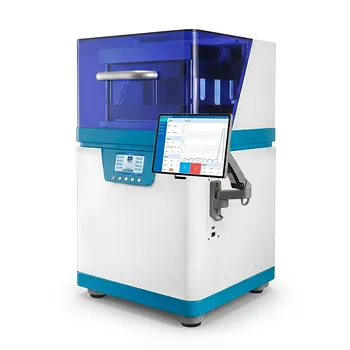
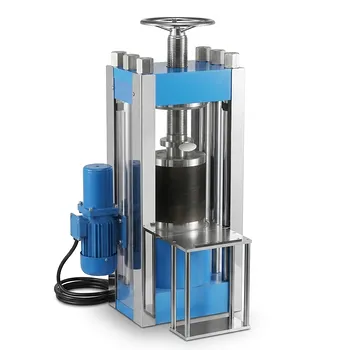
At its core, a KBr press is defined by three primary components: the Die Set, the Hydraulic Press, and the Base Plate. Together, these parts function as an integrated system to apply extreme pressure to potassium bromide powder, transforming it into the transparent solid pellets required for infrared spectroscopy.
Success in creating high-quality KBr pellets relies on the precise interaction between the die set's shaping capability, the stable foundation of the base plate, and the controlled application of 8 to 10 tons of force.
The Anatomy of a KBr Press
The Die Set
The Die Set is the shaping mechanism of the assembly. It is responsible for containing the potassium bromide powder and defining the final dimensions of the pellet.
Typically, this component includes a cylindrical die and two plungers. These internal parts must be kept meticulously clean to ensure the resulting pellet is free of contamination and defects.
The Hydraulic Press
The Hydraulic Press acts as the engine of the operation, providing the sheer force necessary for compression.
To successfully fuse the powder into a solid, transparent disc, this component generally applies pressure in the range of 8 to 10 tons. It is critical to maintain this pressure for several minutes to ensure the pellet is stable and uniform.
The Base Plate
The Base Plate serves as the structural foundation for the entire pressing operation.
It provides a rigid, flat surface that holds the die set securely in place. By doing so, it ensures that the massive force generated by the hydraulic press is distributed evenly across the sample, preventing mechanical failure or uneven pellet formation.
Critical Operational Considerations
The Role of Vacuum Extraction
While not a structural component of the press itself, the application of a vacuum is an essential operational step.
To achieve transparency, a vacuum of several mm Hg should be applied to the die set prior to pressing. This eliminates trapped air and moisture, which are the primary causes of cloudy or unstable pellets.
Maintenance and Environment
The longevity of the die set and press depends heavily on environmental control.
Because KBr is hygroscopic (absorbs moisture), the equipment must be stored in a dry environment to prevent corrosion. Regular lubrication of the hydraulic components and thorough cleaning of the plungers are required to maintain the high tolerances needed for spectroscopy.
Ensuring Optimal Pellet Quality
To get the best results from your KBr press components, align your procedure with your specific objectives:
- If your primary focus is Optical Clarity: Ensure a vacuum is applied to the die set before compression to remove moisture and air that cause cloudiness.
- If your primary focus is Equipment Longevity: Establish a strict routine of cleaning the die set after every use and storing the components in a dry environment to prevent corrosion.
The interplay between a stable base, a high-force press, and a precision die set is the only way to achieve the transparency required for accurate spectral analysis.
Summary Table:
| Component | Primary Function | Key Specifications |
|---|---|---|
| Die Set | Shapes and contains the KBr powder | Cylindrical die with two plungers |
| Hydraulic Press | Applies the force needed for fusion | 8 to 10 tons of pressure |
| Base Plate | Provides structural stability | Ensures even force distribution |
| Vacuum Port | Removes air and moisture | Essential for optical transparency |
Elevate Your Spectroscopy with KINTEK Precision
Don't let poor pellet quality compromise your research. KINTEK specializes in comprehensive laboratory pressing solutions designed for accuracy and durability. Whether you need manual, automatic, heated, or glovebox-compatible models—or advanced cold and warm isostatic presses for battery research—we have the expertise to support your lab.
Ready to achieve superior optical clarity? Contact KINTEK today to find the perfect pressing system for your specific application.
Related Products
- Laboratory Hydraulic Press 2T Lab Pellet Press for KBR FTIR
- Laboratory Hydraulic Pellet Press for XRF KBR FTIR Lab Press
- Automatic Laboratory Hydraulic Press for XRF and KBR Pellet Pressing
- Lab Infrared Press Mold for No Demolding
- Button Battery Sealing Press Machine for Lab
People Also Ask
- What is the role of a laboratory pressure machine and KBr in FTIR? Master Sample Preparation for Flame Retardants
- What is the role of a laboratory hydraulic press in high-loading NCM811 cathode prep for solid-state batteries?
- What role does a laboratory hydraulic press play in reaction pellets? Optimizing Lunar Soil and Metal Fuel Density
- Why is a laboratory hydraulic press necessary for sample preparation? Precise Pelleting for Spiro Heterocyclic Analysis
- Why is high-pressure molding using a laboratory hydraulic press critical for PZT? Achieve 99% Ceramic Density