
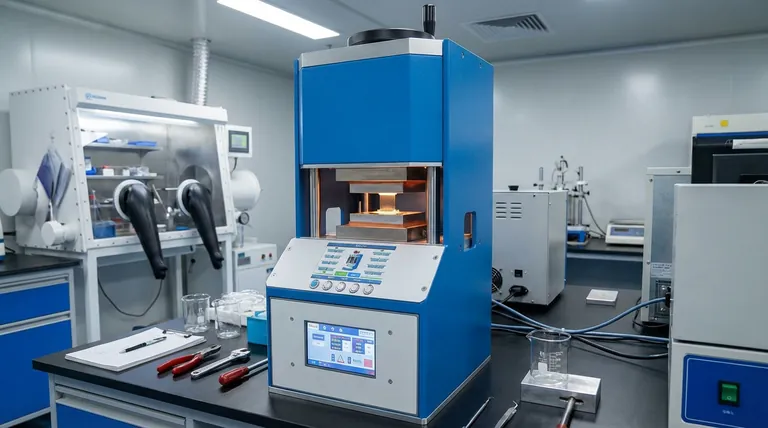
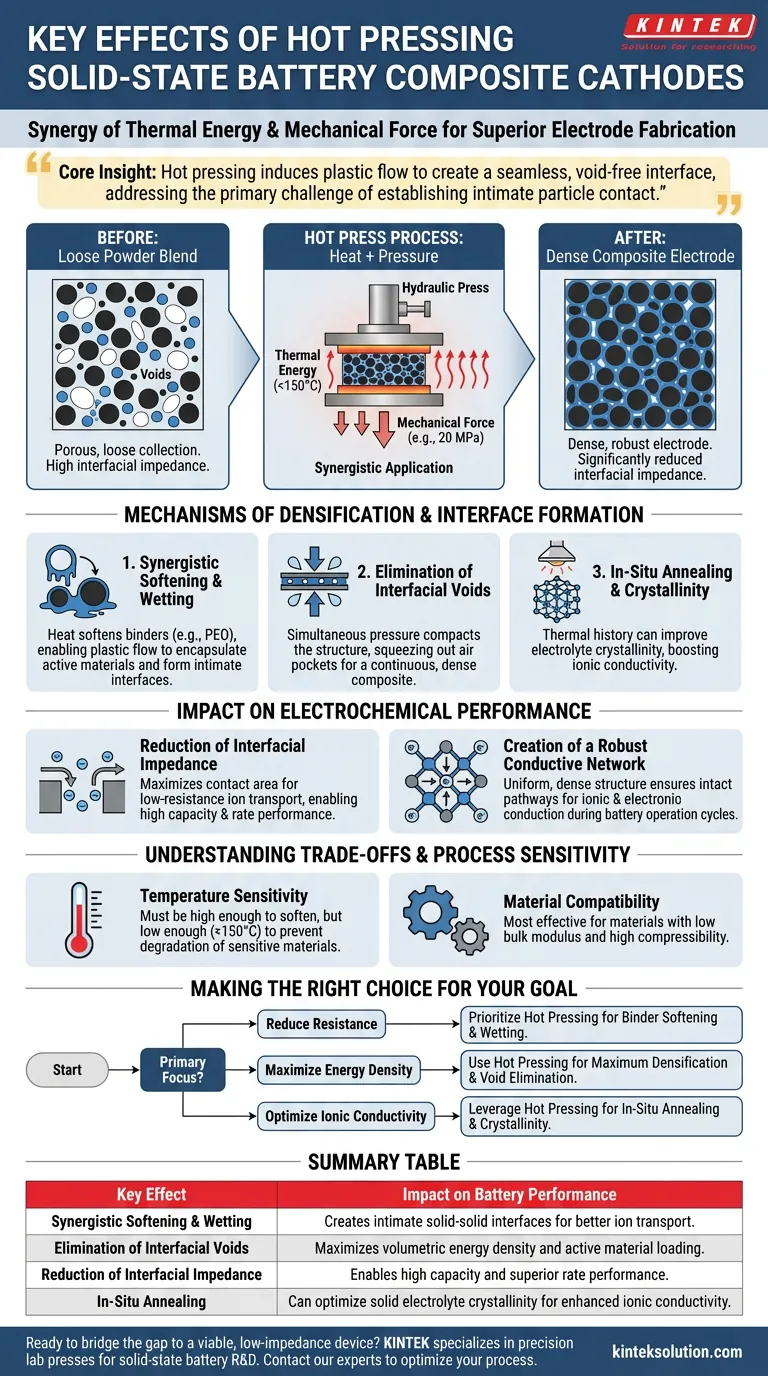
The application of a hot press introduces a critical synergistic effect between thermal energy and mechanical force, fundamentally altering the microstructure of solid-state battery cathodes. By simultaneously applying heat and pressure, you soften polymeric components to facilitate wetting and particle encapsulation while mechanically compacting the mixture to eliminate voids. This process transforms a loose powder blend into a dense, mechanically robust electrode with significantly reduced interfacial impedance.
Core Insight The primary challenge in solid-state batteries is establishing intimate contact between solid particles to allow ion movement. Hot pressing addresses this by inducing plastic flow in the electrolyte and binder, creating a seamless, void-free interface that cold pressing alone cannot achieve.
The Mechanisms of Densification and Interface Formation
Synergistic Softening and Wetting
The application of heat—often controlled below 150°C—serves to soften the polymeric components or solid electrolytes within the cathode mixture.
For materials like PEO (polyethylene oxide), this thermal energy allows the polymer to flow plastically. This "wetting" action enables the binder to encapsulate active material particles, forming intimate solid-solid interfaces that are difficult to achieve at room temperature.
Elimination of Interfacial Voids
While heat softens the material, the simultaneous application of mechanical pressure (e.g., 20 MPa) forces the particles together.
This pressure compacts the electrode structure, effectively squeezing out air pockets and internal voids. The result is a dense, continuous composite rather than a porous, loose collection of particles.
In-Situ Annealing and Crystallinity
Hot pressing functions as more than just a shaping tool; it acts as an in-situ annealing treatment.
For certain electrolytes, this thermal history can improve crystallinity. An optimized crystalline structure often correlates with enhanced ionic conductivity, further boosting the electrochemical performance of the composite.
Impact on Electrochemical Performance
Reduction of Interfacial Impedance
The most significant electrochemical benefit of hot pressing is the drastic reduction in interfacial impedance.
By maximizing the contact area between the active material and the solid electrolyte, you lower the barrier for ion transport. This low-resistance pathway is fundamental to achieving high capacity and superior rate performance.
Creation of a Robust Conductive Network
A uniformly dense electrode establishes effective pathways for both ionic and electronic conduction.
The process transforms the cathode from a fragile coating into a mechanically stable, uniform whole. This structural integrity ensures that the conductive network remains intact during the expansion and contraction cycles of battery operation.
Understanding the Trade-offs and Process Sensitivity
While hot pressing offers superior densification compared to cold pressing, it introduces process variables that must be carefully managed.
Temperature Sensitivity: The temperature must be high enough to induce softening but low enough to prevent material degradation. For example, processing typically occurs below 150°C to avoid damaging sensitive polymer chains or active materials.
Material Compatibility: The benefits of hot pressing are most pronounced in materials with low bulk modulus and high compressibility. If your composite relies on materials that do not soften or flow under moderate heat, the "hot" aspect of the press may yield diminishing returns compared to standard high-pressure compaction.
Making the Right Choice for Your Goal
The decision to utilize a hot press should be driven by the specific limitations of your material system.
- If your primary focus is reducing resistance in polymer-based systems: Prioritize hot pressing to exploit the softening of binders like PEO, ensuring they wet the active material surfaces completely.
- If your primary focus is maximizing volumetric energy density: Use hot pressing to achieve maximum densification and void elimination, which allows for higher active material loading.
- If your primary focus is optimizing ionic conductivity: Leverage the annealing effect of the hot press to improve the crystallinity of the solid electrolyte within the matrix.
Ultimately, hot pressing is the bridge between a theoretical material mixture and a viable, low-impedance electrochemical device.
Summary Table:
| Key Effect | Impact on Battery Performance |
|---|---|
| Synergistic Softening & Wetting | Creates intimate solid-solid interfaces for better ion transport. |
| Elimination of Interfacial Voids | Maximizes volumetric energy density and active material loading. |
| Reduction of Interfacial Impedance | Enables high capacity and superior rate performance. |
| In-Situ Annealing | Can optimize solid electrolyte crystallinity for enhanced ionic conductivity. |
Ready to bridge the gap between your material mixture and a viable, low-impedance electrochemical device?
KINTEK specializes in precision lab press machines, including heated lab presses and isostatic presses, designed to meet the exacting demands of solid-state battery research and development. Our equipment provides the controlled heat and pressure essential for achieving the superior densification and interface formation detailed in this article.
Contact our experts today to discuss how our solutions can optimize your cathode fabrication process and accelerate your battery development timeline.
Visual Guide
Related Products
- Automatic High Temperature Heated Hydraulic Press Machine with Heated Plates for Lab
- Heated Hydraulic Press Machine with Heated Plates for Vacuum Box Laboratory Hot Press
- Automatic Heated Hydraulic Press Machine with Hot Plates for Laboratory
- Heated Hydraulic Press Machine With Heated Plates For Vacuum Box Laboratory Hot Press
- Laboratory Split Manual Heated Hydraulic Press Machine with Hot Plates
People Also Ask
- Function of a Laboratory Hydraulic Press with Heated Platens in SSE? Enhance Battery Density & Conductivity
- How does a laboratory heated hydraulic press facilitate PBN sample prep for WAXS? Achieve Precise X-Ray Scattering
- What are the requirements for electrode pressing with high-viscosity ionic liquids like EMIM TFSI? Optimize Performance
- What are the industrial applications of heated hydraulic presses? Master Heat & Force for Precision Manufacturing
- Why is a laboratory hydraulic press with heating plates required for PLA/TEC films? Achieve Precise Sample Integrity



















